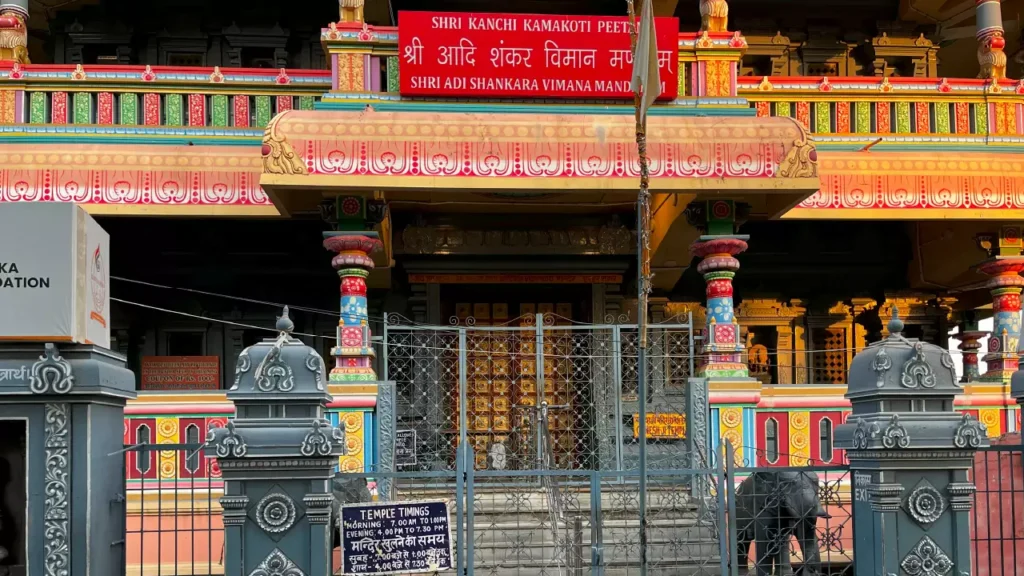
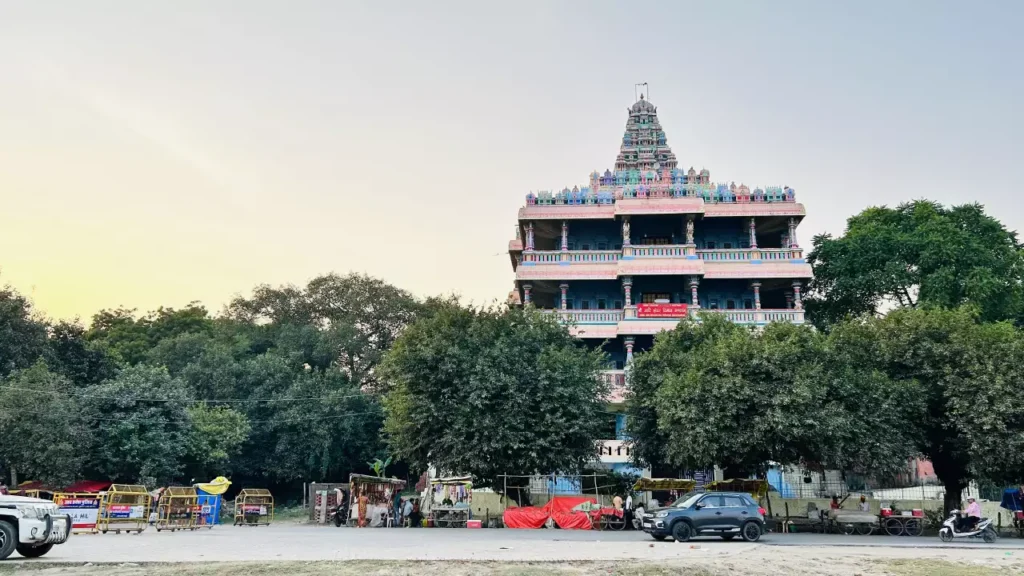
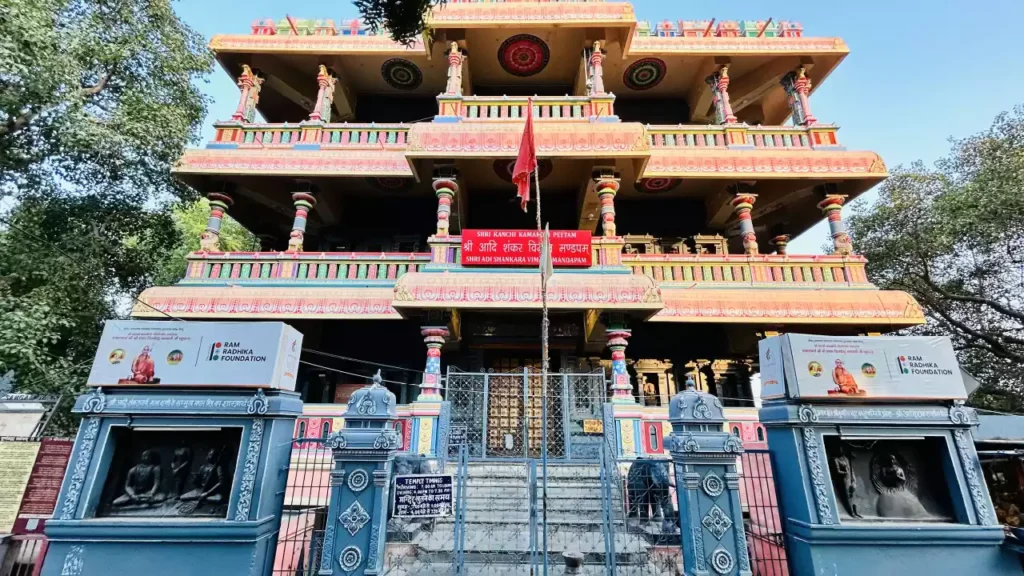
Shankar Viman Mandapam is one of the most visually striking temples in Prayagraj — a full South Indian-style temple complex built at the heart of the Triveni Sangam area, rising incongruously but magnificently among the riverbank ghats and North Indian temple spires of the holy city. With its towering gopuram (gateway tower) covered in painted stucco sculptures of deities, the temple announces itself from a considerable distance as something apart from its surroundings — a South Indian presence at one of North India’s most sacred sites, dedicated to the supreme unity of the divine.
The temple is dedicated to Lord Shiva, worshipped here as the Lord of all auspiciousness and the supreme being who pervades the cosmos — “Shankar” being one of Shiva’s most beloved names, meaning “conferring happiness.” The word “Viman Mandapam” refers to the vimana (the tower above the inner sanctum) and the mandapam (the hall of the temple) — the two central architectural elements of the Dravidian temple tradition. The name, therefore, describes not just the deity but the architectural form of the temple itself.
The South Indian Temple in North India
The presence of a Dravidian-style temple at Prayagraj reflects the all-India scope of this pilgrimage city’s sacred geography. Prayagraj has drawn pilgrims from every corner of the subcontinent since ancient times, and devotees, saints, and donors from Tamil Nadu, Kerala, Karnataka, and Andhra Pradesh have contributed to the city’s religious landscape over the centuries. The Shankar Viman Mandapam was built by a South Indian religious trust as an act of devotion and as a symbol of the unity of all Hindu traditions at this supreme tirtha.
This cross-regional character is, in fact, theologically significant. The Triveni Sangam is described in the Puranas as a place where all sacred rivers, all sacred sites, and all deities are simultaneously present. A South Indian temple at the Sangam is not an anomaly but a natural expression of this universality — Shiva is worshipped in the Dravidian tradition as Mahadeva, the greatest god, and his presence at Prayagraj in this magnificent South Indian form demonstrates that the sacred geography of India’s holiest city transcends regional boundaries.
Architecture: The Gopuram and its Sculptures
The defining feature of Shankar Viman Mandapam is its gopuram — the monumental gateway tower that characterises the Dravidian temple style. Unlike the vertical shikharas of North Indian temples, a gopuram is a tapering rectangular tower, typically much wider at the base than at the apex, with every surface covered in rows of painted stucco figures. Each tier of the gopuram at Shankar Viman Mandapam is populated with dozens of deities, celestial beings, guardians, and mythological scenes, all painted in vivid colours — ochre, white, green, red, and gold.
The figures on the gopuram tell the stories of Shiva: his marriage to Parvati, his destruction of the demon Tripura, his dance as Nataraja (the Lord of the Cosmic Dance), his manifestation as Dakshinamurthy (the teacher-sage), and his battle with the demon Andhakasura. For those familiar with the iconographic vocabulary of South Indian temples, the gopuram is a complete theological education in stone and plaster.
Within the compound, the inner sanctum (garbhagriha) houses the main Shivlinga. The interior follows the traditional Agamic layout of South Indian temples: an outer hall (mahamandapam), an inner hall (ardhamandapam), and the garbhagriha itself. The vimana tower above the inner sanctum rises in diminishing tiers, each adorned with miniature sculptures.
Darshan and Ritual Practices
The temple follows the Agamic tradition of South Indian Shaiva worship. Daily rituals include Thiruvanandal (morning ritual bathing and adornment of the deity), Thiruvanadu (midday worship), and Pallikkiletchi (the deity’s “awakening” rite before aarti). Abhishek is performed with panchamrita (five sacred substances: milk, yoghurt, ghee, honey, and sugar) as well as with Ganga and Yamuna water brought from the Sangam.
The temple is open from approximately 6:00 AM to 12:00 PM and from 4:00 PM to 9:00 PM. Entry is free, and all Hindu devotees are welcome regardless of regional or sectarian background. The temple’s administration maintains the Agamic rituals according to South Indian tradition while remaining open and welcoming to North Indian pilgrims who constitute the majority of visitors.
Festivals and the Kumbh Connection
Mahashivratri is celebrated here with particular grandeur — the gopuram is illuminated, special abhisheks are conducted through the night, and a large gathering of devotees maintains vigil from dusk to dawn. Karthigai Deepam (the festival of lights observed in the Tamil month of Karthigai, corresponding to November-December) is observed according to South Indian tradition, with the summit of the gopuram lit with a great lamp that is visible from across the Sangam area.
During the Kumbh Mela and Ardh Kumbh Mela, Shankar Viman Mandapam receives pilgrims from Tamil Nadu, Kerala, and Karnataka who combine their Sangam dip with a visit to this temple — making it a home-from-home for South Indian pilgrims at the world’s largest religious gathering. The temple’s trust often organises free meals (annadanam) for pilgrims during Kumbh, continuing the ancient South Indian tradition of temple-based community feeding.
Spiritual Significance at the Sangam
The Prayag Mahatmya — the classical text on the spiritual significance of Prayagraj — identifies the Sangam area as a space where Shiva and Vishnu, Shaiva and Vaishnava, North and South, all resolve into a single sacred unity. Shankar Viman Mandapam embodies this unity in its very form: a South Indian temple dedicated to Shiva, built at the supreme Hindu pilgrimage site, visited by pilgrims of all traditions from across the subcontinent. It is a temple that, simply by existing, makes a statement about the breadth and inclusivity of Hindu sacred geography.
For pilgrims completing a circuit of the Sangam area — Lete Hue Hanuman Ji, Patalpuri, Veni Madhav, Alopi Devi — a visit to Shankar Viman Mandapam adds the dimension of South Indian devotional tradition to what is already a remarkably multi-layered pilgrimage experience.
How to Reach
The temple is located in the Sangam-Daraganj area of Prayagraj, near the Triveni Sangam. It is approximately 7 kilometres from Prayagraj Junction. Auto-rickshaws and boats are available. During Kumbh Mela, the area is served by special transport arrangements. Entry is free, and the temple welcomes pilgrims of all backgrounds.
Explore the full pilgrimage circuit of the Triveni Sangam, including Shankar Viman Mandapam, with our Prayagraj pilgrimage and travel guide. Visit the Sangam temples and ghats on our Varanasi-Prayagraj 2N/3D tour package.