








Somnath
The Eternal Shrine of the Moon God
On the shores of the Arabian Sea, where the waves crash against the ancient land of Saurashtra, stands a temple that is not just a place of worship, but a powerful symbol of faith's eternal resilience.
4.4 from 55 Google reviews · 9,300+ travellersWhen to goNov–Feb
- Jan (good)
- Feb (good)
- Mar
- Apr
- May
- Jun
- Jul
- Aug
- Sep
- Oct
- Nov (good)
- Dec (good)
What to see in Somnath
Built from the city’s facts.
First of the 12 Jyotirlingas, A shrine of resilience and reconstruction
- First of the 12 Jyotirlingas
- A shrine of resilience and reconstruction
November-February (Winters)
Traditional vegetarian Gujarati Thali
Bus stand
Tours that include Somnath
Private departures, planned to your dates.
 Yatra2N / 3D · Private2N / 3D · Yatra
Dwarka and Somnath 2N/3D Tour Package
- Dwarka
- Somnath
Starting from ₹10,000per person · 6 Pax MinimumTravellers
Dwarkadheesh Temple DarshanAsk us on WhatsApp
- Private departure
- Planned to your dates
- We'll send you a plan and a price
 Yatra6N / 7D · Private6N / 7D · Yatra
Ahmedabad-Gir-Dwarka-Somnath 6N/7D Tour Package
- Gir
- Somnath
- Dwarka
- Ahmedabad
Starting from ₹37,000per person · 6 Pax MinimumTravellers
Adalaj Stepwell's intricate architectureAsk us on WhatsApp
- Private departure
- Planned to your dates
- We'll send you a plan and a price


Temples in Somnath
From our temple guide.

About Somnath
Our guide to the city.
On the shores of the Arabian Sea, where the waves crash against the ancient land of Saurashtra, stands a temple that is not just a place of worship, but a powerful symbol of faith's eternal resilience. This is Somnath, revered as the first of the twelve sacred Jyotirlingas of Lord Shiva. The name itself means "Lord of the Soma" or "Lord of the Moon," and according to legend, the original temple was built by Chandra, the Moon God himself, out of pure gold to honor Lord Shiva, who had cured him of a curse. This is a place of primal spiritual power, a site so sacred and so renowned for its wealth that it has been a beacon for both devotees and destroyers for over a thousand years.
The story of Somnath is an incredible saga of destruction and rebirth. It is believed to have been built and rebuilt at least seven times. Throughout history, its immense wealth and sanctity attracted a series of invaders who repeatedly plundered its treasures and razed it to the ground. Yet, each time it was destroyed, it was resurrected with even greater devotion by the faithful. This cycle of destruction and reconstruction has transformed the temple from a mere historical site into a living testament to the unwavering, unconquerable spirit of the Hindu faith. The current temple, the seventh reconstruction, was built in the post-independence era, its foundation stone laid by the then-President of India. Its very existence is a statement of national pride and cultural reclamation.
To stand before the magnificent Somnath temple today is to feel the weight of this incredible history. Located at the Triveni Sangam—the sacred confluence of three rivers—it stands proudly on the seashore, its grand spire, or shikhar, pointing to the sky. A unique feature of its location is the Baan Stambh (Arrow Pillar), an ancient pillar that points directly south towards the ocean, proclaiming that there is no piece of land between Somnath and the continent of Antarctica in that straight line—a stunning testament to the advanced geographical knowledge of ancient India. A visit to Somnath is more than a pilgrimage; it is a journey to a place of immense historical resonance, a chance to witness a shrine that has absorbed centuries of turmoil and has emerged, time and again, as an eternal symbol of faith's enduring power.
Key Attractions:
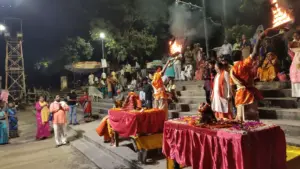
- Somnath Temple: The magnificent, primary shrine. Built in the Chalukya style of architecture, the temple is a grand structure made of honey-coloured stone. The intricate carvings on its walls and the beautifully sculpted main hall (sabha mandap) lead to the serene sanctum sanctorum where the sacred Jyotirlinga of Lord Shiva is enshrined. The temple is most atmospheric during the evening aarti, a beautiful ritual of light and sound. The spectacular evening light and sound show, projected onto the temple itself, narrates its powerful and turbulent history.
- Triveni Sangam Ghat: The sacred confluence where the rivers Kapila, Hiran, and the mythical Saraswati meet the Arabian Sea. This is a highly revered bathing spot, and pilgrims take a holy dip here before proceeding to the main temple. The ghat is a bustling place of rituals and prayers, especially at sunrise.
- Bhalka Tirth: A poignant and deeply significant temple that marks the exact spot where Lord Krishna is said to have departed from his mortal body. According to the Mahabharata, a hunter named Jara mistook Krishna's foot for a deer and shot him with an arrow. The temple, built around a beautiful, ancient Peepal tree, commemorates this final, divine leela (act) of Lord Krishna. It is a place of quiet contemplation and immense spiritual importance.
- Gita Mandir: Located near the Triveni Sangam, this beautiful modern temple is dedicated to the teachings of the Bhagavad Gita. Its walls are inscribed with the verses from the sacred text. It is a serene place of worship, often visited in conjunction with Bhalka Tirth.
- Old Somnath Temple (Ahilyabai Temple): Located just behind the main temple, this smaller, older temple was built in the 18th century by the Maratha queen Ahilyabai Holkar after the previous temple was desecrated. Before the new temple was constructed, this was the main site of worship for many years. It has a more ancient and rustic feel and offers a sense of what the temple might have been like in a previous era.
- Somnath Beach: The beach near the temple offers a stunning backdrop to the main shrine. While not ideal for swimming due to the strong currents, it is a perfect place for a walk, especially in the evening. You can see local fishermen at work and enjoy the sea breeze. The presence of the grand temple on the shore makes it a unique and spiritually charged coastal experience.
- Somnath Museum: The museum houses the architectural remains and sculptures from the previous Somnath temples that were destroyed. It provides a fascinating, tangible link to the temple's long and tumultuous history, showcasing the incredible artistry of the past.
Read before you go
Our Somnath guides.

Plan Somnath with us
Tell us your dates and who is travelling. We reply with a plan and a price.
- A person replies, not a bot, during desk hours
- A plan and a price for your dates
- Your number is used only to reply about your trip
Namaste, I'm your name. We'd like to visit Somnath. Please suggest the right tour and how to reach me.
Request sent, ji
It's with our planning desk in Prayagraj. A planner replies on WhatsApp during desk hours: Mon–Sat 11 AM–9 PM · Sun 12–8 PM (IST).
Open WhatsAppPrefer to talk now? +91 77540 97777