


If you have searched “Is Prayagraj the same as Allahabad?” you are not alone. Millions of travellers, pilgrims, and curious minds ask this every year — and the confusion is completely understandable. Railway booking sites still list both names. Hotel aggregators alternate between them. And when you call a local auto-rickshaw driver and say “Allahabad,” he will understand exactly where you are going.
The short answer is yes — they are the same city. But the longer answer is far more interesting. The name Prayagraj is not a new invention. It is the restoration of one of the oldest place names in Indian civilisation, a name that appears in the Rigveda, in the Mahabharata, and in the Puranas. Understanding why this city had two names for over four centuries, and why the ancient one was brought back, tells you something important about the city itself.
The Ancient Name: What Does “Prayagraj” Actually Mean?
Long before the Mughals arrived in India, the confluence of the Ganga and Yamuna rivers at this location was among the most sacred spots in all of Hindu geography. Ancient texts referred to it simply as Prayag — and then, often, as Teerth Raj, meaning “the King of all pilgrimages.”
The word Prayag comes from two Sanskrit roots: Pra (great, first, or excellent) and Yag (yajna, meaning sacrifice or sacred offering). Together, Prayag means the place of the greatest yajna. Hindu tradition holds that Lord Brahma himself performed the first yajna of creation at this confluence, making it the supreme tirtha among all holy sites.
The suffix “raj” was added in common usage to mean “king” — hence Prayagraj, “the king of all prayags.” There are five Prayags in the Himalayan region (Panch Prayag), and several others across India. But this one, at the confluence of the Ganga, Yamuna, and the mythical Saraswati, has always held the highest rank among them.
Vedic texts like the Matsya Purana and the Padma Purana describe this site in detail. The Mahabharata contains references to the Prayag tirtha as a place where sins are destroyed and moksha is attainable. The sage Bharadvaja, one of the most revered figures in the Vedic tradition, is said to have established his ashram here — a tradition that survives to this day at the Bharadvaj Ashram near the Sangam.
This ancient identity as a sacred city is why, even through four-plus centuries under the name Allahabad, pilgrims, priests, and Sanskrit texts continued to refer to this place as Prayag. The name was never truly abandoned — it was preserved in ritual, in scripture, and in the memory of the devout.
The Mughal Renaming: How Allahabad Got Its Name
The name Allahabad traces back to 1575 AD, when the Mughal Emperor Akbar captured and fortified the confluence city. According to historical records, Akbar originally named it Illahabas — sometimes written as Ilahabad — meaning “the abode of God” in Arabic-Persian. The word derives from “Allah” (God) and “abad” (a settled place or city), a naming convention the Mughals used widely across their empire.
Akbar was drawn to this location for strategic reasons. The confluence of two major rivers made it a natural command point, and he constructed the massive Allahabad Fort here between 1583 and 1584. The fort, which still stands today along the Yamuna bank, became one of the key garrison cities of the Mughal empire. Akbar also reportedly had a personal affinity for this spot — he is said to have bathed at the Sangam and acknowledged its spiritual importance even as he renamed the city in the Persianate tradition of his court.
Over time, the anglicised version “Allahabad” took hold, and the British colonial administration adopted it fully. Under British rule, Allahabad became one of the most significant cities in the United Provinces (now Uttar Pradesh). It was the seat of the Allahabad High Court, founded in 1866, which remains one of the oldest and most respected high courts in India. The city became a centre of the Indian independence movement — the Nehru family, one of the most prominent political dynasties in Indian history, lived here at Anand Bhawan.
A City Through the Ages
Key dates in the history of Prayagraj
The 2018 Renaming: Why Was Allahabad Renamed Prayagraj?
On 16 October 2018, the Uttar Pradesh cabinet under Chief Minister Yogi Adityanath passed a resolution to officially rename Allahabad to Prayagraj. The decision was ratified by the state legislature and the name change was formally notified in the official gazette.
The timing was deliberate. The Uttar Pradesh Government was preparing to host the 2019 Kumbh Mela — the largest religious gathering on Earth — and the administration wanted the city to officially carry its ancient name for the occasion. For millions of Hindu pilgrims, the idea of bathing at “Prayag” carries far deeper religious weight than bathing at “Allahabad.” The name Prayag is the one that appears in their scriptures, in the ritual invocations recited by priests, and in the Vedic geography of sacred India.
Chief Minister Adityanath described the renaming as a cultural restoration — returning the city’s original identity that had been overlaid by Mughal and British nomenclature. Supporters of the change pointed out that the city’s residents had informally called it Prayag for centuries even while the official name remained Allahabad. Opposition parties criticised the move as politically motivated, arguing that the city’s long administrative history under the name Allahabad — its role in the independence movement, its renowned university, its High Court — was an equally valid part of its identity.
That debate continues in political circles. What is not debated is the official legal status: since October 2018, the city’s name is Prayagraj.
The Triveni Sangam: Why This City Is Called the King of Pilgrimages
No explanation of Prayagraj is complete without understanding Triveni Sangam — the three-river confluence that has defined this city’s identity for millennia.

Triveni means “three braids” and Sangam means “confluence.” The three rivers are:
- Ganga — flowing from the Himalayas, considered the most sacred river in Hinduism, whose waters are believed to carry purifying properties
- Yamuna — appearing as a dark, greenish current visibly distinct from the Ganga’s grey-blue waters when they meet
- Saraswati — a river mentioned extensively in the Rigveda but invisible at this point, believed in Hindu tradition to flow underground and join the other two at the Sangam
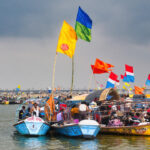
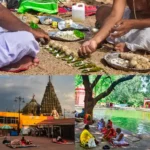
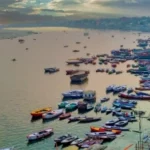
At the actual confluence point, you can see the different colours of the Ganga and Yamuna meeting — a phenomenon visible to the naked eye, particularly during winter when water levels are right. Pilgrims take boat rides to this point, where they bathe and offer prayers. The ritual dip here is considered among the most powerful acts of purification in Hindu practice.
The Matsya Purana states that of all tirthas on earth, Prayag is the greatest, and that there is no place equal to Prayag in the three worlds. This scriptural authority is why pilgrims have been travelling here for thousands of years — and why the Kumbh Mela, held at this precise location, draws the largest peaceful human gathering on the planet.
The Prayagraj teerth guide covers the Sangam in detail — boat timings, ghat access, what to carry, and the protocols for performing ritual snan at the confluence.
Kumbh Mela: The Festival That Belongs Only to Prayagraj
The Kumbh Mela is the defining reason why Prayagraj occupies a unique position not just in India but in world culture. It is held at four locations in India — Haridwar, Nashik, Ujjain, and Prayagraj — in a rotating cycle. The one at Prayagraj is considered the greatest of all four, known as the Maha Kumbh when it falls on the full 12-year cycle.
According to the Skanda Purana, the nectar of immortality (amrit) from the samudra manthan (churning of the cosmic ocean) was carried in a Kumbh (pot), and drops of it fell at these four locations. The Prayagraj site is associated with the most powerful of these drops, which is why Kumbh here draws more pilgrims than anywhere else.
The 2019 Kumbh Mela — the first one after the city was officially renamed Prayagraj — was estimated to have drawn over 240 million visitors over 49 days, making it the largest human gathering in recorded history. This figure was verified by satellite imagery commissioned by the UP Government and reported by multiple international news organisations including the BBC and Reuters.
The Maha Kumbh of 2025, held again at Prayagraj from January to February, continued this tradition on an even larger scale. The UP administration reported record attendance at the Mauni Amavasya snan (the day of silence bathing) alone, with an estimated 60–70 million pilgrims arriving at the Sangam on a single day.
Between the 12-year Maha Kumbh cycles, the Ardh Kumbh (half Kumbh) is held every six years, and the annual Magh Mela takes place every January–February. This means Prayagraj’s Sangam is never truly quiet — there is always a festival, a tithi, or a pilgrimage season that brings devotees to these banks.
What Has Changed Since the Renaming — and What Has Not
For a practical traveller, the most important question is often: “What do I need to know about the name change when I am booking travel?” Here is a clear breakdown.
Railway Stations: New Names and Station Codes
The railway stations have been formally renamed. The key changes to know:
- Allahabad Junction (ALD) is now Prayagraj Junction (PRYJ) — this is the main station and the one most long-distance trains use
- Allahabad City station has been renamed Prayagraj Rambag
- Allahabad Chheoki is now Prayagraj Chheoki (PYX) — this is the station closest to the Sangam area
When booking on IRCTC or any rail booking platform, search for PRYJ or type “Prayagraj” — both the old and new station codes should appear in results. If a train schedule you found online still shows ALD, verify it against current IRCTC listings as the codes have been updated in the national railway database.
Airport: IXD Prayagraj
The airport serving Prayagraj is Prayagraj Airport, with the IATA code IXD. It was previously called Bamrauli Airport and then Allahabad Airport. IndiGo, Air India, SpiceJet, and Akasa Air operate flights here from Delhi, Mumbai, and Bengaluru. When booking flights, search for “Prayagraj” or the code IXD.
Institutions That Retain the Allahabad Name
Not everything in the city has changed. Several major institutions have chosen to retain the Allahabad name, either because of their own historical identity or because formal renaming requires separate legal processes:
- University of Allahabad — one of India’s oldest central universities (established 1887), still officially Allahabad University
- Allahabad High Court — the Uttar Pradesh High Court is still formally named the High Court of Judicature at Allahabad
- Allahabad Museum — the large state museum in Alfred Park (now Chandrashekhar Azad Park) retains its original name
This is why even today, “Allahabad” and “Prayagraj” are used interchangeably in everyday conversation. Locals who grew up calling the city Allahabad continue to do so. For them, both names refer to the same place — the same ghats, the same bazaars, the same Sangam.
Key Attractions in Prayagraj
Whether you are visiting for religious reasons or historical curiosity, Prayagraj offers a dense concentration of significant sites within a relatively compact urban area. Here are the ones that genuinely deserve your time.

Must-Visit Sites in Prayagraj
Where history, spirituality, and culture converge
Triveni Sangam
The sacred confluence of Ganga, Yamuna, and the mythical Saraswati. The single most important pilgrimage point in Hindu geography.
Allahabad Fort
Built by Akbar in 1583-84. Contains the 240 BCE Ashoka Pillar and the sacred Akshay Vat banyan tree inside Patalpuri Temple.
Anand Bhawan
The Nehru family home, now a national museum. Jawaharlal Nehru was born here. The Indian National Congress held key sessions within these walls.
Bade Hanuman Ji
The unique Hanuman temple near the Sangam where the deity is depicted in a reclining posture — the only such major Hanuman temple in India.
Khusro Bagh
A Mughal-era walled garden with the tomb of Prince Khusro, Jahangir's eldest son. Excellent Mughal architecture, rarely crowded.
Bharadvaj Ashram
The ashram of Vedic sage Bharadvaja, mentioned in the Valmiki Ramayana as the place Lord Ram visited during his exile journey south.
Allahabad Fort and the Ashoka Pillar
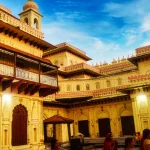
The Allahabad Fort, built by Akbar between 1583 and 1584, is one of the largest forts constructed during the Mughal period. It sits at the confluence of the Ganga and Yamuna rivers and was designed both as a military garrison and as an imperial palace. The fort houses the Ashoka Pillar, a polished sandstone column from approximately 240 BCE on which Emperor Ashoka inscribed edicts relating to dharma. The Allahabad Pillar is particularly significant because it bears a later inscription from Samudragupta (Gupta dynasty, 4th century CE) recounting his military campaigns — making it a palimpsest of Indian imperial history spanning over six centuries.
Inside the fort complex is the Patalpuri Temple, one of the oldest temples in Prayagraj, which contains the Akshay Vat — an ancient banyan tree considered indestructible and immortal in Hindu belief. References to the Akshay Vat appear in the Mahabharata. Even Akbar, who renamed the city, reportedly respected the sanctity of this tree and did not have it removed from the fort grounds.
Anand Bhawan: The House That Shaped Modern India
Anand Bhawan (House of Joy) was the family home of Motilal Nehru, and later of his son Jawaharlal Nehru — India’s first Prime Minister. The building served as a de facto headquarters of the Indian National Congress during much of the freedom struggle. Jawaharlal Nehru was born here, and Indira Gandhi, his daughter and India’s first female Prime Minister, grew up in this house. The building was donated to the nation in 1970 and is now a museum. Visiting Anand Bhawan gives you an intimate sense of the intellectual and political environment that shaped modern India.
Khusro Bagh
One of the lesser-visited but genuinely impressive Mughal sites in the city, Khusro Bagh is a large walled garden that contains the tombs of Khusro Mirza (Emperor Jahangir’s eldest son), his mother Shah Begum, and his sister Nithar Begum. The funerary architecture here — particularly the double-storeyed sandstone tomb of Khusro — is a fine example of early 17th-century Mughal work. The garden is quiet enough to explore without crowds, making it a good choice if you want to see Mughal Prayagraj away from the bustle of the Sangam.
The Food of Prayagraj

Prayagraj has a distinct food culture shaped by its position as a pilgrimage city. The area around the Sangam and the old city bazaars is known for aloo ki tehri (spiced rice with potatoes), kachori-sabzi (deep-fried lentil bread with vegetable curry), baati-chokha (hard wheat balls baked over coals, served with roasted vegetables), and an assortment of chaat styles that differ from those found in Delhi or Lucknow. The winter months bring seasonal sweets and the famous Imarti — a jalebi variant made with urad dal batter, served at the old sweet shops near the Civil Lines area.
Prayagraj and Varanasi: The Pilgrimage Circuit
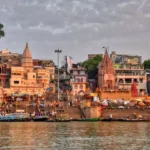
Most serious pilgrims and thoughtful travellers visit Prayagraj as part of a broader spiritual itinerary that includes Varanasi (Kashi). These two cities are connected in Hindu theology as the twin centres of the Ganga pilgrimage. Varanasi is where Lord Shiva is said to reside eternally and where the Ganga flows northward (Uttaravahini) — a rare directional reversal that adds to its sanctity. Prayagraj is where the Ganga meets the Yamuna and Saraswati, completing the sacred geography of the river’s upper plains.
The two cities are approximately 120 km apart by road (around 2.5 to 3 hours) and are well connected by both road and rail. Our Varanasi–Prayagraj 2N/3D tour package pairs the Triveni Sangam with the Kashi Vishwanath temple, the ghats of Banaras, and the Sarnath deer park — covering the full spiritual and historical circuit in a single organised journey.

How to Reach Prayagraj
By Train
Prayagraj is one of the best-connected railway junctions in North India. The main station, Prayagraj Junction (PRYJ), is served by major trains from Delhi (around 7–8 hours on express trains), Mumbai (around 22–24 hours), Kolkata (around 12–14 hours), and Varanasi (around 2–3 hours). The Prayagraj Express, the Duronto Express, and the Humsafar Express are among the more popular services from Delhi. Prayagraj Chheoki (PYX) is the closest station to the Sangam area and a good option if your accommodation is near the ghats.
By Air
Prayagraj Airport (IXD) has seen significant expansion in recent years, with direct flights from Delhi, Mumbai, Bengaluru, Hyderabad, and Kolkata. IndiGo, Air India, and SpiceJet all operate regular services. The airport is approximately 12 km from the city centre, and pre-paid taxis and app-based cabs are available at the terminal.
By Road
The Prayagraj–Lucknow Expressway and NH-19 (the main Delhi–Kolkata highway) both pass through or near the city. AC buses from Lucknow (approx. 200 km, 3–4 hours), Varanasi (approx. 120 km, 2.5 hours), and Agra (approx. 380 km, 5–6 hours) are available through UPSRTC and private operators. During the Kumbh Mela, special bus services are run from all major UP cities.
Best Time to Visit Prayagraj
The ideal months to visit Prayagraj are October through March. During this period, the weather is dry and pleasant (daytime temperatures of 15–25°C in the coolest months), the rivers are at a manageable level for boat rides to the Sangam, and the Magh Mela — held every January–February — draws a focused gathering of devout pilgrims. This month-long fair allows you to experience the spiritual atmosphere of the Sangam without the overwhelming scale of the Kumbh itself.
Summer (April–June) is hot and humid, with temperatures regularly crossing 42–45°C. The monsoon (July–September) brings heavy rainfall that causes the Ganga and Yamuna to flood the Sangam area significantly — boat access to the confluence point becomes difficult or impossible at peak monsoon. If you want to see the Sangam at its most dramatic and full, late September or early October — just as the rivers begin to recede — offers a good balance of accessibility and visual impact.
Prayagraj’s Identity Today: Same City, Restored Name
Prayagraj today holds multiple identities simultaneously. It is the seat of one of India’s oldest High Courts, home to one of its most historic central universities, the ancestral city of Jawaharlal Nehru, the site of a Mughal fort that survives largely intact after 440 years, and the location of the most important pilgrimage confluence in Hinduism. These identities are not in conflict — they are layers, each added in its time, each still visible in the city’s streets and institutions.
The name Prayagraj does not erase Allahabad any more than the name Allahabad erased Prayag. The local community carries both names. The institutions carry their own histories. And the Sangam itself — the actual reason millions of people have been coming here for three thousand years — is unchanged by any of it.
For a first-time visitor, our detailed guide to exploring Prayagraj for the first time covers the layout of the city, how to navigate between the Sangam, the fort, and the Civil Lines hotel area, and what to prioritise if you have only one or two days.
You can also read our broader piece on what makes Prayagraj special — covering the spiritual geography, the unique food culture, and the experiences that visitors consistently remember long after they return home. And our guide to the wonders of Prayagraj provides a curated overview of the city’s most significant sites with practical visitor details.
✨ Varanasi + Prayagraj Pilgrimage Tour
Experience both the Triveni Sangam and the Kashi Vishwanath Jyotirlinga in a single guided journey. Two of Hindu India’s most sacred cities, paired in one itinerary.
- Boat ride to Triveni Sangam and ritual snan guidance
- Ganga Aarti at Varanasi Dashashwamedh Ghat
- Licensed local guide covering history and religious significance
- Accommodation, daily breakfast and dinner included
Prayagraj vs Allahabad: Common Questions Answered
Everything travellers and pilgrims want to know
Is Prayagraj the same as Allahabad?
Yes, completely. Prayagraj and Allahabad are the same city. Allahabad was the official name from the Mughal era (around 1575) until October 2018, when the Uttar Pradesh Government under Chief Minister Yogi Adityanath officially renamed it Prayagraj. The new name restores the ancient Sanskrit name, which appears in Vedic texts and is thousands of years older than the Mughal name.
Has the railway station name changed from Allahabad to Prayagraj?
Yes. The main station is now Prayagraj Junction with station code PRYJ (previously Allahabad Junction, ALD). Allahabad City station is now Prayagraj Rambag, and Allahabad Chheoki is now Prayagraj Chheoki (PYX). When booking on IRCTC or any rail platform, search for Prayagraj or PRYJ.
Why was Allahabad renamed Prayagraj?
The UP Government described it as a cultural restoration — returning the city to its ancient Sanskrit name Prayag, which appears in the Rigveda, Mahabharata, and major Puranas. The name Allahabad was given by Mughal Emperor Akbar around 1575. The timing in October 2018 was partly to have the ancient name in place before the 2019 Kumbh Mela, where pilgrims come specifically to bathe at Prayag, the name they know from scripture.
Do locals still call it Allahabad?
Yes, many residents still use Allahabad in everyday speech, and both names are widely understood. Major institutions including the University of Allahabad and the Allahabad High Court retain their original names. If you ask a local auto driver for Allahabad, he will know exactly where you mean.
What is the significance of Triveni Sangam at Prayagraj?
Triveni Sangam is the confluence of three rivers: the Ganga, Yamuna, and the mythical underground Saraswati. In Hindu belief, bathing at this confluence destroys accumulated sins and brings the soul closer to moksha (liberation). The Matsya Purana calls Prayag the greatest tirtha in the three worlds. It is the site of the Kumbh Mela, the largest religious gathering on Earth.
What is the best time to visit Prayagraj?
The best time is October to March, when weather is cool and dry (15-25 degrees Celsius). January and February are ideal for the Magh Mela at the Sangam. Summer (April-June) is very hot (up to 45 degrees). The monsoon (July-September) causes flooding near the Sangam and limits boat access. If visiting during the Kumbh Mela (every 12 years), plan accommodation months in advance as the city fills completely.
Is the Allahabad Fort worth visiting?
Yes, though access is partially restricted as it is an active military installation. The sections open to the public include the Patalpuri Temple (containing the sacred Akshay Vat banyan tree), the Ashoka Pillar (240 BCE), and the Saraswati Koop (a sacred well). The fort exterior and river frontage are excellent for photography. Check access rules locally before visiting as timings can vary.