



It is a widely held belief among Teertha Purohits that while human hair naturally floats on water, the hair offered during Veni Daan at the Triveni Sangam immediately sinks to the riverbed, signifying Mother Ganga‘s acceptance of the sacrifice
If there is one spiritual journey that completely redefines the matrimonial bond in Hindu traditions, it is the performance of the Sari Pooja, integrated intricately with Veni Daan in Prayagraj and the Veni-Lingam Pooja. Deeply revered by couples, especially from Maharashtra and South India, the sacred ritual of Veni Daan in Prayagraj is a beautiful and emotional blend of devotion, sacrifice, and eternal love.
Here is a complete, detailed guide to understanding this magnificent ritual.
Where is it done?
This profound ceremony is exclusively performed at the Triveni Sangam. When couples plan for their Veni Daan in Prayagraj, they travel to this physical and spiritual confluence of three mighty rivers: the holy Ganga, the Yamuna, and the invisible, mythical Saraswati. Couples often travel thousands of miles to this exact location, as Vedic scriptures dictate that performing Veni Daan in Prayagraj is where these matrimonial offerings bear their highest spiritual fruits.
Why is it Done and What are the Benefits?
The core purpose behind performing Veni Daan in Prayagraj alongside the Sari Pooja is to pray for the longevity, good health, and immense prosperity of the husband. In Hindu traditions, a woman’s hair (Veni) represents her pride and beauty. By sacrificing a small portion of it to the sacred rivers during Veni Daan in Prayagraj, she symbolically sheds her ego and surrenders her pride to the divine for the sake of her spouse.
Why Perform Veni Daan?
The spiritual fruits of this matrimonial sacrifice.
- Husband's Longevity: The primary prayer is for the "Ayush" (Long Life) and health of the husband.
- 7 Lifetimes Bond: A vow to remain united as soulmates for seven consecutive births (Sapta Janma).
- Removal of Ego: Hair represents beauty and pride; sacrificing it symbolizes surrendering ego for the family's welfare.
- Pap Kshayartham: Washing away sins accumulated in past lives that might be hindering marital happiness.
The ritual serves as a profound spiritual renewal of marriage vows. The couple prays to the divine to be reborn as husband and wife for seven consecutive lifetimes. Furthermore, it is believed that participating in Veni Daan in Prayagraj washes away past-life sins (Pap Kshayartham), invites absolute marital bliss, and secures a loving relationship completely unhindered by worldly obstacles.
With Whom Should it be Done?
This pooja is strictly a couple’s ritual. Veni Daan in Prayagraj must be performed by a married woman actively alongside her husband. The physical presence and participation of both partners are crucial, as the ceremony is a reenactment of their original wedding vows. A qualified local priest (Panda of Prayag) guides the couple through the traditional Vedic mantras during the Veni Daan in Prayagraj ceremony.
What Should be Worn?
Attire plays a pivotal role in maintaining the sanctity of the pooja. For Veni Daan in Prayagraj, the woman must be clad in a traditional Sari—often worn in her native regional style, such as a Maharashtrian Nauvari or a traditional South Indian silk sari. Auspicious colours like vibrant red, yellow, or green are highly preferred as they signify suhag (auspicious married life). She should also adorn herself completely with bridal jewellery, her mangalsutra, glass bangles, and a bindi. The husband must also be in traditional, unstitched attire, typically wearing a pristine white or yellow dhoti and an angavastram (shawl) while performing Veni Daan in Prayagraj.
What Should be Eaten?
Because this is a deeply purifying rite, the couple must adhere to a strict Satvik diet. This means eating pure vegetarian food completely devoid of onion, garlic, eggs, and heavy, heat-inducing spices. Most couples choose to observe a strict fast from morning until the holy dip and the Veni Daan in Prayagraj rituals are fully completed. Afterwards, they break their fast by partaking in simple temple prasad, fresh fruits, and a freshly prepared Satvik meal consisting of rice, dal, and vegetables cooked in pure ghee.
Complete Details of the Ritual
The ritual itself is highly intricate, emotionally moving, and consists of three major phases:
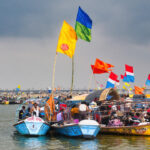
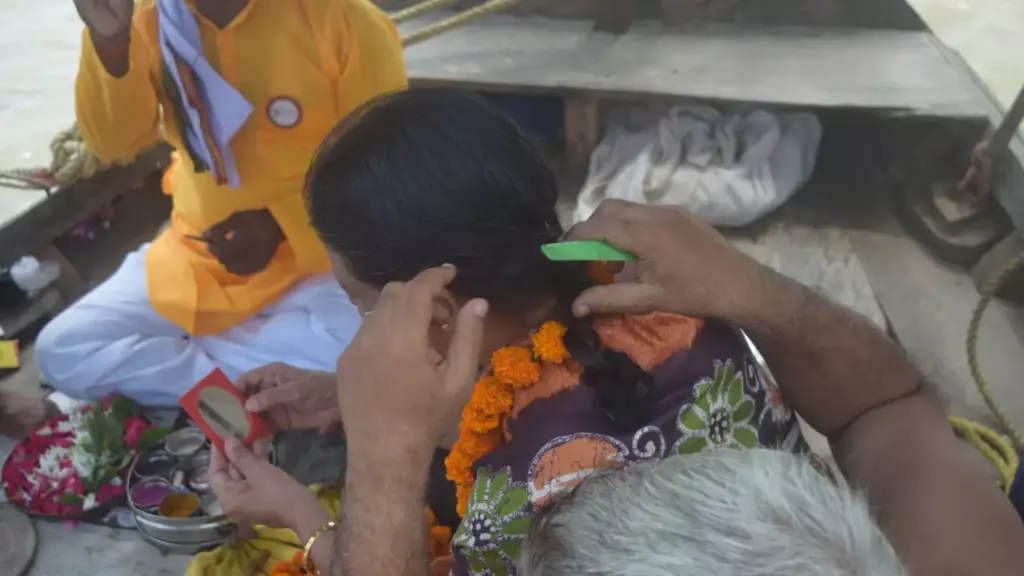
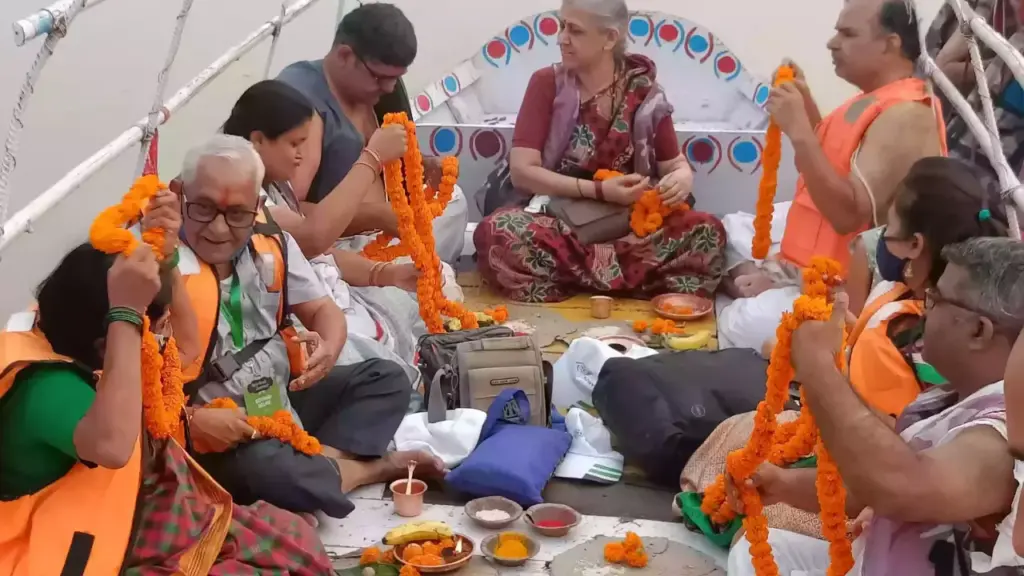
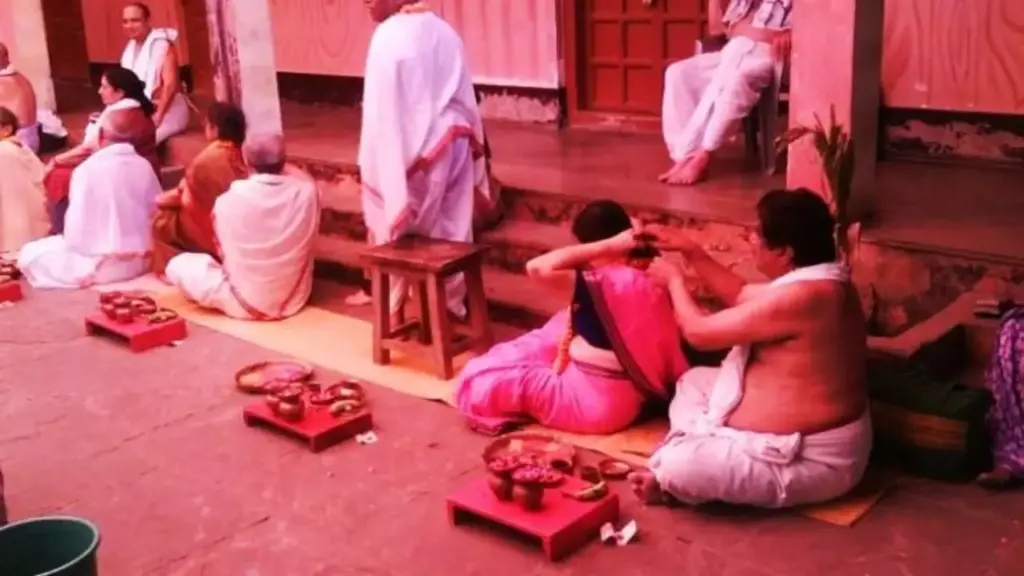
- The Veni Daanam: The heart of Veni Daan in Prayagraj involves sitting on the banks of the Sangam or on a specially hired boat, where the husband lovingly combs his wife’s hair, braiding it and adorning it with a garland of fresh flowers. Amidst the powerful chanting of Vedic mantras by the priest, the husband uses ritualistic scissors to cut a very small tip of her braided hair. Miraculously, locals and priests note that while human hair usually floats on water, the hair offered at the Sangam immediately sinks directly to the riverbed, signifying the river goddess accepting the offering.
- The Veni-Lingam Pooja: The snipped hair is then carefully combined with the holy mud and sand of the Triveni Sangam to craft a sacred Veni-Lingam (a form of Lord Shiva). This Lingam is worshipped with utmost devotion, offering flowers and holy water, before being gently dissolved into the meeting point of the rivers.
- The Sari Pooja (Suvasini Pooja): The completion of the vow involves the sacred Sari Pooja. A brand-new Sari, along with auspicious Suhag Samagri (a mirror, comb, turmeric, kumkum, and a blouse piece), is placed on a flat plate or a traditional wooden winnowing basket (Muram). This holy offering is worshipped and then respectfully offered to the Triveni Sangam, or gifted to a Suvasini (a respected married Brahmin woman) as a direct symbol of Goddess Parvati’s eternal blessings.
Conclusion
The Sari Pooja, deeply intertwined with Veni Daan in Prayagraj and the Veni-Lingam rituals, is far more than a mere set of traditional rites. Surrounded by the gentle lapping of the holy waters and the resonant chanting of ancient hymns, couples find themselves taking a joint holy dip while holding hands, washing away the past and stepping forward into a blessed, eternal future together.
Common Questions about Veni Daan
Clarifying doubts about the hair offering.
How much hair needs to be cut?
Tradition requires only a small portion—usually the tip of the braid (about 1–2 inches). You do not need to shave your head or cut a large amount.
Can we perform this if we are not from South India/Maharashtra?
Yes. While it is most popular among Maharashtrians and South Indians, any Hindu married couple can perform this beautiful Vedic ritual.
Is it done on the bank or a boat?
It is most auspicious when performed on a boat at the exact confluence point (Sangam) of the three rivers. We arrange safe, private boats for this.