

The importance of Prayagraj in Hindu civilization and Indian history is difficult to overstate. Sitting at the meeting point of three rivers — the Ganga, the Yamuna, and the invisible Saraswati — this ancient city has been a seat of spiritual power, political consequence, and cultural memory for thousands of years. Pilgrims have been walking to Prayagraj since before recorded history, drawn by the belief that a single bath at the Triveni Sangam washes away lifetimes of karma. Today it remains one of the most visited religious destinations in the world — and one of the most misunderstood.
The Triveni Sangam: Where Three Rivers Meet
At the heart of Prayagraj’s spiritual identity is the Triveni Sangam — the point where the Ganga and Yamuna physically converge, while the mythical Saraswati is said to join them from below the earth. The word “triveni” comes from Sanskrit: tri (three) and veni (braid), describing the three rivers braided together at this sacred point.
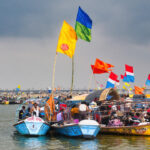
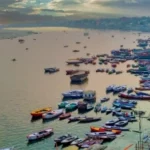
Standing at the Sangam, you can see the confluence with your own eyes. The greenish-blue Yamuna meets the murkier, clay-tinted Ganga in a visible seam of colour that stretches across the water. The line where the two rivers merge is considered one of the most potent tirthas — crossing points between the human and divine — in all of Hindu geography.
The Saraswati river, once a mighty waterway described at length in the Rigveda, is believed to have gone underground over millennia. Its invisible presence at the Sangam is not merely mythological to devout Hindus — it is a living spiritual reality. The Triveni Sangam is therefore considered trigunatmak — carrying the combined spiritual energy of all three rivers simultaneously.
Bathing at this confluence is believed to grant moksha — liberation from the cycle of birth and death. The Matsya Purana explicitly names Prayagraj as “Tirtharaj,” the king of all tirthas. No other bathing site in Hindu tradition carries this title.
Importance of Prayagraj in the Vedas and Puranas
Prayagraj’s sanctity is not a medieval invention — it is rooted in some of the oldest texts of the Hindu tradition. The Rigveda mentions the Ganga-Yamuna confluence as a place of extraordinary spiritual merit. The Mahabharata describes Prayagraj as a place where the gods themselves come to bathe. The Puranas — especially the Matsya Purana, the Padma Purana, and the Brahmanda Purana — dedicate entire sections to the glory of this city.
The Matsya Purana goes further, listing Prayagraj as one of the five most sacred places in the universe, alongside Kashi (Varanasi), Kurukshetra, Gaya, and Avantika (Ujjain). Of these, Prayagraj is named first and called the supreme among them — Tirtharaj Prayag.
The Skanda Purana contains the Prayaga Mahatmya — a dedicated text on the spiritual merits of Prayagraj. It describes the city as the very navel of the earth (prithvi nabhi), the place from which creation began and to which it will ultimately return. These are not small claims. They reflect a civilization-level conviction about the sacred geography of this place that has persisted for over three thousand years.
Kumbh Mela: Why Prayagraj Hosts the World’s Largest Gathering
The Kumbh Mela — held every twelve years at Prayagraj — is the largest peaceful gathering of human beings on Earth. During the Maha Kumbh of 2025, over 400 million pilgrims visited across the 45-day event. No stadium, no city, no single event in human history has drawn this many people to one place for one purpose.
The origin of the Kumbh Mela at Prayagraj comes from the Samudra Manthan myth — the churning of the cosmic ocean by gods and demons seeking amrita, the nectar of immortality. When the kumbh (pot) of amrita finally emerged, a celestial battle ensued. Four drops of amrita fell to earth at four locations: Prayagraj, Haridwar, Nashik, and Ujjain. These four cities now host the Kumbh Mela on a rotating cycle.
Prayagraj’s Kumbh is considered the most spiritually powerful of the four. The planetary alignment that occurs during the Prayagraj Kumbh — when Jupiter enters Taurus and the Sun and Moon are in Capricorn — is believed to supercharge the already potent Sangam waters. Bathing during the Shahi Snan (royal bath) on the main tithi dates is said to grant the equivalent of thousands of years of spiritual practice.
The scale of the Kumbh also explains much of Prayagraj’s modern infrastructure development. The city has been rebuilt and expanded in successive waves — in 2001, 2013, 2019 (Ardha Kumbh), and 2025 — with new ghats, roads, pontoon bridges, and facilities constructed each time.
Prayagraj’s Key Sacred Sites
Beyond the Sangam itself, Prayagraj is home to a cluster of religious sites that together form one of the densest concentrations of sacred geography in the Hindu world.
Akshayavat (the Immortal Banyan Tree) — Located within the premises of Prayagraj Fort, the Akshayavat is considered one of the most sacred trees in Hinduism. It is mentioned in the Mahabharata and the Puranas as indestructible — the tree that will survive even the pralaya (dissolution of the universe). Pilgrims tie sacred threads to its branches and pray for the welfare of their families. Access to the Akshayavat, previously restricted during British and Mughal rule, was fully reopened to devotees in 2019.
Patalpuri Temple — Also within the fort compound, this underground temple is one of Prayagraj’s oldest places of worship. It is believed to house a form of Lord Vishnu known as Veni Madhav. The temple’s subterranean character — you descend into the earth to enter it — is itself considered symbolic of its connection to the deepest levels of the sacred.
Mankameshwar Temple and Hanuman Mandir — The Hanuman Mandir near the Sangam is famous for housing a reclining (shayan) form of Hanuman — rare in Hindu temple iconography. The idol is believed to be self-manifested (swayambhu). During Kumbh, this temple sees some of the longest queues in the city.
Saraswati Koop — Within the Patalpuri complex, the Saraswati Koop is a well believed to be connected directly to the subterranean Saraswati river. Devotees draw water from this well for use in rituals, believing it to carry the sanctity of all three Triveni rivers.
Shri Alopi Devi Mandir — One of the 51 Shakti Peethas, the Alopi Devi Mandir holds the distinction of being the only Shakti Peetha where no idol of the goddess is installed. Instead, a wooden chariot (doli) serves as the focal point of worship — marking the spot where, according to tradition, no part of Sati’s body fell, only the bier on which her body was carried.
Pind Daan and Shraddh Rituals at Prayagraj
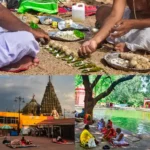
Prayagraj is not only a place of pilgrimage for the living — it is equally significant for the rites performed on behalf of the dead. The Triveni Sangam is considered one of the most powerful locations in Hindu tradition for performing Pind Daan (offering of rice balls for ancestral liberation), Tarpan (water oblations to ancestors), and Shraddh ceremonies.
According to the Puranas, performing Pind Daan at the Sangam delivers one’s ancestors directly from whatever realm they inhabit — even if they have been suffering in lower planes of existence. The combined power of three rivers amplifies the merit of any ritual performed here. This is why, after major cremations, families frequently travel to Prayagraj to immerse the ashes and perform the accompanying ancestral rites.
The Veni Daan poojan is another significant ritual unique to Prayagraj — the offering of a braid of hair at the Sangam as a mark of surrender and devotion. Women in particular perform this ritual as a form of sankalpa (sacred resolve), cutting their hair and offering it to the river as a symbol of ego dissolution.
During the Pitrupaksha fortnight (the 16-day period in the Hindu calendar dedicated to ancestral rites), the ghats of Prayagraj see thousands of families arriving daily to perform Shraddh and Tarpan. Prayagraj shares this function with Gaya (Bihar) and Varanasi, but it is considered the more accessible and equally powerful option for families from northern and central India.
Historical Importance: From Ancient Prayag to Allahabad to Prayagraj
The city’s history runs parallel to the history of the subcontinent itself. In ancient texts it was called Prayag — the place of prayaga (sacrifice). The Gupta Empire, which presided over one of the golden ages of Indian civilization (4th–6th century CE), used Prayagraj as a major administrative and cultural center. The Allahabad Pillar, a polished sandstone column erected by Ashoka around 240 BCE, still stands within the fort. Its inscriptions — added later by the Gupta emperor Samudragupta — record military campaigns across the subcontinent, effectively using Prayagraj as the symbolic centre of imperial power.
Under Akbar, the city was renamed Allahabad (City of God) in 1574, and a massive fort was constructed at the confluence point. The fort remains standing today, though much of it is under the control of the Indian Army and only partially accessible to the public. Within it sit the Akshayavat and Patalpuri Temple, which survived every change of political regime because local population resistance to their demolition was too fierce to ignore.
During the British Raj, Allahabad became the administrative capital of the United Provinces — one of the most important cities in colonial India. It housed the Allahabad High Court (established 1866), one of the oldest and most prestigious in the country, and Allahabad University (established 1887), which was called the “Oxford of the East” and produced generations of India’s political and intellectual leadership.
In November 2018, the Uttar Pradesh government officially renamed the city from Allahabad back to Prayagraj — a restoration of its ancient Sanskrit name, and one that was broadly welcomed by pilgrims and religious communities who had continued to call it Prayag informally for centuries.
Political Importance: Anand Bhavan and the Independence Movement
No account of Prayagraj’s importance would be complete without acknowledging its central role in India’s independence struggle. Anand Bhavan — the ancestral home of the Nehru family — sits in the heart of the city and served as a hub for the Indian National Congress during the freedom movement.
Motilal Nehru, one of the founding fathers of the Congress, lived here. His son Jawaharlal Nehru — India’s first Prime Minister — was born in Prayagraj and shaped much of his political philosophy in this city. The Nehru family donated Anand Bhavan to the nation in 1970; it now functions as a museum and a living monument to the independence movement. The adjacent Swaraj Bhavan, the original family home before Anand Bhavan was constructed, houses another museum.
Prayagraj also witnessed some of the most significant moments of the independence struggle: the 1920 Indian National Congress session where Gandhi’s non-cooperation movement was formally adopted, and several major civil disobedience actions organized from the city. The Allahabad High Court served as the venue for landmark legal battles over civil rights during colonial rule.
Prayagraj as the Gateway to the UP Spiritual Triangle
One of the most underappreciated aspects of the importance of Prayagraj is its position as the entry point to one of the richest spiritual circuits in India. Within a 150-kilometre radius of Prayagraj lie Ayodhya (the birthplace of Lord Ram) and Varanasi (the eternal city of Lord Shiva) — forming what travel planners and pilgrims alike call the Uttar Pradesh spiritual triangle.
Prayagraj sits geographically between the two, making it the natural base for any multi-city pilgrimage through this region. From Prayagraj, Ayodhya is approximately 160 kilometres (around 3 hours by road), and Varanasi is around 120 kilometres (roughly 2.5 hours). This proximity makes Prayagraj the default staging point for pilgrims combining visits to all three cities.
The Prayagraj-Ayodhya-Varanasi tour package is one of the most popular pilgrimage itineraries in North India, and for good reason. Each city anchors a distinct aspect of Hindu devotion: Prayagraj for the ancestral and purificatory rites at the Sangam, Ayodhya for Ram bhakti, and Varanasi for Shiva darshan and the Ganga aarti at Dashashwamedh Ghat.
Many pilgrims also extend this circuit to include Chitrakoot (where Ram, Sita, and Lakshmana spent the first part of their 14-year exile) and Vindhyachal (seat of the goddess Vindhyavasini), both within easy reach of Prayagraj.
Educational and Institutional Legacy
Beyond its religious and political roles, Prayagraj has long been one of India’s foremost centers of learning. Allahabad University, founded in 1887, was for much of the 20th century considered one of the four elite universities in India alongside Calcutta, Bombay, and Madras. Its alumni include multiple Prime Ministers, Supreme Court judges, and figures who shaped modern India’s institutions.
The Allahabad High Court is the largest high court in India by number of judges and handles one of the heaviest judicial caseloads in the country. Its influence on Indian law and jurisprudence over 150 years cannot be understated.
The city is also home to prominent institutions including the Motilal Nehru National Institute of Technology (MNNIT), the Indian Institute of Information Technology Allahabad (IIIT-A), and the Central Institute of Higher Tibetan Studies. This combination of ancient spiritual authority and modern institutional strength makes Prayagraj unusual among Indian cities — it is simultaneously among the most ancient and among the most academically credentialed.
Modern Prayagraj: Infrastructure, Connectivity, and Tourism
The city’s transformation in the years leading up to Maha Kumbh 2025 has been dramatic. The Uttar Pradesh government invested over ₹7,500 crore in Prayagraj’s infrastructure between 2019 and 2025, covering road widening, new flyovers, upgraded railway stations, expanded Prayagraj Airport (now an international-capable terminal), new ghats along the Sangam, and an entirely rebuilt mela ground capable of housing tens of millions of pilgrims.
Prayagraj Junction is now one of the busiest railway hubs in Uttar Pradesh, with direct connectivity to Delhi, Mumbai, Kolkata, Patna, Varanasi, Lucknow, and most major cities. The Yamuna Expressway connects Prayagraj to Agra and Delhi, and the Purvanchal Expressway links it eastward toward Varanasi and beyond.
Hotel and accommodation capacity has expanded significantly, with major chains establishing properties in the city alongside a large established network of dharamshalas, ashrams, and budget lodges catering to pilgrims at every price point. The city’s hospitality infrastructure, long considered its weakest point, has been substantially modernised.
For visitors planning to explore what Prayagraj has to offer, the city rewards time spent beyond just the Sangam. The Civil Lines area retains its colonial-era character with wide tree-lined roads and heritage buildings. The old city around Daraganj and Mirghat is dense with ancient temples, narrow lanes, and the kind of street-level religious life that has not changed in centuries. Those who want a more curated introduction should consider discovering Prayagraj’s wonders through a structured city tour before exploring independently.
Why Prayagraj Endures
Cities are usually defined by one thing — a natural harbour, a trade route, a military position. Prayagraj is defined by many things simultaneously: sacred geography, scriptural authority, historical consequence, institutional prestige, and modern connectivity. That combination — more than any single factor — explains why it has remained continuously relevant for over three millennia.
The Kumbh Mela will return. Families will continue to bring their departed elders’ ashes to the Sangam. Students will sit their civil service exams at Allahabad University. Pilgrims will file past the Akshayavat. And the Ganga and Yamuna will continue their visible, ancient, daily confluence at the point where the invisible Saraswati is forever said to arrive.
Prayagraj does not ask to be understood. It only asks to be visited.
Frequently Asked Questions About the Importance of Prayagraj
Why is Prayagraj called Tirtharaj?
Prayagraj is called Tirtharaj — meaning “king of all tirthas” — because it sits at the confluence of three sacred rivers (Ganga, Yamuna, and the invisible Saraswati) and is described in the Matsya Purana as the most spiritually powerful bathing site in the Hindu universe. No other tirtha carries this specific title in the primary scriptures.
Why is the Kumbh Mela held at Prayagraj?
According to Hindu tradition, a drop of amrita (the nectar of immortality produced during the Samudra Manthan) fell at Prayagraj during a celestial battle between gods and demons. The Kumbh Mela is held here every 12 years — during a specific planetary alignment involving Jupiter, the Sun, and the Moon — when the Sangam waters are believed to be at their most potent. Of the four Kumbh Mela cities, Prayagraj hosts the Maha Kumbh (the grandest cycle) every 144 years.
What is the significance of Pind Daan at Prayagraj?
Performing Pind Daan at Prayagraj’s Triveni Sangam is considered exceptionally meritorious in Hindu tradition. The Puranas state that ancestral rites performed at the Sangam free the departed soul from suffering in any lower realm and help them attain moksha. The combined sanctity of three rivers at the Sangam amplifies the ritual’s spiritual impact beyond what is possible at most other locations. Families typically perform Pind Daan here after a death in the family, during Pitrupaksha, or on the death anniversary (tithi) of a relative.
When was Allahabad renamed to Prayagraj?
The Uttar Pradesh state cabinet passed the resolution to rename Allahabad to Prayagraj on October 16, 2018. The renaming was made official shortly after. The name “Allahabad” had been given by the Mughal emperor Akbar in 1574 when he established a fort at the confluence. The city’s ancient Sanskrit name — Prayag or Prayagraj — had remained in continuous informal use among pilgrims and religious communities throughout the Mughal and British periods.
Is the Saraswati river at Prayagraj real?
The Saraswati is described extensively in the Rigveda as a mighty river in northwestern India. Most historical geographers and archaeologists believe the ancient Saraswati corresponded to the Ghaggar-Hakra river system, which dried up between 1900 and 1500 BCE due to tectonic shifts and climate change. Whether a subterranean channel continues to flow beneath Prayagraj and join the Ganga-Yamuna confluence is a matter of faith and ongoing geological interest. For Hindu pilgrims, the Saraswati’s presence at the Sangam is a spiritual reality that has been affirmed in scripture and tradition for over three thousand years, regardless of the physical evidence.