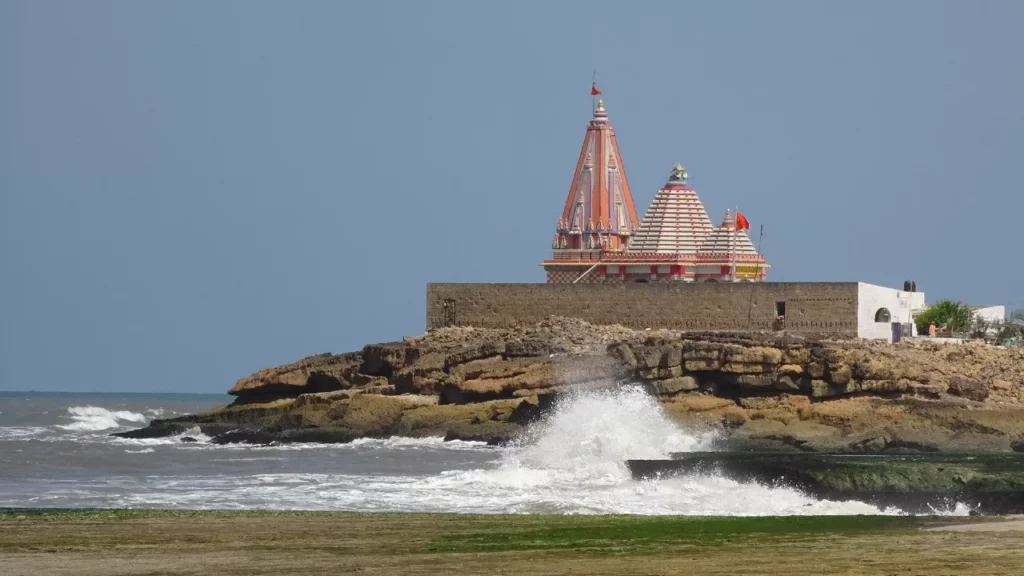
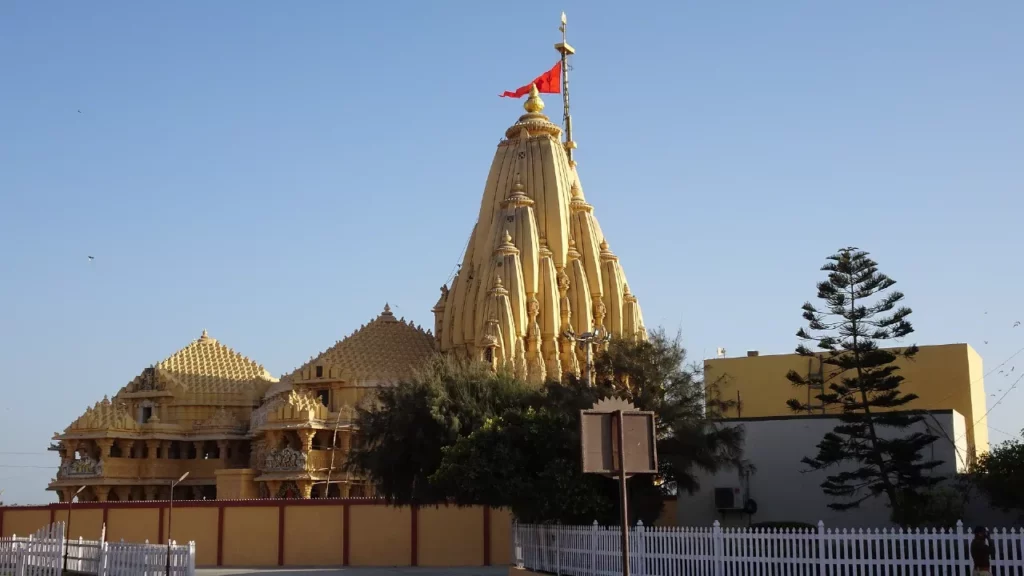
Somnath Temple on the southwestern coast of Gujarat stands at a place where the Arabian Sea meets one of the most ancient traditions of Shiva worship in the world. It is the first of the twelve Jyotirlingas — the self-luminous manifestations of Lord Shiva that are considered the most sacred Shiva shrines on earth — and its history spans more than two thousand years of devotion, destruction, and defiant rebuilding. No other temple in India has been destroyed and rebuilt as many times as Somnath, and no other temple embodies the resilience of Hindu faith quite as vividly.
The First Jyotirlinga: What That Means
The Jyotirlinga tradition holds that Lord Shiva, to end a dispute between Brahma and Vishnu about who was supreme, manifested as an infinite column of light (Jyoti) that had no beginning and no end. Twelve points where this column of light touched the earth became the Jyotirlingas — places where Shiva’s presence is believed to be self-manifest (Swayambhu) and therefore inexhaustible. The Shiva Purana lists all twelve: Somnath, Mallikarjuna, Mahakaleshwar, Omkareshwar, Kedarnath, Bhimashankar, Kashi Vishwanath, Tryambakeshwar, Vaidyanath, Nageshwar, Rameshwaram (Ramanathaswamy), and Grishneshwar.
Somnath holds the position of the first among these twelve, giving it a symbolic primacy in the Jyotirlinga tradition. Pilgrims who undertake the complete circuit of all twelve Jyotirlingas — a journey that covers Gujarat, Maharashtra, Uttarakhand, Jharkhand, Uttar Pradesh, and Tamil Nadu — conventionally begin at Somnath.
A History of Seventeen Destructions and Rebuildings
Somnath has been destroyed an extraordinary number of times — historical accounts cite seventeen destructions, though some of these are more comprehensively documented than others. The most famous destructions were carried out by Mahmud of Ghazni in 1025 CE, who looted the temple’s legendary wealth and broke the Jyotirlinga, and by Alauddin Khalji’s general Ulugh Khan in 1299 CE. Further destructions came under Muzaffar Shah in 1395 CE, Mahmud Begada of Gujarat in 1451 CE, and Aurangzeb in 1706 CE, who demolished a temple that had been rebuilt by Maratha queen Ahilyabai Holkar’s contemporary, and in earlier periods by Shivaji’s associates.
Each time the temple was destroyed, it was rebuilt — by local rulers, by devotees, by the queens of the Maratha empires. This cycle of destruction and reconstruction became a defining narrative of the temple’s identity. It also explains why the current temple structure dates only to 1951 CE, while the sanctity of the site extends back at least two thousand years.
The 1951 Reconstruction: Sardar Patel’s Vision
The most recent and current temple was built through the vision and determination of Sardar Vallabhbhai Patel, India’s first Home Minister and the man responsible for integrating more than five hundred princely states into the Indian Union. Patel visited Somnath in November 1947 — just four months after Independence — and publicly committed to the temple’s reconstruction on behalf of the Indian government, seeing it as a symbol of India’s cultural renaissance after colonial rule.
K.M. Munshi, another senior figure in the post-Independence government, was the primary architect of the reconstruction project. Construction began in earnest in 1950, and the temple was consecrated on 11 May 1951 by President Rajendra Prasad. The reconstruction was significant enough that Prime Minister Nehru noted his personal reservations about government involvement in temple construction — a political debate that reflected the larger conversation about India’s secular identity. Despite this, the temple was built and has been a centre of active pilgrimage ever since.
Architecture: Chalukya Style on the Arabian Sea
The current temple is built in the Chalukya (also called Solanki) architectural style — the same tradition responsible for the magnificent temples at Modhera and Mount Abu in Gujarat. The style is characterised by intricate stone carving, a tall shikhara that tapers in a gentle curve to a crowned top, and projecting balconies (jhharokas) with perforated stone screens. The temple faces west, toward the sea, which is architecturally and symbolically significant — the shikhara is visible from the water, and the sea breeze is a constant presence on the temple premises.
The Jyotirlinga in the sanctum sanctorum is housed in a chamber that is deliberately austere, directing all attention to the Linga itself. The surrounding walls of the temple are decorated with carvings of deities, celestial beings, and scenes from Puranic narratives.
The Triveni Sangam and Sound and Light Show
At the base of the Somnath complex, three rivers meet the Arabian Sea — the Hiran, Kapila, and the underground Saraswati. This confluence is called the Triveni Sangam of Somnath and is considered a site of high ritual merit for bathing and for performing the last rites (Asthi Visarjan) for deceased family members. The area around the Sangam also contains the ruins of older temple structures, which have been preserved as part of the site’s archaeological heritage.
Every evening after sunset, a Sound and Light Show is held at the Somnath complex, narrating the temple’s history of destruction and rebuilding against the backdrop of the sea and the lit temple. This has become one of the most popular experiences for visitors to Somnath, particularly for those who want to understand the full historical arc of the site.
Practical Information for Pilgrims
Somnath Temple is located in Prabhas Patan, Veraval taluka, Gir Somnath district, Gujarat — approximately 7 km from Veraval railway station and about 80 km from Junagadh. The nearest airport is at Diu (approximately 80 km) or at Rajkot (approximately 200 km). The temple is open from 6:00 AM to 9:30 PM, with three aarti sessions — Mangala aarti at 7:00 AM, Madhyahna (midday) aarti at 12:00 PM, and Sandhya (evening) aarti at 7:00 PM. The Sandhya aarti, performed as darkness falls and the sea glimmers beyond the temple walls, is particularly atmospheric.
Photography inside the sanctum is not permitted. The temple authorities have created a well-organised pilgrim facility with prasad counters, a museum, and locker facilities for belongings. Accommodation is available in the temple trust’s dharamshala, as well as in private hotels in Veraval town.
For those planning a pilgrimage across India’s sacred sites, read our guide to India’s top temples for context on the Jyotirlinga tradition. Explore our pilgrimage destinations guide for other major shrines covered on our platform. Also see our tour packages for curated pilgrimage itineraries across India.