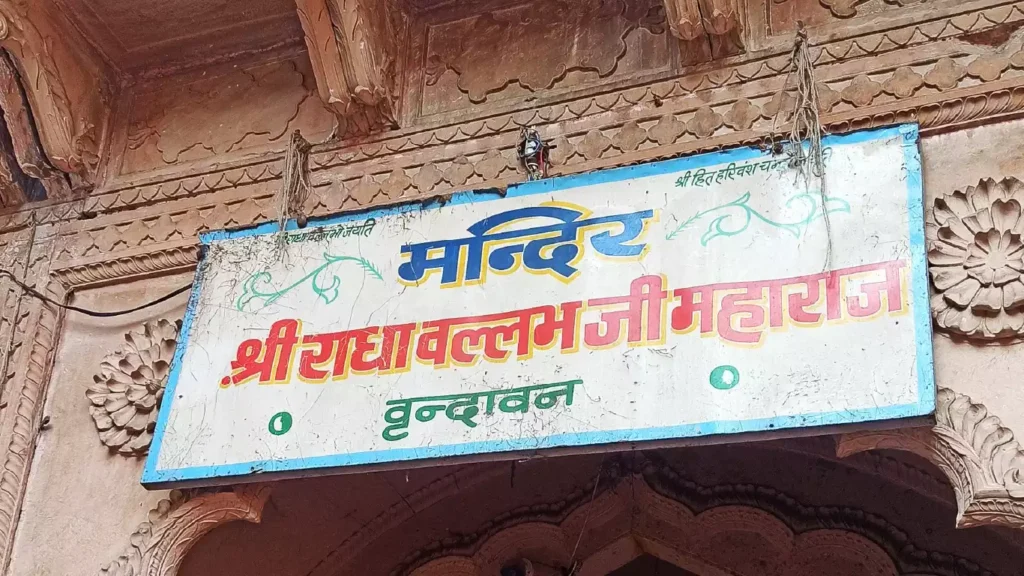
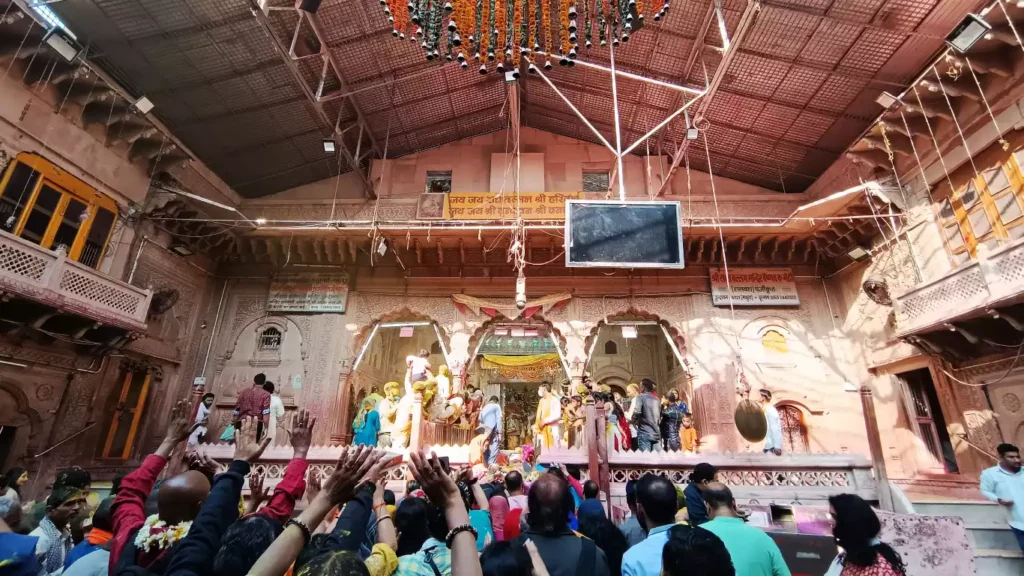
The Radha Vallabh Temple in Vrindavan is one of the most architecturally distinctive and theologically fascinating temples in the entire Braj region. Founded in 1585 by Goswami Hit Harivansh Mahaprabhu — the founder of the Radhavallabha sampradaya, one of Vrindavan’s principal devotional traditions — this temple is unusual in multiple ways. It is built of red sandstone at a time when such material was the preserve of Mughal imperial architecture. Its theology places Radha Rani at the absolute summit of devotion, above even Krishna. And yet, like the Radha Raman Temple, it houses no separate murti of Radha — only the solitary form of Krishna-Radha Vallabh, with a crown placed beside him to indicate Radha’s presence.
Goswami Hit Harivansh Mahaprabhu and the Radhavallabha Sampradaya
Hit Harivansh Mahaprabhu (1502-1552) was born in Devband, Uttar Pradesh, and from early childhood displayed an intensity of devotion to Radha Rani that distinguished him even among the great saints of his era. He came to Vrindavan and established his own sampradaya (devotional lineage) centred on a radical Radha-first theology: in the Radhavallabha tradition, Radha Rani is not a consort or complement to Krishna but the supreme original deity, the source of all love, all beauty, and all devotion. Krishna himself is understood as Radha Vallabh — “beloved of Radha” — and his primary identity is as the one who serves and delights Radha, rather than the other way around.
This theological position — unprecedented in its directness even within the Braj Vaishnava world — gave the Radhavallabha sampradaya a distinctive flavour of pure, feminine devotion. The tradition’s poetry, particularly Hit Chaurasi (Hit Harivansh’s 84 devotional verses in Braj Bhasha), is regarded as among the most exquisite expressions of Radha-centred love in Indian literature.
The temple’s construction was completed with the support of Sundardas Bhatnagar, who received a royal firman (decree) from the Mughal Emperor Akbar granting permission for its construction. This imperial sanction during a period of otherwise tense Hindu-Muslim relations reflects Akbar’s well-documented policy of religious tolerance and his personal interest in devotional traditions. The Akbar-era firman is still part of the temple’s documented history.
Architecture: Red Sandstone and Royal Proportions
The Radha Vallabh Temple is a striking departure from the typical white marble or pale sandstone temples of Vrindavan. Built primarily of red sandstone — the material of choice for Mughal forts and palaces at Agra, Fatehpur Sikri, and Delhi — the temple has a certain monumental gravity that reflects its Akbar-era construction. The walls are reportedly 10 feet thick in places, giving the structure a fortified quality unusual in a place of worship. Some accounts note that the outer walls were deliberately built twice-pierced — a structural technique intended to provide both thermal insulation and acoustic resonance during kirtan performances.
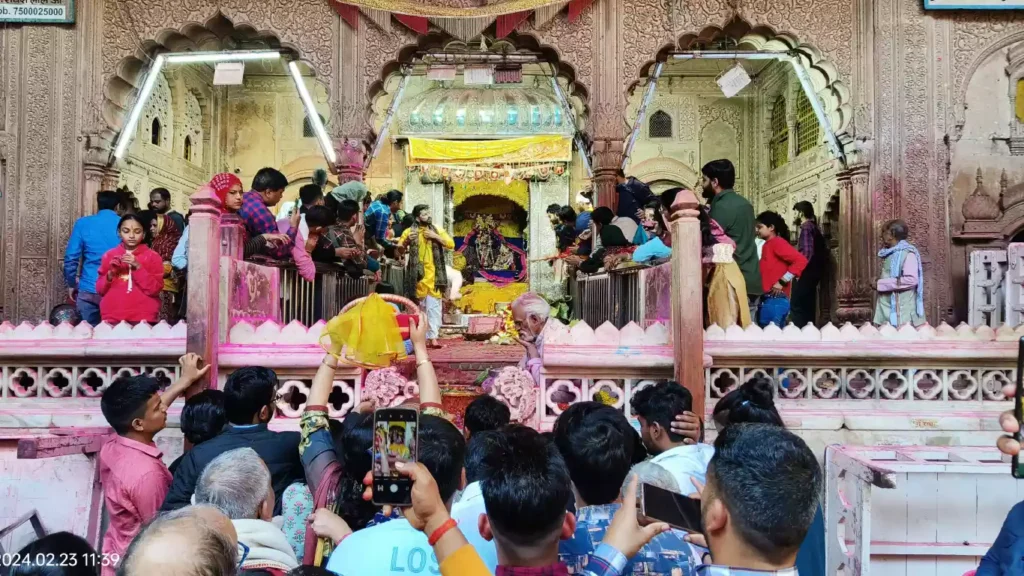
The entrance gateway is particularly imposing, with deeply carved sandstone panels depicting foliate and geometric patterns that show clear Mughal stylistic influence alongside distinctly Vaishnava iconography — a physical embodiment of the cross-cultural dialogue of the period. The inner courtyard is large and open, with a shaded veranda running around its perimeter where devotees traditionally sit for extended periods of kirtan and scriptural recitation.
The temple’s setting on a slight elevation on the Yamuna side of old Vrindavan gives it a commanding position. Local tradition holds that Hit Harivansh Mahaprabhu himself chose the location on the instructions of Lord Shiva, who appeared to him in a vision and directed him to place the Radha Vallabh idol on the high bank above the Yamuna.
The Deity: Radha Vallabh and the Symbolic Crown
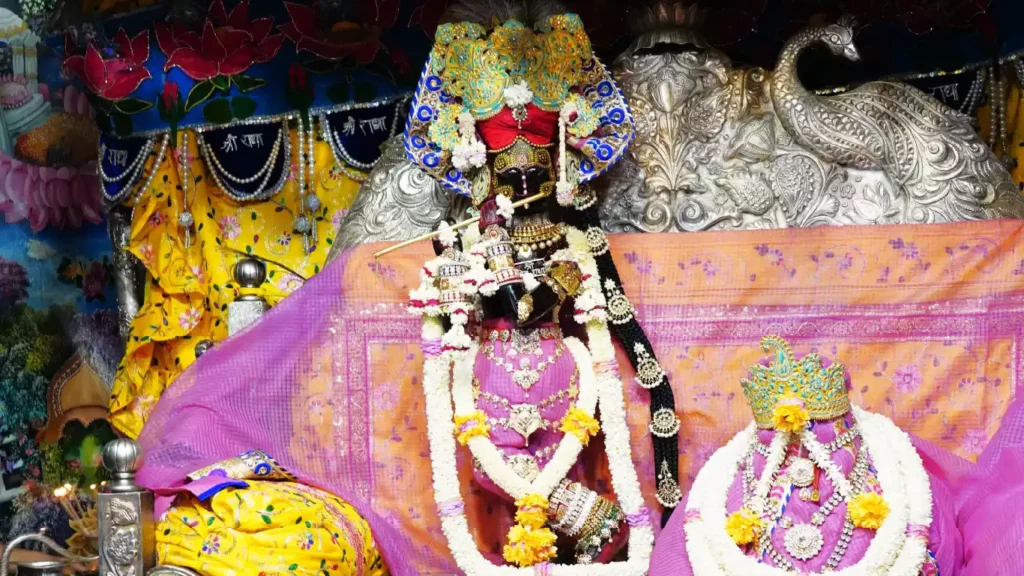
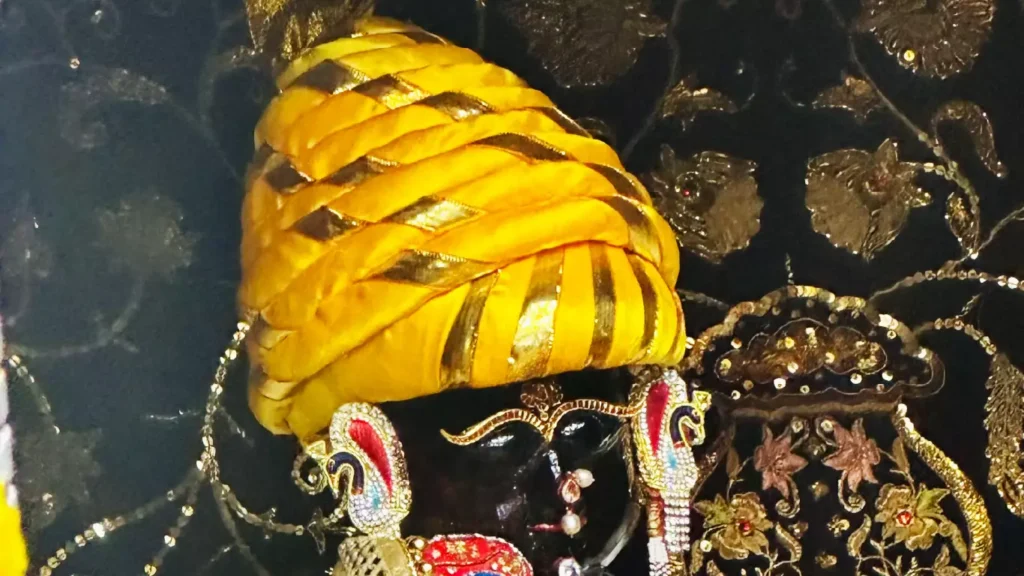
The presiding deity, Shri Radha Vallabh, is a beautiful black stone murti of Krishna, standing in the characteristic three-bend (tribhanga) posture with a flute at his lips. To his left, a jewelled crown sits on a decorative cushion — this is Radha Rani’s crown, her symbolic presence beside Radha Vallabh. The tradition holds that Radha’s presence is so complete and encompassing that a separate murti would be inadequate to contain her; the crown, being something that rests on one’s beloved, expresses proximity and intimacy more truly than any carved image could.
The deity’s daily shringar (ritual ornamentation) is performed with exceptional care, with the costume and ornaments changing completely at each darshan period. The Radhavallabha tradition places particular emphasis on the aesthetic quality of worship — flowers, fragrances, fabrics, and music are all curated with an eye to creating an environment of extraordinary beauty for the divine couple.
Worship Tradition and the Seva Tradition
The Radhavallabha sampradaya is particularly celebrated for its kirtan tradition. The style of bhajan (devotional singing) that developed at Radha Vallabh Temple — known as Rasiya or Braj Bhasha kirtan — is characterised by a melodic intimacy and lyrical tenderness that distinguishes it from the energetic congregational kirtan of other sampradayas. Listening to a traditional Radhavallabha kirtan in the temple courtyard is an experience in itself, quite different from the drum-driven kirtans at ISKCON or the classical melodies of the Nathdwara tradition.
The temple remains active today under the care of the Radhavallabha Sampradaya trust, with resident priests maintaining the daily schedule of eight seva periods from pre-dawn to late evening.
Visiting Radha Vallabh Temple
The temple is located in the older part of Vrindavan, near the Yamuna embankment, roughly 2.5 km from Vrindavan Railway Station. It is accessible by e-rickshaw from the main bazaar (₹20-30, 10 minutes) or on foot if you are doing the Vrindavan parikrama. The temple opens in the early morning and follows the traditional Vaishnava schedule with a midday closure. Entry is free. Photography inside the main sanctum is not permitted, but the courtyard and gateway are accessible for photography.
To explore Vrindavan’s full range of sacred sites — from the ancient Thakurs to the modern Prem Mandir — visit our Vrindavan teerth-sthal guide. You can visit Radha Vallabh Temple as part of a comprehensive Braj pilgrimage on our Mathura-Vrindavan 4N/5D tour package, which covers the city’s most significant temples across both sampradaya traditions.