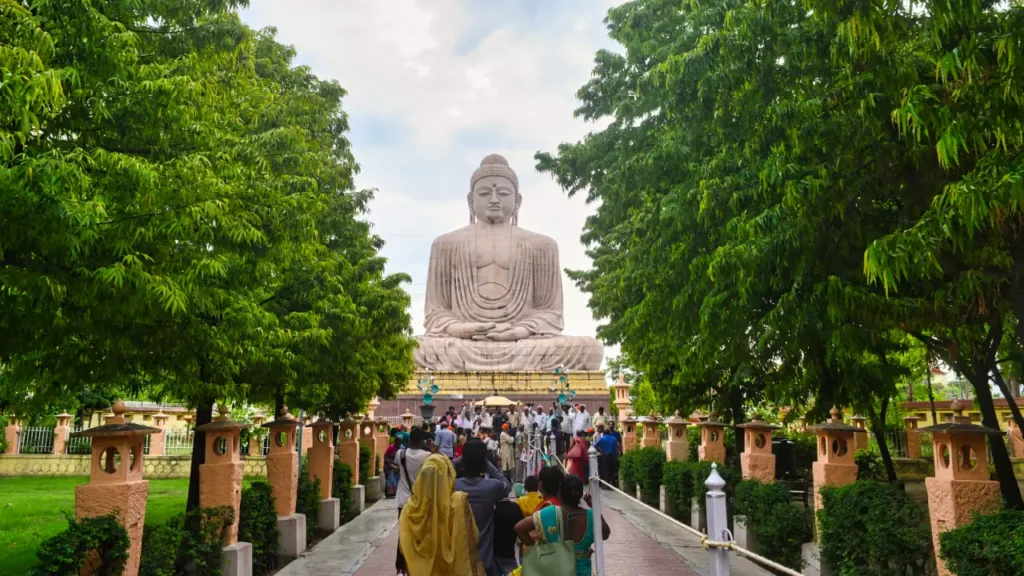
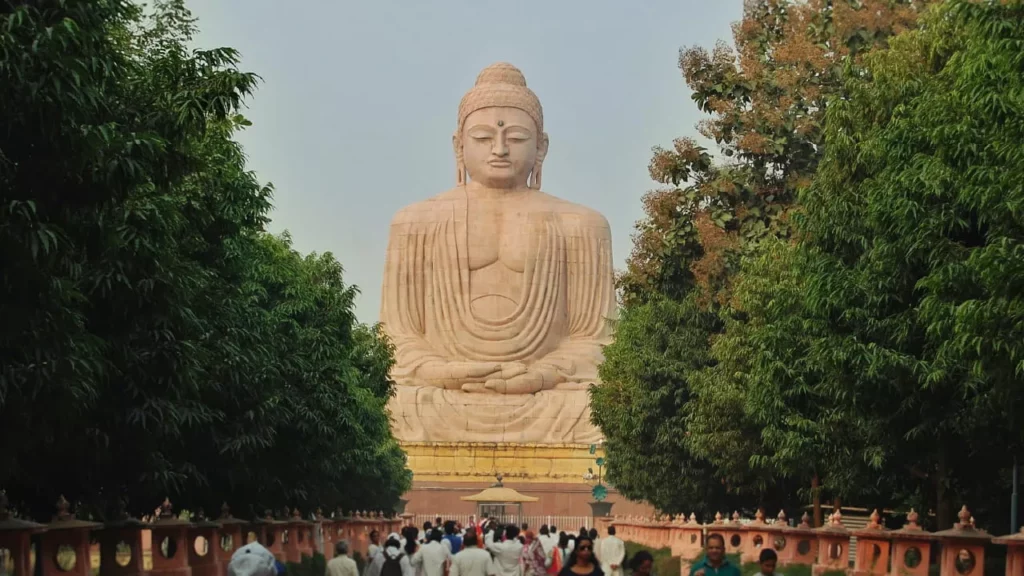
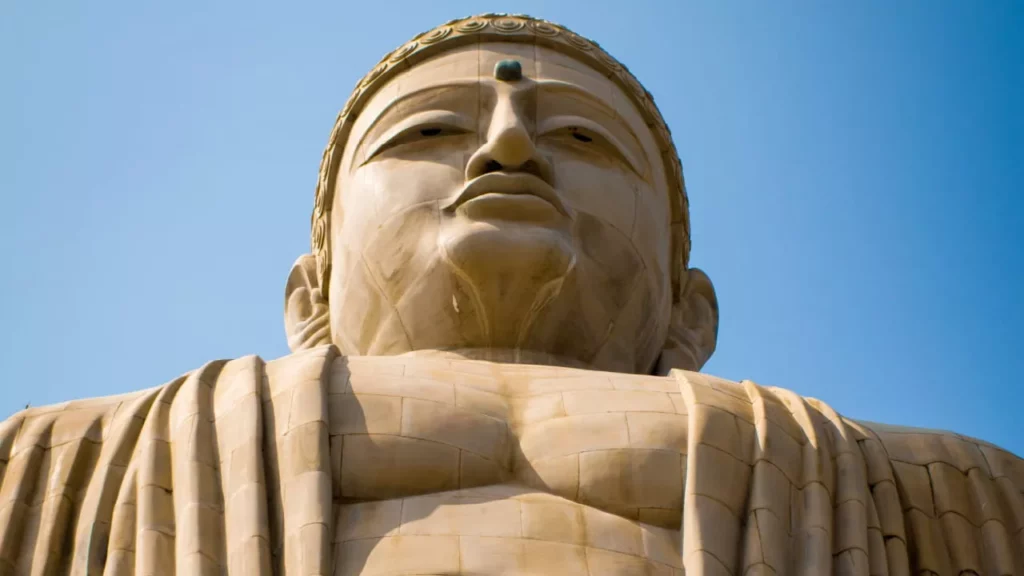
The Great Buddha Statue stands 25 metres tall in the heart of Bodh Gaya, Bihar — a towering presence in sandstone and red granite that has drawn pilgrims, meditators, and curious travellers since it was consecrated in 1989. Situated 1.5 km from the Mahabodhi Temple and roughly 1 km from Bodhgaya Bus Station, this is the first large-scale Buddha statue ever built in India, and it remains one of the most recognisable landmarks on the entire Buddhist Circuit.
History and Construction
The project was conceived in the early 1980s by a group of Japanese and Indian Buddhist organisations who wanted a permanent monument that would anchor Bodh Gaya as a global centre of Buddhist pilgrimage. Construction began in 1982, using Chunar sandstone — the same fine-grained stone used by Emperor Ashoka to erect his famous pillars across the subcontinent. The statue depicts the Gautama Buddha seated in the dhyana mudra (meditation posture) on a fully-bloomed lotus, an iconographic choice that reinforces Bodh Gaya’s identity as the place where the historical Buddha attained enlightenment.
The XIV Dalai Lama, Tenzin Gyatso, formally dedicated the statue on November 18, 1989, attended by monks, lay practitioners, and dignitaries from across the Buddhist world. The dedication drew international attention to Bodh Gaya at a time when the site was still developing its modern infrastructure for pilgrimage.
What the Statue Contains
One of the lesser-known facts about the Great Buddha Statue is that it is not solid. Inside the statue, workers placed approximately 20,000 smaller metal Buddha figurines during construction — a traditional consecration technique used in several Buddhist cultures to imbue a major statue with spiritual merit. Some of these inner figures are hollow themselves, creating a layered sanctity that practitioners consider deeply auspicious.
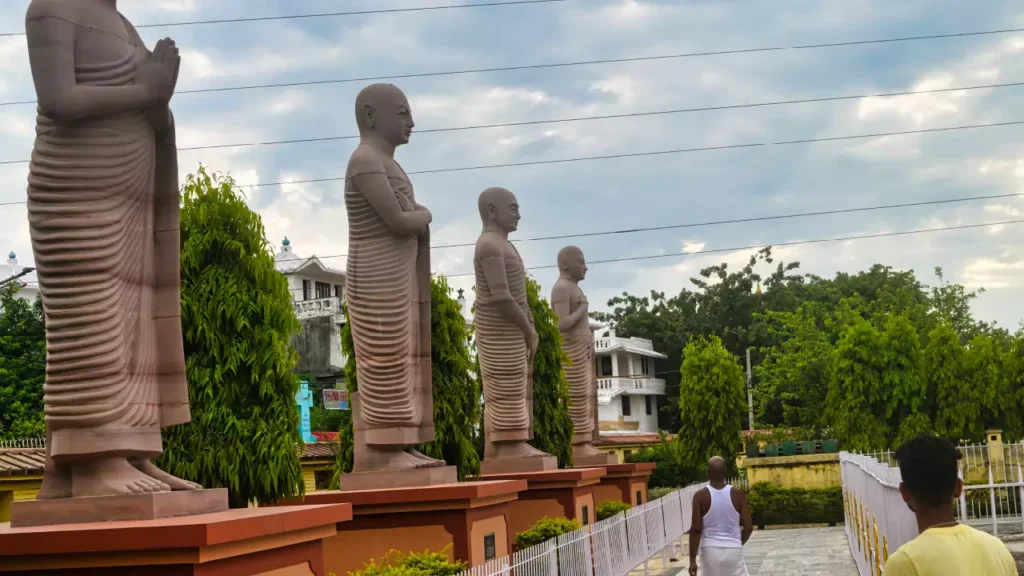
Surrounding the main statue are ten life-size standing figures, each carved from the same Chunar sandstone. These represent the ten most prominent disciples of the historical Buddha, installed in two phases. Sariputta and Mahamoggallana, considered the two chief disciples, were dedicated in 1993. The remaining eight — Mahakassapa, Subhuti, Punna, Mahakaccana, Anuruddha, Upali, Rahula, and Ananda — followed in 1996. Together, the central statue and its surrounding figures form a complete tableau of the Buddha’s inner circle, giving the site a narrative and devotional depth that a single statue alone cannot provide.
The Daijokyo Buddhist Temple Nearby
Just adjacent to the Great Buddha Statue is the Daijokyo Buddhist Temple, established by the Japanese Daijokyo sect. This temple houses several significant iconographic elements, including a central figure of the Eternal Shakyamuni Buddha flanked by four great Bodhisattvas from the Lotus Sutra: Visistacaritra, Anantacaritra, Visuddhacaritra, and Supratisthitacaritra. The temple also displays a collection of Daijokyo religious paintings that trace key doctrinal teachings. For anyone with a serious interest in Mahayana Buddhism, the Daijokyo temple is worth at least an hour of unhurried exploration.
Meditation and Atmosphere
The grounds around the statue are kept deliberately quiet. Visitors are asked to maintain silence in the immediate vicinity of the main figure, and early morning — between 6 and 8 AM — is when the atmosphere is most conducive to meditation. Small groups of monks from the nearby monasteries often gather here at dawn for brief chanting sessions. The stone benches placed around the perimeter allow visitors to sit in contemplation facing the statue, and on clear winter mornings the light across the sandstone takes on a golden quality that is genuinely difficult to describe.
Visiting Information
- Location: 1.5 km south of Mahabodhi Temple, near Bodhgaya Bus Stand
- Timings: Open daily, approximately 7:00 AM to 6:00 PM
- Entry: No entry fee for the statue grounds; a modest charge may apply for the Daijokyo temple adjacent to it
- Dress code: Modest clothing is expected; remove footwear before entering the inner compound
- Photography: Permitted in the outer grounds; restricted inside the adjacent temple
- Best time to visit: October to March, when temperatures in Bodh Gaya are between 10°C and 28°C
Getting There
From Gaya Junction railway station, the statue is about 13 km by road. Auto-rickshaws and taxis are available at the station and typically charge Rs. 200–300 for a one-way trip to Bodh Gaya. Once in Bodh Gaya, the statue is within easy walking distance of the Mahabodhi Temple. E-rickshaws operate within the town and are a convenient option for moving between sites.
If you are planning a broader pilgrimage that combines Bodh Gaya with Gaya’s ancestral rites, our Gaya Pind Daan tour package covers both destinations in a structured itinerary. For a deeper orientation to Bodh Gaya’s geography, history, and practical logistics, the Bodh Gaya travel guide is the right starting point.
Significance Within the Buddhist Circuit
The Great Buddha Statue is one of several anchor points on India’s Buddhist Circuit, a trail that connects Lumbini (Nepal), Bodh Gaya, Sarnath, Kushinagar, and several other sites associated with the life of the historical Buddha. Within Bodh Gaya itself, the statue serves as a secondary focal point after the Mahabodhi Temple — it receives visitors who have already completed their prayers at the Bodhi Tree and want to spend more time in contemplation without the density of crowds that gathers around the UNESCO World Heritage site.
For pilgrims combining the Buddhist Circuit with Gaya’s Hindu pilgrimage traditions — particularly those performing Pind Daan for their ancestors — the statue is typically visited on the first afternoon after arrival, before the more ritually demanding activities at Vishnupad Temple and Phalguni Ghat begin the following morning.