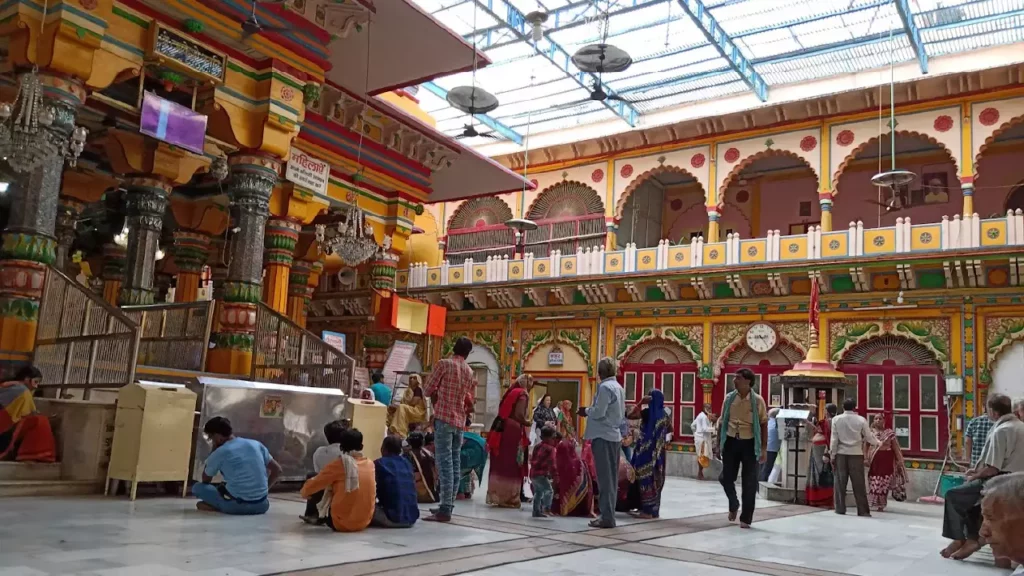
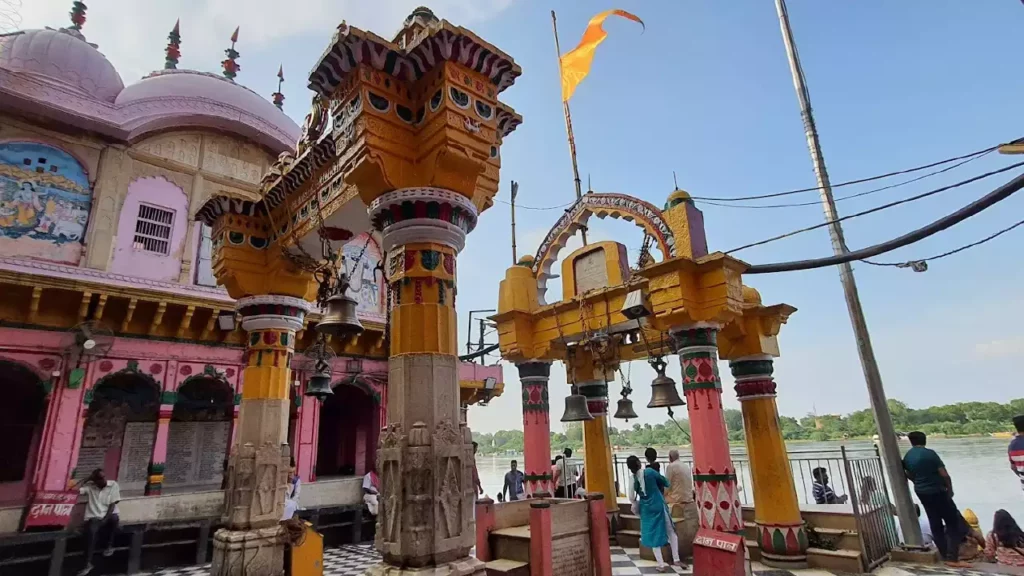
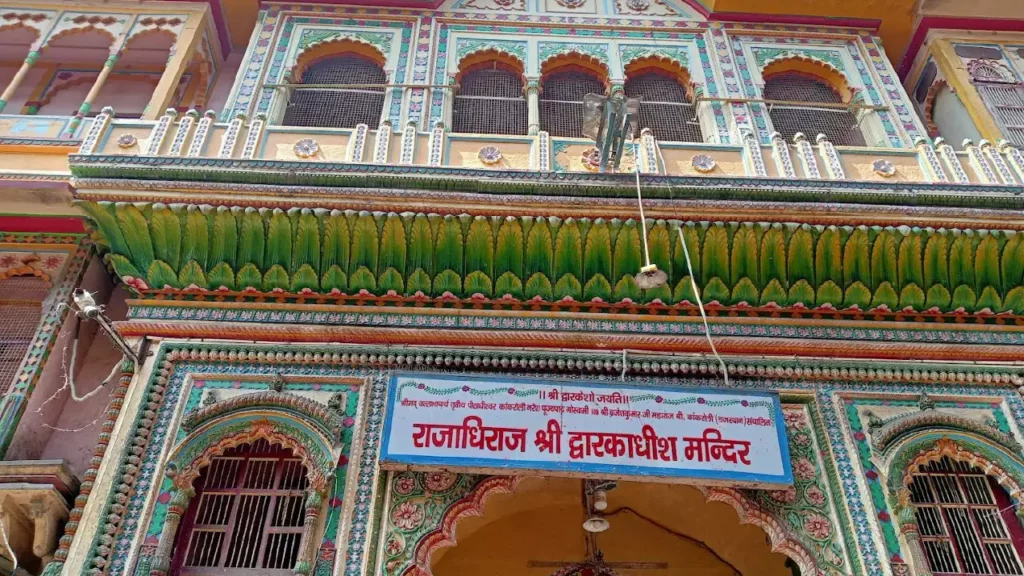
The Dwarkadhish Temple in Mathura is one of the most celebrated Vaishnava shrines in all of Braj. Dedicated to Lord Krishna in his majestic form as Dwarkadhish — the King of Dwarka — this temple draws hundreds of thousands of pilgrims each year. Founded in 1814 by the philanthropist Seth Gokuldas Parikh, a treasurer under the Gwalior State, the temple was completed within a few decades and consecrated as a grand landmark of Braj devotion. Whether you arrive during the riotous celebrations of Holi or the serene quiet of a morning aarti, the Dwarkadhish Temple leaves an impression that stays long after you leave Mathura.
History and Foundation
Seth Gokuldas Parikh commissioned the temple in 1814 as an act of deep personal devotion. The construction drew on the combined artistic traditions of Rajasthan and Gujarat, and the result is a structure that feels distinctly regal — fitting for a temple honouring the King of Dwarka. The presiding deity, Dwarkadhish, is carved from black marble (kala pathar) and stands adorned with elaborate shringar (ritual ornamentation) that changes with every festival and season. The image is attended to with great care throughout the day, with multiple darshan slots and aartis that have continued unbroken for over two centuries.
The temple was built adjacent to the Vishram Ghat on the Yamuna, a spot considered particularly sacred because tradition holds that Lord Krishna rested here after slaying the demon Kansa. This proximity to the river and the ghat gives the entire precinct an atmosphere of layered sanctity — pilgrims can take a ritual bath in the Yamuna and proceed directly to the temple for darshan.
Architecture and Artistic Details
Approaching the Dwarkadhish Temple, the first thing you notice is the shikhara — the towering spire that rises above the roofline of the surrounding bazaar lanes. The shikhara is built in the Rajasthani nagara style, with intricately carved sandstone tiers that diminish as they rise. The exterior walls are adorned with panels depicting scenes from Krishna’s life: his birth in the prison of Kansa, the butter-stealing exploits of his Vrindavan childhood, and the grand episodes of the Mahabharata in which he served as Arjuna’s charioteer.
Inside the mandapa (the pillared hall before the sanctum), the ceiling is painted with detailed depictions of Vishnu’s dashavataras (ten incarnations). The floor is cool polished marble. Devotees sit cross-legged during aarti, and the space fills quickly on festival days. The garbhagriha (inner sanctum) is comparatively small but intensely charged — the black marble Dwarkadhish idol, resplendent in gold and silk, seems to absorb and return every lamp that flickers before it.
The swing festival (Jhulan Yatra) is observed with particular grandeur here: the idol is placed on an ornate silver swing and garlanded elaborately as bhajans ring through the halls. If you are planning a visit specifically for a festival, Jhulan Yatra (usually in July or August), Janmashtami, and Holi are the three occasions when the temple reaches its full ritual intensity.
Daily Darshan and Aarti Schedule
The temple follows a rigorous daily schedule of shringara (dressing), bhog (food offerings), and aarti. The mangala aarti takes place before sunrise, and the temple thereafter cycles through five additional darshan periods through the day, closing for a midday rest before reopening in the afternoon. The sandhya aarti at dusk is particularly beautiful — the inner sanctum is lit entirely by ghee lamps and the sound of conch shells and cymbals carries into the lane outside.
Photography inside the sanctum is not permitted, though the outer courtyard and mandapa are usually accessible. Dress modestly: men should cover their shoulders and women should wear a saree, salwar, or any full-coverage attire. Footwear must be left at the entrance.
The Significance of Dwarkadhish in Braj Theology
In Braj Vaishnavism, the name Dwarkadhish marks a specific lila (divine play) of Krishna — his later life as king and householder after leaving Vrindavan. The temple thus holds a particular emotional weight: it celebrates not the playful cowherd boy of Braj, but the same Krishna grown into a sovereign figure, radiating both majesty and compassion. Many pilgrims who complete the Braj parikrama (the 84-kos circumambulation of the sacred region) include Dwarkadhish Temple as a culminating darshan, seeing it as a bridge between Krishna’s pastoral youth and his kingly maturity.
The temple is also one of the four principal Dhams of Mathura city, the others being Kesava Deva (Janambhoomi), Ranganatha Temple, and Birla Mandir. Together they form the backbone of the Mathura pilgrimage circuit that most devotees cover in a single day.
Getting There and Practical Tips
The Dwarkadhish Temple sits in the old city of Mathura, roughly 500 metres from Vishram Ghat. From Mathura Junction Railway Station, the temple is about 2 km by auto-rickshaw (15-20 minutes, roughly ₹50-80). Parking near the temple is limited; if you are arriving by private vehicle, park near Vishram Ghat and walk. The lanes leading to the temple are lined with flower sellers, garland stalls, and prasad shops — it is customary to carry an offering of tulsi, marigold, and peda (a sweet native to Mathura) for the deity.
The temple precinct can become extremely crowded on Ekadashi, Janmashtami, and Holi. If crowds are a concern, the early morning mangala aarti window (around 5:30 AM) offers a quieter, more contemplative darshan. Entry is free; no donation is required though donation counters are present.
To visit Dwarkadhish Temple as part of a structured pilgrimage, see our complete Mathura travel guide covering all major ghats, temples, and logistics. You can also book a guided tour through our Mathura-Vrindavan 4N/5D tour package, which includes temple visits, a Yamuna aarti experience, and Vrindavan day trips.