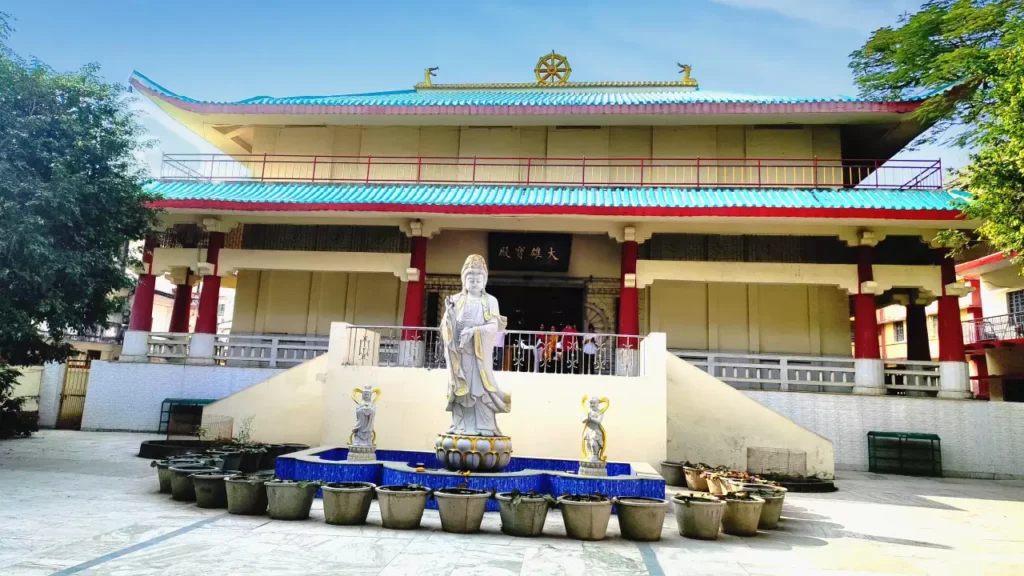
The Chinese Temple in Bodh Gaya is one of the oldest international Buddhist monasteries in the town and one of the few that blends Indian and Chinese architectural traditions in a single coherent structure. Located 1 km from Bodhgaya Bus Station and directly across from the main entrance to the Mahabodhi Temple complex, it occupies one of the most strategically significant positions in Bodh Gaya’s pilgrimage geography — making it a natural first or last stop for anyone visiting the UNESCO World Heritage site.
History of the Temple
The Chinese Temple was originally built in 1945 by Chinese Buddhist monks working in cooperation with the Chinese government of the Republican era. The choice of 1945 — the final year of the Second World War — was deliberate: the temple was conceived as an act of spiritual renewal and a statement of Buddhist continuity at a time when much of the world, including parts of China and Southeast Asia, had been devastated by conflict.
After decades of use, the temple underwent a major renovation in 1997, which restored its structural elements, refurbished the main shrine, and strengthened several sections of the outer wall that had deteriorated in the intervening decades. The 1997 renovation preserved the original architectural character while upgrading the interior fittings and adding improved facilities for visiting pilgrims and resident monks.
Architecture — The Sino-Indian Fusion
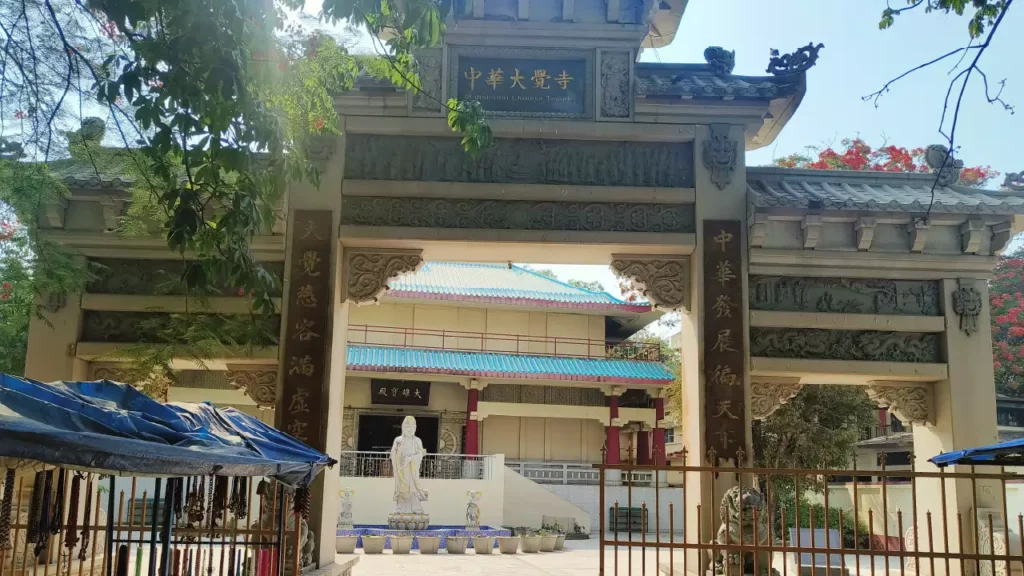
The temple’s exterior is the most immediately striking thing about it. The facade follows Chinese monastery architecture: sweeping upturned eave corners, ornamental roof ridges with ceramic dragon-and-lotus finials, and a gateway modelled on traditional Chinese temple gates. Red lacquered pillars flank the main entrance, and the colour palette — gold, vermillion, and deep green — is distinctly East Asian rather than South Asian.
Moving inside, the architectural language shifts. The floor plan, the arrangement of the shrine, and the use of interior courtyard space follow patterns common to both Chinese and Indian Buddhist monastery design, creating a transition that feels organic rather than arbitrary. The blend is most visible in the decorative panels that line the inner walls, where Indian lotus motifs appear alongside Chinese cloud-scroll borders and phoenix imagery.
The 200-Year-Old Buddha
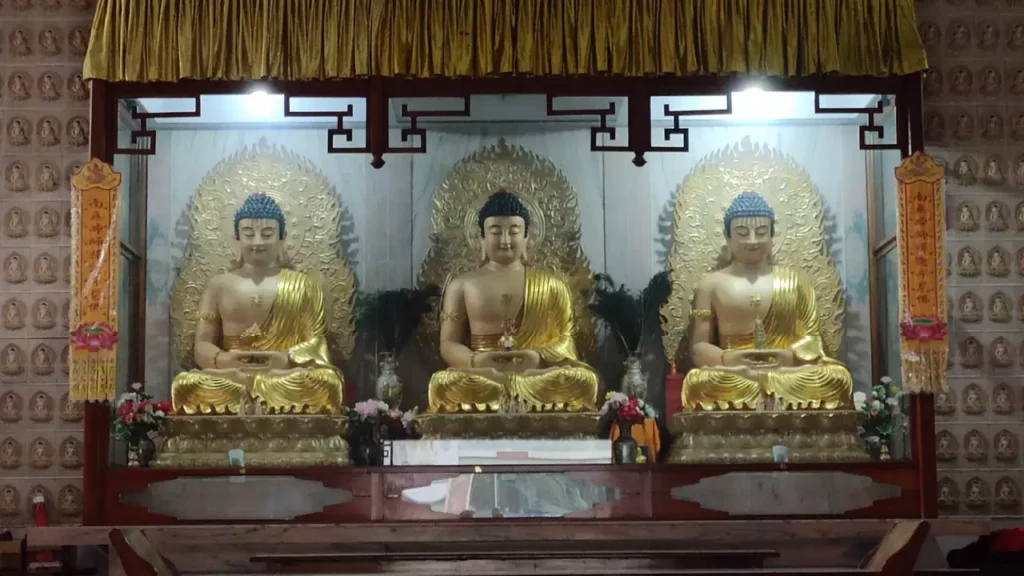
The temple’s most significant artefact is a Buddha statue that the resident monks date to approximately 200 years before the temple’s construction — making it roughly contemporaneous with the Qing dynasty in China. The statue was transported from China specifically to serve as the primary sacred image at Bodh Gaya. Installed as the main shrine piece, it occupies an elevated position at the far end of the prayer hall and is the focal point for daily rituals conducted by the monks.
Flanking this central figure are three additional golden Buddha sculptures that serve as secondary devotional images. These were installed during the 1997 renovation and are worked in the traditional Chinese gilded-lacquer technique. The combination of the ancient imported statue and the newer flanking figures gives the shrine a layered sacred history that regular visitors often find compelling.
The Travel Diary Collection
One of the most historically interesting features of the Chinese Temple is its collection of travel diaries and records written by Chinese Buddhist scholars who made the overland journey to India between the 5th and 7th centuries CE in search of original Buddhist scriptures. The most famous of these pilgrims was Xuanzang (also known as Hiuen Tsang), whose 7th-century travelogue remains one of the most important historical sources for understanding India during the Gupta and early post-Gupta periods.
The temple maintains reproductions and translations of sections from these accounts, displayed in a reading area adjacent to the main prayer hall. The diaries describe Bodh Gaya, Nalanda, Varanasi, Mathura, and other sites as they appeared to foreign eyes more than 1,300 years ago — a remarkable window into a world that has in some ways changed completely and in other ways barely changed at all.
Festivals and Major Events
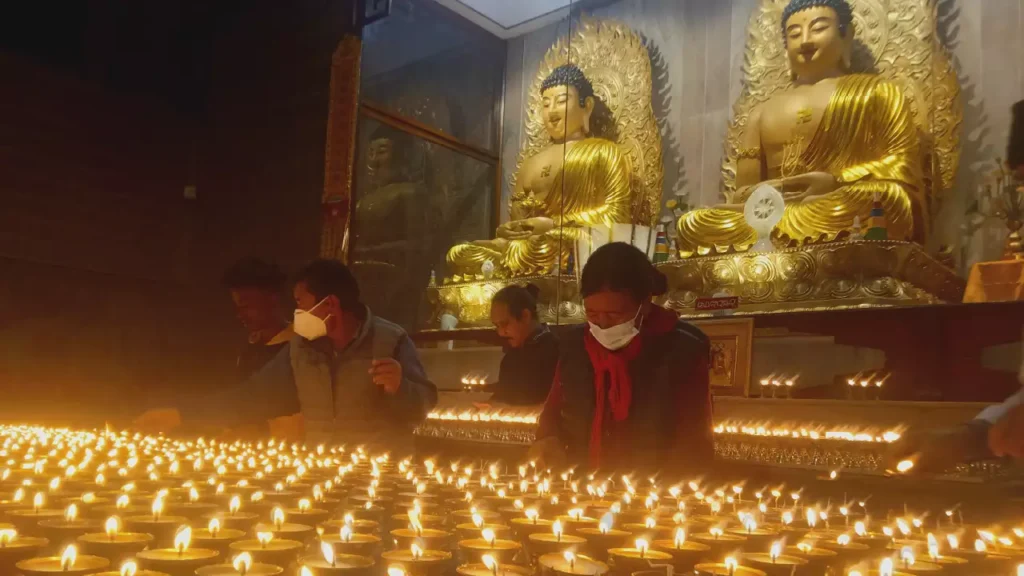
The most important annual event at the Chinese Temple is the celebration of Buddha Jayanti, which marks the birth, enlightenment, and passing of the historical Buddha (all held to have occurred on the same full moon day in the lunar calendar, known as Vesakha or Wesak). During Buddha Jayanti, usually falling in May, the temple hosts monks and lay practitioners from across the Chinese Buddhist world — mainland China, Taiwan, Hong Kong, Singapore, Malaysia, and Chinese Buddhist communities in other countries. The compound fills with flower offerings, incense, candlelit processions, and chanting that continues through the night.
Visiting Information
- Location: Directly opposite the main entrance to the Mahabodhi Temple complex, Bodh Gaya
- Timings: 7:00 AM to 12:00 PM and 2:00 PM to 6:00 PM daily
- Entry: Free
- Dress code: Modest clothing; footwear removed at the entrance
- Photography: Permitted in outer courtyard; restricted in the main shrine room
- Peak season: October to March; special events during Buddha Jayanti (May)
For practical planning of your visit to Bodh Gaya — including how to allocate time across the Mahabodhi complex, the Chinese Temple, and the international monastery zone — our Bodh Gaya travel guide is the essential reference. Pilgrims adding Gaya to their itinerary can find all the arrangements they need through our Gaya Pind Daan tour package.