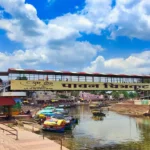

Mathura Vrindavan is not merely a destination — it is the ground where the divine walked, played, and loved. Roughly 145 km south of Delhi in the Braj region of Uttar Pradesh, these twin cities form the most sacred territory in Vaishnavism. Mathura is where Lord Krishna was born, and Vrindavan is where he spent his childhood — dancing with the gopis, lifting Govardhan Hill, and playing his flute on the banks of the Yamuna. For millions of devotees and curious travellers alike, a visit here is both a pilgrimage and a journey into one of the most living, breathing cultures in India.
If you are planning a broader spiritual circuit through Uttar Pradesh, Mathura Vrindavan pairs naturally with Varanasi and what makes Varanasi famous — two very different expressions of Hindu spiritual life. You can also explore our Prayagraj–Ayodhya–Varanasi tour package to cover the wider UP heritage circuit.
Mathura: The Birthplace of Lord Krishna
Mathura is one of the seven sacred cities of Hinduism — the Sapta Puri — and its association with Lord Krishna gives it a devotional energy that few places in India can match. The city sits on the western bank of the Yamuna River and has been a centre of art, culture, and religion since at least the 3rd century BCE. The Mathura school of sculpture, which flourished between the 1st and 3rd centuries CE, is among the earliest and most influential traditions of Buddhist and Hindu art in the subcontinent.
At the heart of the city stands Shri Krishna Janmabhoomi — the site traditionally identified as the exact location of Krishna’s birth. The original temple here was demolished multiple times over the centuries and rebuilt. The current complex includes the Keshav Dev temple alongside a mosque constructed by Mughal emperor Aurangzeb in 1670 on the site of the earlier shrine. The juxtaposition is historically striking. The sanctum sanctorum marks the prison cell where, according to the Bhagavata Purana, Krishna was born to Devaki and Vasudeva at midnight while the tyrant king Kansa held them captive. Visiting at dawn, when the mangala aarti is performed, is an experience of concentrated devotion.
Key Temples and Sites in Mathura
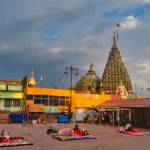
Dwarkadhish Temple is the city’s most architecturally magnificent temple, built in 1814 by Seth Gokuldas Parikh. Dedicated to Lord Krishna in his form as the king of Dwarka, the temple’s facade is an explosion of colours during festivals — painted elephants, dhol players, and enormous flower garlands. The sanctum houses a black stone idol of Krishna with a silver crown.
Vishram Ghat is the most important of Mathura’s 25 ghats along the Yamuna. Tradition holds that Krishna rested here after slaying Kansa. The evening aarti at Vishram Ghat — with oil lamps floated on the river and bells ringing across the water — is one of the more moving rituals in Braj. It is less grand than Varanasi’s Ganga Aarti but more intimate.
Keshav Dev Temple (part of the Janmabhoomi complex) houses the principal deity and receives the largest footfall among the city’s temples. Aarti timings here are strictly observed — plan your visit around them rather than trying to squeeze in at an off-hour.
Explore the complete destination guide for Mathura including all major temples, ghats, festivals, and practical visitor information.
Vrindavan: Where Krishna’s Childhood Unfolded
Twelve kilometres from Mathura lies Vrindavan — a name that translates as “the forest of Vrinda (Tulsi plants).” This was the forest where the young Krishna tended cattle, played pranks on the village women, and performed the Ras Leela — the divine circular dance with the gopis — under the light of the full moon. The entire geography of Vrindavan is considered sacred. Every grove, every pond (kund), and every path is associated with a specific episode from Krishna’s life as recorded in the Bhagavata Purana and the poetry of Surdas, Mirabai, and the eight poets of the Ashtachhap tradition.
The Ras Leela — Krishna’s dance of divine love with the gopis, particularly with Radha — is the theological and artistic centrepiece of Braj culture. Classical dance forms like Kathak and Manipuri trace their origins to this tradition. Performances of Ras Leela are staged year-round in Vrindavan, with the most elaborate productions during the month of Kartik (October–November).
Govardhan Hill, located about 25 km from Vrindavan near the town of Govardhan, is one of the most important sacred sites in all of Braj. According to the Bhagavata Purana, Krishna lifted this hill on his little finger for seven days to shelter the people of Braj from torrential rains sent by Indra. The hill is revered as a form of Krishna himself and is never mined or excavated. Pilgrims perform the Govardhan Parikrama — a circumambulation of the hill — a 21 km walk that takes most walkers five to seven hours.
Key Temples in Vrindavan
Banke Bihari Temple is the most beloved temple in Vrindavan and arguably in all of Braj. The presiding deity is a form of Krishna that was discovered by the saint-musician Swami Haridas in the 16th century. The temple practice is famously unusual: the curtain before the idol opens and closes every few minutes so that devotees do not become overwhelmed by the direct darshan of the deity. No bells are rung, no conch is blown — this is a deliberate choice rooted in the belief that Krishna is easily startled, like a child at play. The lane leading to the temple, packed with flower sellers and sweet shops, is itself a cultural experience.
ISKCON Temple (Sri Krishna Balaram Mandir) was established in 1975 by A.C. Bhaktivedanta Swami Prabhupada, the founder of the International Society for Krishna Consciousness. The complex is immaculate, well-organized, and internationally accessible — all signage is in English and multiple Indian languages. The deities of Radha Shyamasundar, Krishna Balaram, and Gaura Nitai are sumptuously dressed, and the kirtans performed here draw devotees and visitors from across the world. The temple also houses a museum and a guest house, making it a practical base for international pilgrims.
Prem Mandir (Temple of Divine Love) is Vrindavan’s newest major temple, inaugurated in 2012 by Jagadguru Kripaluji Maharaj. Built from white Rajasthani marble and carved over eleven years by over one thousand craftsmen, the temple is a visual feast — the exterior panels depict scenes from Krishna’s life in exquisite relief. At night, coloured lights illuminate the entire structure. While some long-term devotees prefer the older temples’ more austere atmosphere, Prem Mandir is genuinely magnificent and accessible to all.
Radha Raman Temple, established in 1542 CE by the Gaudiya Vaishnava saint Gopala Bhatta Goswami, is among the oldest and most theologically significant temples in Vrindavan. The self-manifest (swayambhu) deity of Radha Raman — a form of Krishna — is said to have emerged from a shaligram shila. One notable feature: the original deity has never left Vrindavan, not even during the Mughal period when many other deities were moved to Rajasthan for safety. The temple maintains a rigorous schedule of seven daily darshans and is considered particularly sacred by Gaudiya Vaishnavas.
For the full destination guide covering all temples, kunds, and sacred forests in Vrindavan, see our Vrindavan travel guide.
Holi in Mathura and Vrindavan: India’s Most Famous Celebration
If there is one event that puts Mathura Vrindavan on the global travel map every spring, it is Holi. The Braj region does not celebrate Holi for one day — it celebrates for an entire week, with a different event each day across different towns. The calendar typically runs from the full moon of Phalguna (late February to mid-March).
Lathmar Holi in Barsana (the village traditionally identified as Radha’s birthplace, about 45 km from Mathura) is the most photographed event. Men from the neighbouring village of Nandgaon come to Barsana in a ritual re-enactment of Krishna teasing Radha — and the women of Barsana drive them away with lathis (wooden sticks). The men carry shields and are expected to take the beatings in good humour. The atmosphere is festive, loud, and genuinely joyful. The following day, the roles reverse in Nandgaon.
Vrindavan celebrates Phoolon ki Holi — Holi with flowers — at Banke Bihari Temple and several other sites. At the ISKCON temple, Holi events are organized with international visitors in mind. In Mathura city, the main celebration at Dwarkadhish Temple draws enormous crowds.
Practical note: book accommodation six to eight weeks in advance if you plan to visit during Holi week. Prices roughly double and hotels in Mathura and Vrindavan fill completely.
Janmashtami: The Biggest Festival in Mathura
Janmashtami — the birthday of Lord Krishna, observed on the eighth day (Ashtami) of the dark fortnight of the month of Bhadrapada (August–September) — is the single most important festival in Mathura. The city receives an estimated five to six million pilgrims over the two main days of the festival, making it one of the largest peacefully organized gatherings in India.
At Shri Krishna Janmabhoomi, the mood builds through the day as devotees fast, sing kirtans, and listen to recitations of the Bhagavata Purana. At midnight — the traditional birth hour — the idol is given an abhishek (ritual bath) with milk, honey, and Yamuna water, then dressed in new clothes and adorned with jewels. The moment of midnight darshan, when the conch shells sound and the bells ring in unison, is deeply moving even for non-devotees.
Dahi Handi — a tradition in which a human pyramid breaks a pot of curd hung at height — is celebrated energetically across the region on the day following Janmashtami (Nandotsav).
The Parikrama Traditions of Braj
Parikrama — circumambulation of a sacred site — is a fundamental act of Hindu pilgrimage. Braj has two major parikrama circuits:
Vrindavan Parikrama is a circuit of approximately 10–12 km that circles the sacred town of Vrindavan, passing through major temples, ghats, and groves associated with Krishna’s pastimes. Most devotees complete it barefoot, which takes three to four hours at a leisurely pace. The route passes Kesi Ghat (where Krishna slew the demon Kesi in horse form), Kaliya Ghat (where he subdued the serpent Kaliya), and the Nidhivan forest, which has its own extraordinary mythology — it is said that the trees turn into gopis at night for the Ras Leela, and no one is permitted to remain inside after sunset.
Govardhan Parikrama is the more demanding circuit — 21 km around Govardhan Hill. Many pilgrims perform this dandavat parikrama, prostrating themselves at each step, which can take several days. The standard walking parikrama takes five to seven hours. The route passes Radha Kund and Shyam Kund — twin sacred ponds that are among the most theologically significant sites in all of Vaishnavism. According to tradition, bathing in Radha Kund on the night of Bahula Ashtami (in the month of Kartik) bestows the same merit as bathing at every tirtha in India simultaneously.
The Yamuna River and Its Spiritual Significance
The Yamuna runs through both Mathura and Vrindavan, and its importance to the Braj pilgrimage is second only to the deities themselves. In Hindu theology, the Yamuna is a goddess — Yamuna Devi, the daughter of Surya (the sun god) and the sister of Yama (the god of death). Her waters are believed to grant liberation from the fear of death.
Bathing in the Yamuna at Vishram Ghat in Mathura is considered equivalent in merit to completing the Ashvamedha Yajna — one of the most elaborate Vedic sacrifices. The ghat comes alive before sunrise when pilgrims descend the stone steps for the morning bath. Boat rides on the Yamuna between Mathura and Vrindavan are a peaceful way to experience the river and see the ghats from the water.
It must be noted, however, that the Yamuna in this stretch suffers from significant pollution — it is on the government’s priority list for the Namami Gange programme. Devotees still bathe here for religious merit; the practical decision is a personal one.
How to Reach Mathura Vrindavan
Mathura is one of the better-connected pilgrimage towns in north India, sitting on the main Delhi–Agra rail and road corridor.
By train: Mathura Junction is a major railway station on the Delhi–Mumbai and Delhi–Chennai main lines. From New Delhi, express trains like the Gatimaan Express (which stops at Mathura on its way to Agra) take 1.5 to 2 hours. From Agra Cantt, Mathura is 55 km — about 45 minutes by local train or express.
By road: The Yamuna Expressway connects Delhi to Mathura in about 2–2.5 hours depending on traffic. NH-19 (the old Delhi–Agra highway via Faridabad and Palwal) is slower but passes through towns. Mathura to Agra is 55 km — roughly 1.5 hours by car. Many travellers combine Mathura Vrindavan with the Agra–Taj Mahal visit as a natural two-destination itinerary.
From Mathura to Vrindavan: 12 km, accessible by auto-rickshaw (around Rs 150–200), e-rickshaw, or tempo. The government has restricted large vehicles in Vrindavan’s older lanes to reduce congestion.
Nearest airport: Agra’s Kheria Airport (90 km) has limited flights. Most travellers fly into Indira Gandhi International Airport in Delhi and continue overland.
We recommend our Krishna Trail — Mathura Vrindavan Barsana tour package for a fully guided experience covering all the major sacred sites across Braj.
Best Time to Visit Mathura Vrindavan
October to March is the ideal window. Winters in Braj are cool (lows of 5–8°C in December and January), dry, and comfortable for temple-hopping on foot. The festival calendar is also rich in this period — Kartik month (October–November) sees Govardhan Puja, Diwali celebrations, and numerous Ras Leela performances. The Dev Deepawali-style lamp festivals on the Yamuna ghats are underrated and beautiful.
February–March brings Holi and is worth planning around even though temperatures start to rise toward 30°C by mid-March.
August–September is Janmashtami season — manageable if you have booked accommodation well in advance and are prepared for very large crowds.
April–June is the least comfortable period: temperatures regularly exceed 40°C and humidity rises. Most serious temples still function normally, but the experience of outdoor exploration is limited.
July–September (monsoon): Braj’s monsoon season is surprisingly beautiful. The forests turn green, the Yamuna fills, and the atmosphere in the older temples becomes particularly atmospheric. Flooding is occasionally a concern near the river ghats.
How Many Days to Spend
The minimum for a meaningful visit is two full days — one day each for Mathura and Vrindavan. This allows you to attend morning aarti in Mathura, visit Janmabhoomi and Vishram Ghat, then cross to Vrindavan in the afternoon for Banke Bihari and an evening kirtan at ISKCON.
Three to four days is the ideal duration if you want to go beyond the headline temples. The extra time allows you to:
- Visit Govardhan Hill and complete the 21 km parikrama
- Go to Barsana (Radha’s birthplace) and Nandgaon (Krishna’s foster family’s village)
- Explore the 12 forests (Dvadasha Vana) of Braj on foot or by bicycle
- Attend a traditional Ras Leela performance in Vrindavan
- Visit Radha Kund and Shyam Kund at Govardhan
Five or more days is for the dedicated pilgrim who wants to walk the full Braj 84 Kos Parikrama — the complete circuit of the Braj region that covers approximately 268 km and traditionally takes 30 days on foot, though most modern pilgrims complete it by vehicle.
Food in Mathura Vrindavan
The entire Braj region is strictly vegetarian — no meat, no eggs, and no alcohol are sold anywhere in Mathura or Vrindavan. This is not a restriction but a cultural expression of the region’s devotion to Krishna, who is associated with cows, milk, butter, and all things dairy.
Mathura ka Peda is the essential food souvenir — a dense, slightly grainy milk sweet made from reduced milk solids and flavoured with cardamom. The pedas from Mathura have a GI (Geographical Indication) tag and are exported across India. The best are still made by traditional halwais in the lanes near Vishram Ghat and Holi Gate.
Lassi in Braj is nothing like the thin, sweetened versions served in restaurants elsewhere. The traditional lassi here is thick, set in terracotta kulhads, topped with malai (clotted cream), and so filling it functions as a meal. The lanes near Banke Bihari Temple in Vrindavan have several legendary lassi shops.
Kachori and sabzi is the classic morning breakfast across Braj — crispy deep-fried flatbreads served with a spiced potato or lentil curry. The version specific to the region uses a slightly more robust spice blend than Varanasi or Agra versions.
Chappan Bhog — the offering of 56 food items traditionally made to Krishna — is replicated as prasad at many temples. Govardhan’s temples are particularly known for their prasad distributions.
Temple prasad at Banke Bihari includes a remarkable churma (crushed wheat fried in ghee and mixed with sugar), and the ISKCON temple has a full prasadam restaurant serving simple, well-made sattvic meals open to all visitors.
Where to Stay in Mathura Vrindavan
Accommodation options span the full range:
Dharamshalas and ashrams: Vrindavan has dozens of dharamshalas run by various religious trusts — these are inexpensive (Rs 200–600 per night for a basic room) and functional. The ISKCON guesthouse is the best-organized option in this category, with clean rooms, a dining hall, and strong security. Booking ahead is essential during festivals.
Mid-range hotels: Mathura city has the larger selection of mid-range business hotels (Rs 1,500–4,000 per night). Vrindavan’s hotel stock is growing — several newer properties near Prem Mandir offer clean, well-maintained rooms with air conditioning.
Heritage and boutique stays: A handful of haveli-style properties have opened in both cities catering to the premium traveller seeking character accommodation. These book out earliest during Holi and Janmashtami seasons.
Agra as a base: If you are combining Mathura Vrindavan with the Taj Mahal, staying in Agra (55 km away) gives you access to better hotel infrastructure while keeping both destinations within day-trip range.
Practical Tips for Visitors
- Dress modestly. Shoulders and knees should be covered when entering temples. Lightweight cotton clothing works well in most seasons. Carry a dupatta or shawl — many temples require women to cover their heads.
- Remove footwear. All major temples require shoes to be removed. Carry a bag for your shoes or use the paid cloakrooms available outside temples like Banke Bihari and Janmabhoomi.
- Photography rules vary. Banke Bihari Temple does not permit photography of the deity. ISKCON and Prem Mandir are more permissive in common areas. Always check before pointing a camera.
- Beware of touts and fake pandas. The lanes leading to Banke Bihari and Janmabhoomi have aggressive touts offering “VIP darshan” or guide services. Fix your arrangements before arrival or use a reputable tour operator.
- Monkeys are everywhere. Vrindavan’s monkeys — both rhesus macaques and langurs — are bold and will snatch food, glasses, phones, or anything shiny. Keep bags closed and do not feed them.
- Cash is still king. While UPI is accepted at larger shops, many smaller prasad sellers, auto-rickshaw drivers, and dharamshalas are cash-only. Carry adequate notes.
- Start early. Morning darshan at Mathura (5:30–7:00 AM) and early kirtan at ISKCON Vrindavan are the most spiritually charged moments of the day. Late arrivals miss the best of both cities.
- Hire a local guide for the 12 forests. The sacred groves of Vrindavan are not well-signposted and are easy to get lost in. A good local guide will bring them to life with the associated mythological narratives.
Ready to experience Mathura Vrindavan in depth? Explore our Krishna Trail tour package — a curated journey through the sacred towns of Braj, covering all major temples, the Govardhan Parikrama, and Barsana, led by experienced local guides.