










Every major Hindu temple carries stories that go far beyond what you see in stone and mortar. Hanuman Garhi in Ayodhya is no different — except that the tales about Hanuman Garhi are more vivid, more dramatic, and more deeply woven into the fabric of Ayodhya’s identity than almost any other temple in the city. These are not dusty academic footnotes. They are living stories, told by priests on the steps, whispered by grandmothers to grandchildren, and repeated by pilgrims who climb the 76 steps every single day.
If you are planning a visit to Hanuman Garhi (and you should — it is the first stop on any Ayodhya pilgrimage), knowing these tales will transform a temple visit into something far more meaningful. Here are seven fascinating tales about Hanuman Garhi that every visitor should know before climbing those steps.
Tale 1: Why Hanuman Chose This Hilltop — The Guardian of Ayodhya
The most foundational of all tales about Hanuman Garhi begins after the great war in Lanka. When Lord Ram returned to Ayodhya and was crowned king, his companions each received roles in the new administration. Vibhishana was given Lanka. Sugriva returned to Kishkindha. But Hanuman, the most devoted of all, asked for nothing.
Ram, knowing Hanuman’s heart, gave him the most important task of all: “You shall be the Kotwal of Ayodhya.” Kotwal means chief protector — the one who guards the gates. Hanuman was given authority over who enters and who does not. No devotee, according to this tradition, may approach Ram without first seeking Hanuman’s permission.
Hanuman chose the highest point in the city — the hillock that is now Hanuman Garhi — as his watchpost. From here, he could see the entire city and guard it from any threat. He did not build a palace. He sat in a cave, meditating on Ram’s name, watching over Ayodhya with the vigilance that only absolute devotion can sustain.
This is why, to this day, pilgrims in Ayodhya visit Hanuman Garhi before they visit Ram Janmabhoomi. It is not a suggestion — it is a deeply held custom. You seek the guardian’s blessing before approaching the king.
Tale 2: The Nawab’s Sick Son and the Miracle That Built the Temple
For centuries, Hanuman Garhi existed as a mound with a cave shrine — not the fortress-like structure you see today. The story of how the current temple came to be built involves an unlikely alliance between a Hindu saint and a Muslim ruler.
In the 18th century, the Nawab of Awadh, Shuja-ud-Daula, had a son who fell gravely ill. The royal physicians (vaids and hakims) tried everything — Unani medicine, Ayurvedic remedies, prayers — but the boy’s condition only worsened. The court was in despair.
Someone suggested calling Mahant Abhayram Das, a saint who lived on the Hanuman Garhi hillock and was known for his spiritual powers. Abhayram Das came to the Nawab’s court, chanted mantras, and sprinkled holy water from Hanuman’s feet (charanamrit) on the boy. The child recovered.
The grateful Nawab asked Abhayram Das to name his reward. The saint, true to his ascetic nature, said he needed nothing for himself. But if the Nawab wished to express gratitude, he could build a proper temple for Hanuman on the hillock. The Nawab agreed and donated 52 bighas of land — a vast tract that encompasses the entire temple complex you see today, including residential quarters, subsidiary shrines, and courtyards.
The fact that a Mughal-era Muslim ruler funded the construction of one of Hinduism’s most important temples is a historical detail that often surprises visitors. It speaks to the syncretic traditions of Awadh that persisted even during politically turbulent times.
Tale 3: The Miraculous Idol — Hanuman Holding Baby Ram
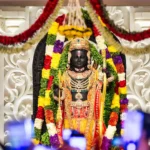
Walk into the inner sanctum of Hanuman Garhi and you will see something unusual. The main idol does not show Hanuman in his typical warrior form — tearing open his chest to reveal Ram and Sita, or flying with the Sanjeevani mountain. Instead, you see Mata Anjani (Hanuman’s mother) holding the infant Hanuman on her lap, with the child Hanuman in turn cradling baby Ram.
This is the Anjaneya form, and it is extraordinarily rare in North Indian temples. Most Hanuman temples across Uttar Pradesh, Madhya Pradesh, and Rajasthan depict the adult, powerful Hanuman — the Veer Hanuman or Dasa Hanuman forms. The mother-and-child depiction at Hanuman Garhi is almost unique.
The tale behind this idol is tender. It represents the idea that even the mightiest warrior is, at his core, a child of his mother. And that child’s greatest joy is holding his beloved Ram. The idol is only about six inches tall, always adorned with fresh flowers and sindoor (vermilion), and sits inside the cave that was Hanuman’s original meditation spot.
Priests at the temple say that the idol “appeared” (prakatt hua) — it was not carved by human hands but manifested through divine will. Whether you take this literally or metaphorically, the experience of seeing this small, intimate idol after climbing 76 steps and passing through a fortress is genuinely moving.
Tale 4: The Secret Tunnel to Ram Janmabhoomi
Ask any local guide or longtime priest at Hanuman Garhi about the underground passages, and you will hear a story that has been told for generations: there is a tunnel — or a network of tunnels — connecting Hanuman Garhi to Ram Janmabhoomi, roughly one kilometer away.
The logic of the tale fits perfectly with the guardian narrative. If Hanuman is the Kotwal stationed on the hilltop, he would naturally need a direct, hidden route to reach his lord’s palace instantly in case of danger. The tunnel, according to local belief, was Hanuman’s secret passage — a way to move between his guard post and Ram’s court without being seen.
There is no archaeological confirmation of such a tunnel. But the belief is deeply held, and some priests claim that older sections of the temple complex contain sealed passages that have never been fully explored. During various construction and renovation projects over the centuries, workers have reportedly encountered underground chambers and bricked-up corridors.
Whether the tunnel exists physically or only in the spiritual imagination of Ayodhya’s faithful, it reinforces the central theme: Hanuman and Ram are never truly separated. The distance between their temples is an illusion — they are connected, always.
Tales About Hanuman Garhi: The Sacred Monkeys and the Langur Tradition
You will notice langurs (grey langur monkeys) around Hanuman Garhi almost immediately. They are everywhere — on the steps, the walls, the railings, and especially near the prasad stalls. Unlike at many other temples where monkeys are treated as nuisances, at Hanuman Garhi they are regarded with genuine reverence.
The reason is straightforward: Hanuman is the Vanar (monkey) god, and these langurs are considered his living representatives. Feeding them is an act of devotion, not charity. Pilgrims buy bananas and chickpeas specifically to offer to the monkeys before entering the main shrine.
The older tale goes deeper. It is said that the langurs of Hanuman Garhi are descendants of the Vanar Sena — the monkey army that fought alongside Ram in Lanka. When Hanuman took up his post as guardian of Ayodhya, some of his loyal soldiers stayed with him. Their descendants, generation after generation, have never left the hilltop.
Priests say that when the langurs are calm and well-fed, Hanuman is pleased. When they are agitated, it is a sign of spiritual disturbance. This may sound like folklore, but it has a practical effect: the temple community takes very good care of the monkeys, and the langurs in turn have become remarkably comfortable around human visitors.
Tale 6: Tulsidas, Hanuman, and the Writing of the Ramcharitmanas
Goswami Tulsidas, the poet-saint who wrote the Ramcharitmanas — the Hindi retelling of the Ramayana that is read in millions of households across North India — has a deep connection to Hanuman Garhi. According to tradition, it was at this very spot that Tulsidas had his first direct vision (darshan) of Hanuman.
The story, as told by the Ramanandi tradition, goes like this: Tulsidas was desperately seeking a vision of Lord Ram. He had devoted his entire life to Ram’s worship but had never seen him directly. A wise man told him that to see Ram, he must first find Hanuman — because Hanuman is always where Ram is.
Tulsidas came to Ayodhya and sat on the steps of Hanuman Garhi, reciting the Hanuman Chalisa (which, by some accounts, he composed here). After prolonged meditation and devotion, Hanuman appeared before him — not as a grand deity, but as an old man. Hanuman then guided Tulsidas to a spot where he could finally have darshan of Ram and Lakshman.
This story is one of the reasons the Hanuman Chalisa is recited with such intensity at Hanuman Garhi. Every Tuesday and Saturday, thousands of devotees gather on the steps and in the courtyard to chant the 40 verses together. The sound echoes across the city — a living continuation of what Tulsidas himself is believed to have started here.
Tale 7: The 76 Steps and What Each One Represents
There are exactly 76 steps leading from the base of the hill to the main entrance of Hanuman Garhi. This number is not arbitrary, though its exact significance is debated among scholars and priests.
One tradition holds that the 76 steps correspond to the 76 forms (roopas) of devotion described in the Bhakti tradition. Each step is a stage of surrender — from initial curiosity, through doubt, through testing, through struggle, and finally to complete submission. By the time you reach the top, you have metaphorically passed through every phase of the devotee’s journey.
Another interpretation links the number to the age of Mahant Abhayram Das when the temple construction was completed — 76 years of life, each one memorialized in stone.
A third, more mystical explanation connects the 76 steps to numerology within the Ramanandi tradition, where 7 + 6 = 13, and 1 + 3 = 4, representing the four pillars of dharma.
Regardless of which interpretation you prefer, the physical experience matters. The steps are steep. Climbing them in the Ayodhya heat requires effort. By the time you reach the top, slightly out of breath, looking out over the city, you have earned the darshan. Nothing at Hanuman Garhi comes without effort — and that is precisely the point.
The Oral Tradition: How Tales About Hanuman Garhi Stay Alive
What makes these stories remarkable is not just their content but their mode of transmission. Unlike the Ramayana itself, which exists in written form in dozens of languages, the tales about Hanuman Garhi are primarily oral. They are told by the pandas (hereditary priests) who have served the temple for generations, by the shopkeepers on the surrounding lanes, and by the older devotees who have been coming here for decades.
Each telling adds subtle variations. The Nawab’s son was “near death” in one version and “possessed by a spirit” in another. The tunnel leads directly to Ram Janmabhoomi in one telling and to a hidden underground temple in another. Tulsidas sat on the steps for “seven days” or “forty days” depending on who you ask.
This is not a weakness — it is a feature. Oral traditions are living things. They adapt, grow, and respond to the needs of each generation. The core truths remain constant: Hanuman is the guardian, devotion is rewarded, the powerful protect the faithful, and the divine manifests in unexpected ways.
If you visit Hanuman Garhi, take the time to sit with a priest or an older devotee after your darshan. Ask them to tell you a story. The version you hear will be slightly different from what you have read here — and that is exactly as it should be.
Why These Tales Matter for Visitors Today
Knowing these stories before you visit changes the experience entirely. Without them, Hanuman Garhi is a hilltop temple with 76 steps, some monkeys, and a small idol. With them, every element becomes meaningful — the steps are a spiritual journey, the monkeys are descendants of warriors, the cave is a meditation chamber of the world’s most devoted servant, and the fortress walls were built by a Muslim ruler’s gratitude.
Ayodhya itself is a city of stories. Dashrath Bhawan tells the story of a father’s sacrifice. Ram Ki Paidi tells the story of a river’s devotion. And Hanuman Garhi tells the story of a servant who loved his master so completely that he became the most powerful guardian in the city. If you are planning an Ayodhya pilgrimage, consider booking a Prayagraj-Ayodhya-Varanasi tour package that gives you enough time to absorb these stories properly — a rushed visit does not do justice to a city this layered.
Frequently Asked Questions: Tales About Hanuman Garhi
Why do pilgrims visit Hanuman Garhi before Ram Janmabhoomi?
According to tradition, Lord Ram appointed Hanuman as the Kotwal (guardian) of Ayodhya. No one enters Ram’s court without the guardian’s permission. Visiting Hanuman Garhi first is how pilgrims seek that permission — it is a deeply held custom, not just a suggestion.
Is the underground tunnel from Hanuman Garhi to Ram Janmabhoomi real?
There is no archaeological confirmation of the tunnel. However, the belief is widespread among locals and priests. Some claim that sealed passages and underground chambers have been found during construction work over the centuries. The tunnel is part of Ayodhya’s living oral tradition.
What is unique about the Hanuman idol at Hanuman Garhi?
The main idol shows Mata Anjani holding infant Hanuman, who in turn cradles baby Ram. This Anjaneya (mother-child) form is extremely rare in North Indian Hanuman temples, which typically depict the adult warrior Hanuman. The idol is only about six inches tall and sits inside the original cave shrine.
Who built the current Hanuman Garhi temple structure?
The current fortress-like structure was built in the 18th century. According to the most widely told account, the Nawab of Awadh donated 52 bighas of land after Mahant Abhayram Das healed the Nawab’s gravely ill son using holy water from the shrine. The saint used the land grant to construct the temple complex.
Why are there so many monkeys at Hanuman Garhi?
The langurs at Hanuman Garhi are considered living representatives of Hanuman, who is himself a Vanar (monkey god). Local tradition holds that they are descendants of the Vanar Sena that fought alongside Ram. Feeding them is considered an act of devotion, and the temple community takes special care of them.
Plan Your Ayodhya Pilgrimage With Us
The legends of Hanuman Garhi become a lot more vivid when you are standing at the top of those 76 steps. Our Ayodhya package gives you the time and guidance to experience the full Ramkot circuit — Hanuman Garhi, Ram Janmabhoomi, Kanak Bhawan, and Dashrath Bhawan — without the scramble of self-arranged darshan. A dedicated guide explains the stories; you just bring the devotion.
Starting from ₹12,000 per person | Includes darshan, meals, and local transport