



Welcome to New Delhi, a spectacular journey through time where the rise and fall of great empires is written in stone. Far more than a collection of historic sites, Delhi is a living timeline shaped by seven ancient capitals, where the fierce drama of the Sultanate, the grand romance of the Mughals, and the sweeping ambition of the British Raj unfold before your eyes. We have carefully designed your itinerary around “Context-First Curation”—sharing the vibrant human stories and fascinating history with you during smooth, air-conditioned transitions so that once you step through the monument gates, you can completely escape the crowds and immerse yourself in the emotional and sensory beauty of the architecture. Get ready to witness a visible chronicle of power, beautifully paced to ensure your ultimate comfort and inspiration every step of the way.
Delhi historical monuments
Monument 1: The Qutub Minar Complex – The Sultanate Foundation
1. The Deep History and Story of the Empire
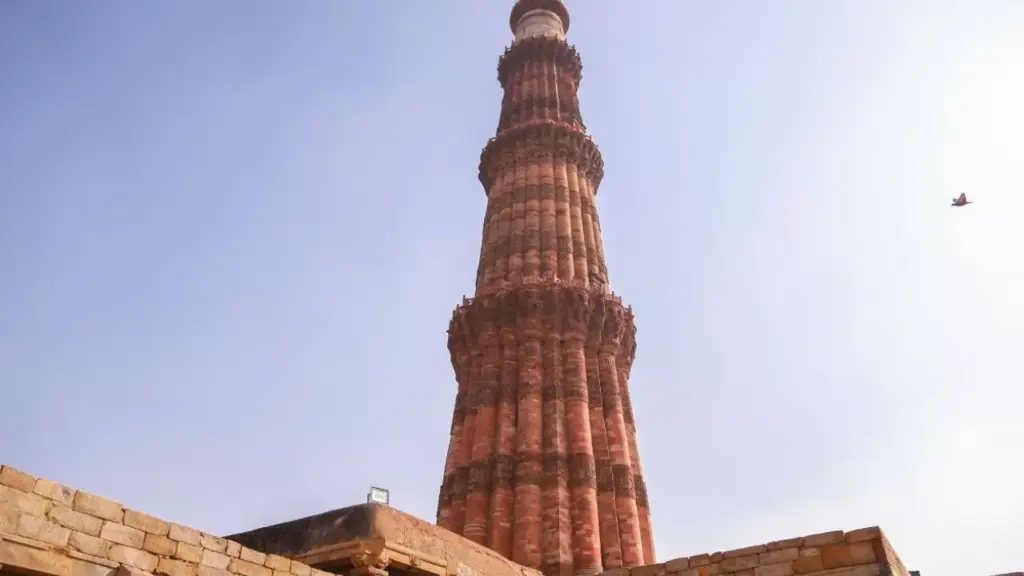
The Qutub Minar is much more than just a tall brick tower. It is a powerful symbol of the very beginning of Islamic rule in India. In the late 12th century, a general named Qutb-ud-din Aibak conquered Delhi. To celebrate his victory and mark the start of the Delhi Sultanate, he began building this massive tower in 1199. However, he only lived long enough to finish the first floor. His successor and son-in-law, Iltutmish, added three more stories. Years later, a lightning strike damaged the top, and Emperor Firoz Shah Tughlaq repaired it, adding the final sections in marble and sandstone.
When you walk through this complex, you are walking through the exact moment when Indian architecture completely changed. You can see the transition from ancient Indian temple designs to grand Islamic archways and domes. The rulers brought new ideas from Central Asia, but they used local Indian craftspeople to build them. This created a beautiful new style called Indo-Islamic architecture, where you can see traditional Indian lotus flowers carved right next to elegant Arabic writing.
2. The Architectural Marvels You Will See
- The Great Tower (Qutub Minar): Standing at a staggering 72.5 meters (about 238 feet) tall, this is the tallest brick minaret in the world. It has five distinct stories, each marked by a projecting balcony supported by beautifully carved brackets. The outside of the tower is covered in intricate carvings and verses from the Quran.
- The Iron Pillar: This is perhaps the most magical part of the complex. Long before the mosque was built, this 1,600-year-old iron pillar stood here. It is a true marvel of ancient Indian metalwork. Despite being exposed to rain and sun for over a thousand years, it has never rusted. Our guides will draw your focus to this amazing piece of history to capture your imagination before you explore the rest of the complex.
- Quwwat-ul-Islam Mosque: This translates to the “Might of Islam.” It is the very first mosque built in Delhi. If you look closely at the pillars in the courtyard, you will notice they are covered in Hindu and Jain carvings. This is because the mosque was built using the ruins of 27 older temples that previously stood in the area.
- The Alai Minar: Emperor Alauddin Khalji wanted to build a tower twice as high as the Qutub Minar. He started building the base, which you can still see today, but he died before it could be finished. It stands as a giant, unfinished dream made of rough stone.
3. Your Comfort, Timings, and Ticketing Details
- Where is it? The complex is located in Mehrauli, a historic neighborhood in South Delhi.
- When is it open? It is open every single day of the week, from 7:00 AM in the morning until 5:00 PM in the evening.
- Ticket Prices: For Indian citizens, the ticket is a very affordable ₹35. For foreign tourists, the ticket is ₹550. Children under the age of 15 can enter for completely free. If you want to use a professional video camera, there is a small extra charge of ₹25.
- Time Needed: You should plan to spend about 2 to 3 hours here so you can walk slowly, take beautiful photographs, and really absorb the history without rushing.
4. Our Special Plan for Your Visit
- Beat the Crowds: We always schedule this visit for the early morning. Arriving at 7:00 AM or 8:00 AM allows you to avoid the most aggressive crowd surges that happen later in the day. The morning light is also soft and golden, making your photos look spectacular.
- The Context-First Rule: Delhi is loud and busy. To make sure you understand what you are seeing, our tour managers require our guides to tell you all the historical facts, dates, and stories while you are comfortably seated in our air-conditioned coach. Once you step inside the gates, the guide stops giving lectures. Instead, they shift into a “narrative mode,” letting you simply enjoy the beautiful sights and the emotional feeling of the ancient stones without any distractions.
- Stay Cool: During the hot summer months from April to September, we strictly follow a Heat-Avoidance Policy. We will only bring you here before 11:00 AM or after 3:30 PM to make sure you stay cool and never suffer from heat exhaustion.
Monument 2: Humayun’s Tomb – The Garden Paradise
1. The Deep History and Story of the Empire
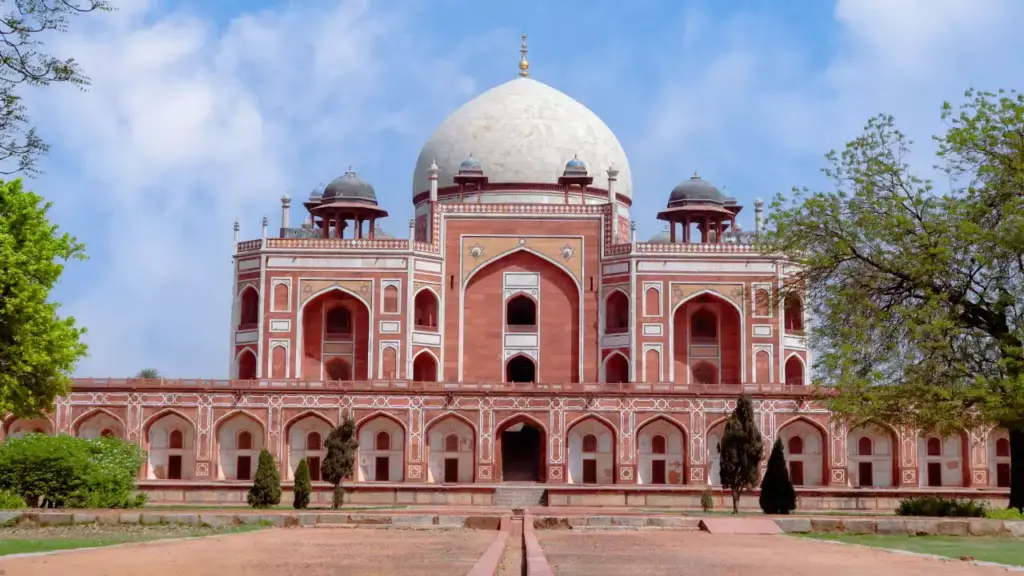
Humayun’s Tomb is one of the most important and beautiful monuments in all of India. Built in 1570, this incredible structure serves as the direct architectural inspiration for the famous Taj Mahal.
Emperor Humayun was the second Mughal emperor of India. He had a very difficult life, losing his empire for 15 years before finally winning it back, only to die shortly after by falling down the stairs of his library. His grief-stricken first wife, Empress Bega Begum, decided to build a magnificent tomb to honor him. She brought in a famous Persian architect named Mirak Mirza Ghiyas to design it.
This building is famous because it was the very first major “garden-tomb” built on the Indian subcontinent. The Mughals loved nature and believed that heaven was a beautiful, lush garden. So, they designed this tomb to look exactly like their vision of a “Garden Paradise,” a concept known as a Charbagh. This monument is absolutely vital for you to see, especially if your travel plans do not include a trip to Agra to see the Taj Mahal.
2. The Architectural Marvels You Will See
- The Beautiful Transition: Our guides will help you focus on the amazing transition from a solemn place of burial into a grand, formal imperial garden complex. The gardens are divided into four large squares by long pools of water and pathways, representing the four rivers of paradise described in the Quran.
- The Main Tomb: The building is a stunning mix of bright red sandstone decorated with elegant borders of white and black marble. It sits on a massive, wide platform that makes it look like it is floating above the gardens.
- The Double Dome: When you look up, you will see a massive white marble dome. This was the first time a “double dome” was used in India. It has an inner ceiling that is low enough to look beautiful from the inside, and an outer shell that reaches high into the sky to look impressive from the outside.
- Isa Khan’s Tomb: Before you even reach Humayun’s Tomb, you will walk past the older tomb of an Afghan noble named Isa Khan. His tomb is shaped like a perfect octagon and is surrounded by its own beautiful, sunken garden.
3. Your Comfort, Timings, and Ticketing Details
- Where is it? It is located on Mathura Road, right across from the historic Nizamuddin Dargah in New Delhi. The nearest metro station is the Jawaharlal Nehru (JLN) Stadium station.
- When is it open? It is open every day of the week, from the moment the sun rises (around 6:00 AM) until the sun sets (around 6:00 PM).
- Ticket Prices: Indian citizens pay ₹35. Foreign tourists pay ₹550. Children under 15 enter for free. You can bring your camera and take as many photos as you want for free!
- Time Needed: You will need about 1.5 to 2 hours to walk through the grand gates, explore the main tomb, and stroll peacefully through the vast water gardens.
4. Our Special Plan for Your Visit
- Exclusive Early Access: For our high-net-worth clients, we strongly recommend a private, early-access entry at 8:00 AM. Walking into the completely quiet, empty gardens of Humayun’s Tomb in the soft morning mist is an entirely different, much more valuable experience than visiting at a standard, noisy 10:30 AM slot.
- Sensory Experience: The beauty of this place is the sound of the birds, the sight of the flowing water, and the wind moving through the trees. Because of our “Context-First” rule, your guide will explain all the history on the bus, allowing you to walk through the gardens in peace, just as the emperors once did.
Monument 3: Red Fort (Lal Qila) – The Imperial Flourish
1. The Deep History and Story of the Empire
The Red Fort, known locally as Lal Qila, represents the absolute peak of Mughal power and wealth. In 1639, Emperor Shah Jahan (the same man who built the Taj Mahal) decided to move his capital from Agra back to Delhi. He wanted to build a brand new, glorious city called Shahjahanabad, and the Red Fort was built to be the shining heart of this new empire.
For nearly 200 years, this massive fortress was the home of the Mughal emperors. It was a city within a city, filled with gardens, royal baths, gorgeous meeting halls, and thousands of royal staff. However, the fort has also seen great tragedy. It was looted by the Persian invader Nadir Shah in 1739, who stole the famous Peacock Throne and the Koh-i-Noor diamond. Later, during the 1857 uprising, the British army took over the fort, exiled the last Mughal emperor, and destroyed many of the beautiful inner palaces to build ugly military barracks.
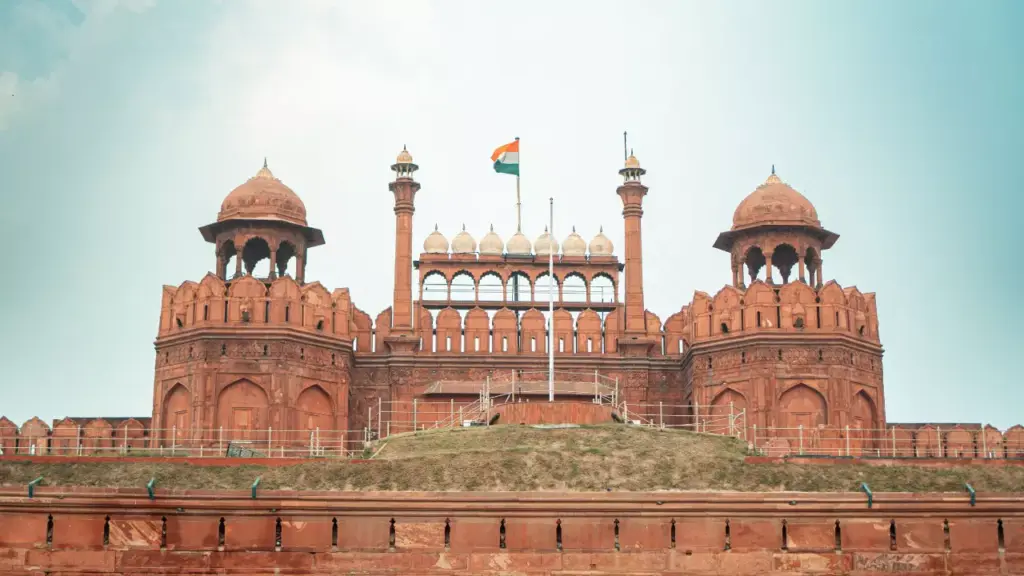
Today, it stands as a proud symbol of India’s independence. Every year on August 15th, the Prime Minister of India hoists the national flag above its gates to celebrate freedom.
2. The Architectural Marvels You Will See
- The Massive Walls: The fort is named for its towering, impenetrable walls made of red sandstone, which stretch for over two kilometers and rise up to 33 meters high.
- The Lahori Gate: This is the main entrance to the fort, named because it faces the city of Lahore (which is now in Pakistan). It leads into a fascinating covered bazaar called the Chatta Chowk, where the royal women used to shop for silks and jewels.
- Diwan-i-Aam (Hall of Public Audience): A large, open pavilion with beautiful arches where the Emperor would sit on a marble balcony to listen to the complaints and requests of the common people.
- Diwan-i-Khas (Hall of Private Audience): This is where the Emperor met with kings, ambassadors, and special guests. It was once entirely covered in silver and gold. On the walls, a famous poem is carved: “If there is a paradise on earth, it is this, it is this, it is this.”
- Moti Masjid (The Pearl Mosque): A tiny, stunningly beautiful mosque made entirely of pure white marble, built later by Emperor Aurangzeb for his personal daily prayers.
3. Your Comfort, Timings, and Ticketing Details
- Where is it? It is located in the heart of Old Delhi, on Netaji Subhash Marg, very close to the famous Chandni Chowk market.
- When is it open? It is open from 9:30 AM to 4:30 PM. Please note: The Red Fort is closed to the public every Monday.
- Ticket Prices: Indian citizens pay ₹35, and foreign tourists pay ₹550. Children under 15 are free.
- Light and Sound Show: In the evening, the fort hosts a brilliant light and sound show. Tickets for this show cost between ₹80 and ₹130 depending on the language and seating.
- Time Needed: You will need about 2 to 2.5 hours for a comfortable visit.
4. Our Special Plan for Your Visit
- The “Empire Walk” Strategy: The footprint of the Red Fort is incredibly massive and requires a huge amount of walking in the sun. To protect you from getting exhausted, we do not force you to look at every single empty building. Instead, our guides will curate a special “Empire Walk” just for you. We will bypass the less important outer structures and direct you straight toward the most beautiful parts, like the Diwan-i-Khas and the Moti Masjid. This preserves your energy while ensuring you see the very best the fort has to offer.
- Heat Protection: Just like our other tours, we avoid the heavy midday heat by scheduling your visit in the cool morning hours.
Monument 4: Purana Qila (Old Fort) – The Ancient Connection
1. The Deep History and Story of the Empire
Purana Qila, which translates to “Old Fort,” is a place where history blends with ancient mythology. It connects the 16th-century Mughal era to the deepest, oldest legends of India. According to ancient stories, this exact piece of land is where the magical city of Indraprastha was built thousands of years ago during the era of the great epic, the Mahabharata. Modern archaeologists have even found ancient pottery buried deep in the ground here, proving that people have lived on this spot for over 3,000 years!
The massive stone fort you see today was started in the 1530s by Emperor Humayun. He wanted to build a grand new capital called Dinpanah. However, before he could finish it, a powerful Afghan warrior named Sher Shah Suri defeated him and took over the fort. Sher Shah added many of his own strong, beautiful buildings inside. Because of this, the fort is a fascinating mix of both Mughal and Afghan architectural styles.
It was also inside this fort, at an octagonal building called the Sher Mandal, where Emperor Humayun tragically fell down the stairs to his death after hearing the call to prayer.
2. The Architectural Marvels You Will See
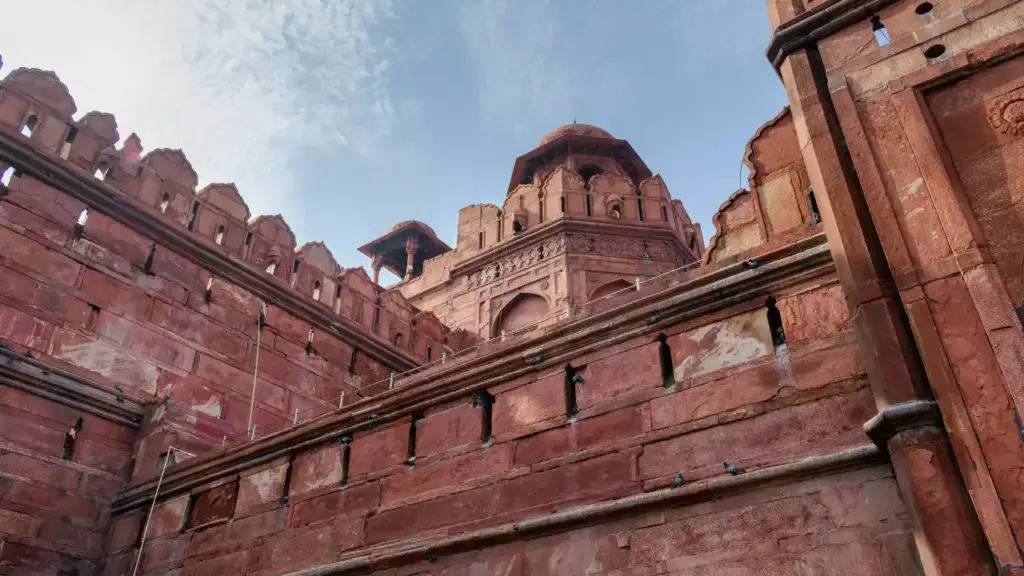
- The Mighty Gates: The fort has three massive, towering gates: the Bada Darwaza (Big Gate), the Humayun Gate, and the Talaqi Gate (Forbidden Gate). These gates are incredibly thick and built for heavy defense, featuring a mix of Hindu-style brackets and Islamic-style pointed arches.
- Qila-i-Kuhna Mosque: Built by Sher Shah Suri, this is one of the most beautiful mosques in Delhi. It perfectly shows the transition from the rough, simple style of the early sultans to the highly decorated, elegant style of the later Mughals. The stonework is a gorgeous mix of red sandstone and white marble.
- Sher Mandal: A small, two-story octagonal tower. It was originally built as a pleasure pavilion, but Humayun later turned it into his personal library and stargazing observatory.
- The Peaceful Lake: The fort is surrounded by a calm, green lake that was originally part of the fort’s defensive moat.
3. Your Comfort, Timings, and Ticketing Details
- Where is it? It is located on Mathura Road, near the Pragati Maidan area, perfectly situated between Old and New Delhi.
- When is it open? It is open every day of the week, from 7:00 AM to 5:00 PM.
- Ticket Prices: Indian citizens pay just ₹30. Foreign tourists pay ₹300.
- Fun Extras: If you like, you can enjoy a 20-minute relaxing boat ride on the lake for about ₹100. There is also a wonderful archaeological museum inside (which is closed on Fridays).
- Time Needed: About 1.5 hours is perfect for a relaxing walk.
4. Our Special Plan for Your Visit
- The Twilight Conclusion: We always schedule your visit to Purana Qila for the late afternoon. The thick walls look stunning as the sun goes down, providing a perfect “atmospheric twilight” feeling.
- Evening Magic: By visiting in the late afternoon, your trip perfectly aligns with the evening light-and-sound show. This spectacular show projects lights onto the ancient ruins and makes the oldest myths of Delhi completely accessible and entertaining for foreign audiences. It is the absolute best way to comfortably conclude a busy day of intense sightseeing.
Monument 5: Lutyens’ Delhi & The Rashtrapati Bhavan – The Colonial Transition
1. The Deep History and Story of the Empire
To truly understand Delhi, you must see its final major transformation. In 1911, the British Empire decided to move the capital of India from Calcutta (now Kolkata) to Delhi. They wanted to build a brand new, highly organized city to show off the ultimate power of the British Raj. They hired two famous British architects, Edwin Lutyens and Herbert Baker, to design it.
This new city took 20 years to build and was finally completed in 1931. The architecture represents a brilliant marriage of traditional European neoclassicism (think giant Roman columns and wide streets) beautifully mixed with traditional Indian motifs.
When India gained its independence in 1947, this area did not lose its power. Instead, it successfully transitioned into the beating heart of the world’s largest democracy. The grand palace built for the British Viceroy became the home of the President of India.
2. The Architectural Marvels You Will See
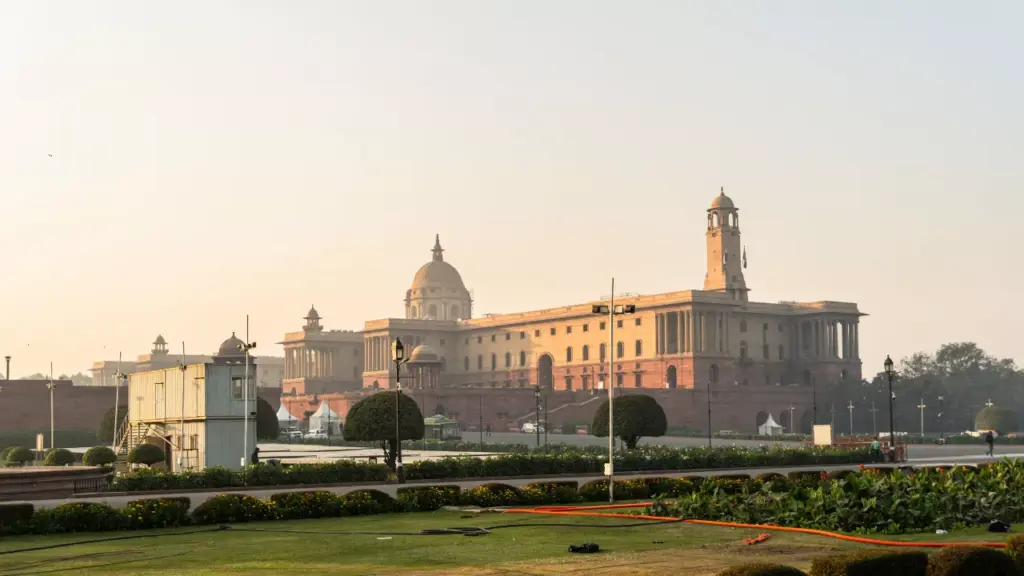
- Rashtrapati Bhavan (The President’s House): This is one of the largest presidential residences in the entire world, containing 340 rooms. It is a stunning building that uses classic Indian features, like small stone umbrellas (chhatris), elephant statues, and carved stone screens (jaalis), but wraps them in a grand European layout. It also features the beautiful Mughal Gardens (now named Amrit Udyan).
- The North and South Blocks: These two giant, matching buildings sit on a hill just below the President’s House. They house the most important government ministries of India.
- India Gate: At the far end of the grand boulevard stands this massive 42-meter-high archway. It is a war memorial built to honor the 70,000 Indian soldiers of the British Indian Army who lost their lives during World War I.
- Kartavya Path (formerly Rajpath): The incredibly wide, beautiful, tree-lined avenue that connects India Gate to the President’s House. It is the site of India’s famous Republic Day parade every January.
3. Your Comfort, Timings, and Ticketing Details
- Where is it? This area is located right in the center of New Delhi.
- When is it open? Because these are active government streets, you can drive through the area at any time of day or night for free. (Going inside the actual President’s House requires booking special tickets online weeks in advance, but the exterior view is magnificent on its own).
- Best Time to Visit: Early mornings or late evenings are best, as the buildings are beautifully lit up at night, and the daytime traffic is avoided.
4. Our Special Plan for Your Visit
- A Relaxing Driving Tour: The scale of Lutyens’ Delhi was specifically designed by the British for “imperial optics”—meaning it was built to look massive and intimidating. Because the distances are so huge, we do not make you walk this area. Instead, we use this space for a luxurious, comfortable driving tour.
- The Spatial Contrast: As you relax in your air-conditioned car, your guide will point out the amazing “spatial contrast”. You will instantly feel the drastic shift from the claustrophobic, narrow, maze-like “inner-city” streets of the Mughal monuments you saw earlier, to the expansive, highly structured, wide-open spaces of this modern “open-city”. It is the perfect, relaxing way to see how Delhi evolved into the modern world.
| Monument | Primary Material | International Fee | Security Fee / Extra | B2B Strategy | Core Narrative Focus | Optimal Arrival Slots |
| Qutub Minar Complex | Brick, Stone & Marble | ₹550 | ₹25 (Pro Video Camera) | Context-First Rule & Heat-Avoidance | Foundation of Islamic Rule & Architectural Transition | 7:00 AM – 8:00 AM |
| Humayun’s Tomb | Red Sandstone & Marble | ₹550 | None | Exclusive Early Access & Sensory Experience | Garden Paradise (Charbagh) | 8:00 AM |
| Red Fort (Lal Qila) | Red Sandstone | ₹550 | None | The “Empire Walk” Strategy | Peak of Imperial Mughal Power | Early / Cool Morning |
| Purana Qila (Old Fort) | Stone, Sandstone & Marble | ₹300 | None | The Twilight Conclusion & Evening Magic | Ancient Mythology & Afghan/Mughal Mix | Late Afternoon |
| Lutyens’ Delhi | Sandstone & Brick | Free (Exterior Drive) | None | A Relaxing Driving Tour & Spatial Contrast | Colonial Transition & Modern Democracy | Early Morning or Late Evening |