Trimbakeshwar — The Jyotirlinga of Three Faces
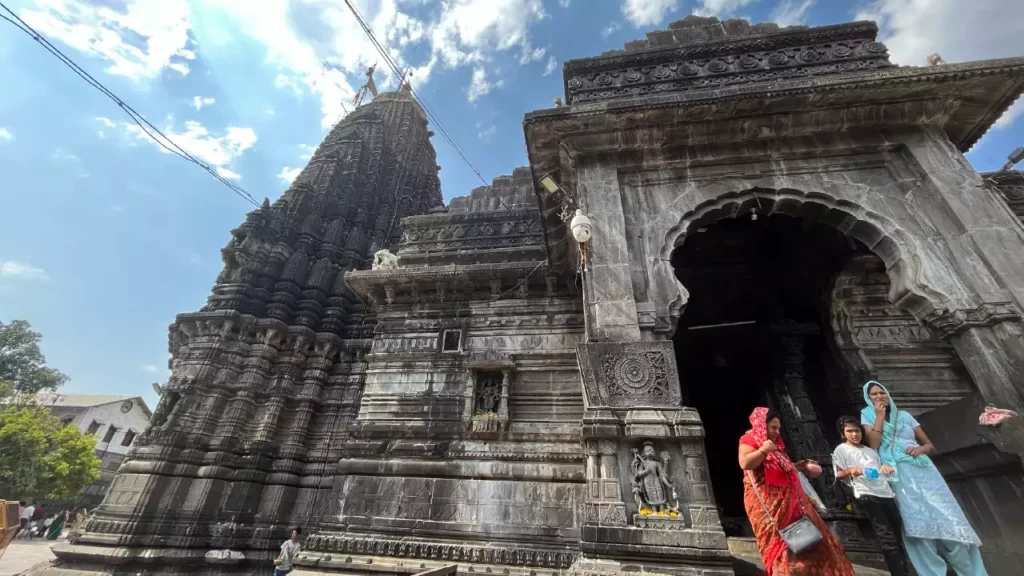
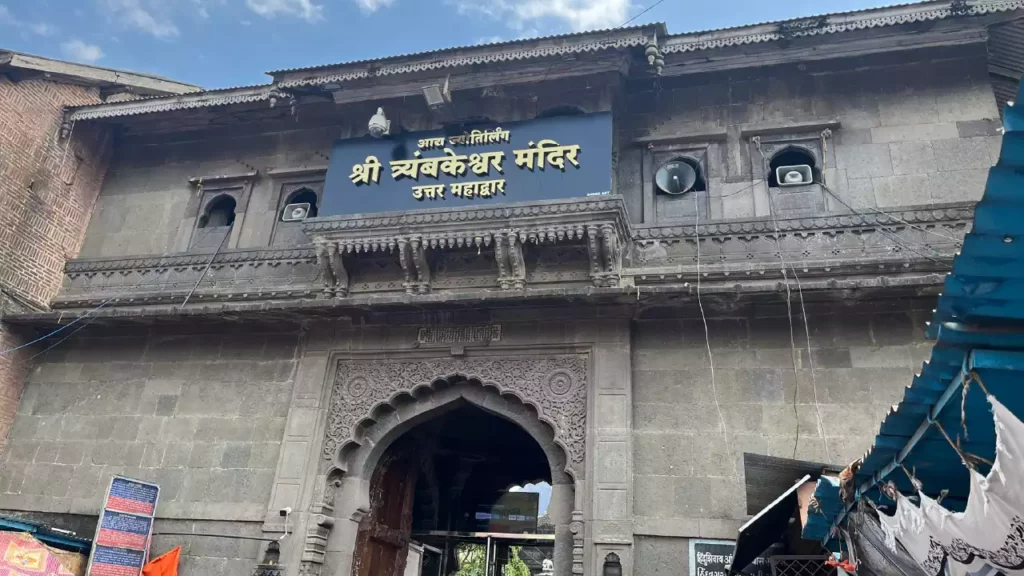
Trimbakeshwar Temple stands at the base of the Brahmagiri Hills, 28 kilometres west of Nashik in Maharashtra, enshrining one of the twelve Jyotirlingas in a form that is unique among them all. The Trimbakeshwar Jyotirlinga has three faces — representing the Trimurti: Lord Brahma, Lord Vishnu, and Lord Rudra (Shiva). No other Jyotirlinga embodies the three primary cosmic functions of creation, preservation, and dissolution in a single form. The name itself encodes this meaning: “Trimbak” means “three-eyed” (a Shaiva epithet) or, by another interpretation, “three banks/shores” — the meeting point of the Godavari with two other streams.
The Godavari River — the longest river of the Deccan plateau and one of the seven sacred rivers of Hinduism — is believed to originate here, from the Kusavarta Kund within the temple complex. The temple thus sits at the source of the river that nourishes the Deccan, adding a literal and spiritual dimension of life-giving power to the site. Pilgrims who bathe in the Kusavarta Kund believe they receive the combined merit of bathing in all the tirthas along the Godavari from source to sea.
History and the Legend of Brahma’s Curse
The founding legend of Trimbakeshwar is connected to the cosmic story told across multiple Puranas. Lord Brahma and Lord Vishnu were engaged in an argument about who was the supreme deity. Lord Shiva manifested between them as an infinite pillar of fire — a Jyotirlinga — and challenged each to find its end. Vishnu took the form of a boar and dove down; Brahma took the form of a swan and flew upward. Neither could find the end of the pillar. Brahma, however, lied: he claimed to have found the top of the pillar, citing the ketaki flower as a false witness.
Shiva, who knew the truth, cursed Brahma that he would never be worshipped in temples. He also, by different accounts, retreated underground at this spot — and the lingam at Trimbakeshwar is a low-lying, embedded linga, nearly flush with the ground, reflecting this legend of Shiva’s self-concealment. The three faces of the linga represent the three deities and the three cosmic functions they embody.
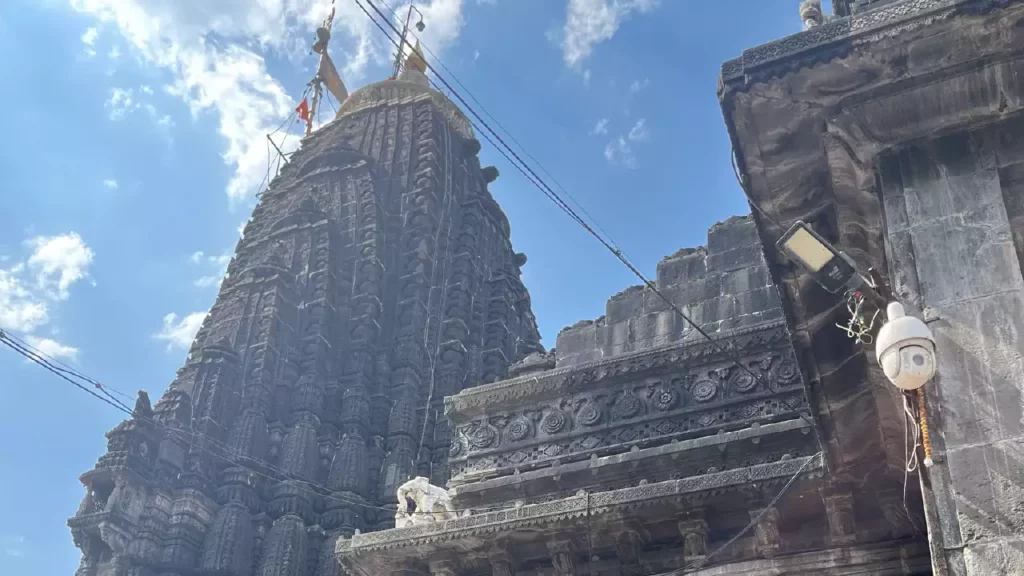
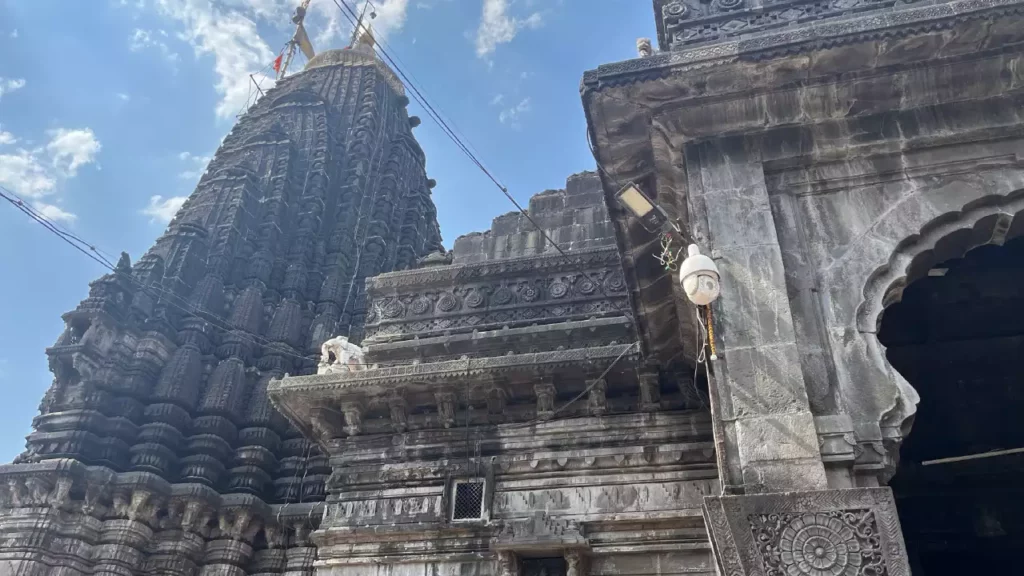
The current temple was built in the 18th century (completed around 1755–1786 CE) by the Peshwa ruler Balaji Bajirao (known as Nana Saheb) in the Hemadpanthi architectural style, which is characteristic of Maharashtra’s medieval temple tradition — black basalt stone, shikhara towers, and dense decorative carving.
The Three-Faced Linga and the Ratna Mukut
The Trimbakeshwar Jyotirlinga is distinctive in its physical form. The linga is small and set very low inside the garbhagriha (inner sanctum), partially sunk into the floor in a silver depression. Three small faces representing Brahma, Vishnu, and Shiva are carved on the linga, though these are often covered by the Ratna Mukut — a gold crown set with rubies, emeralds, and diamonds donated to the temple over the centuries. The Ratna Mukut is considered among the most valuable items in any Hindu temple treasury. It is displayed only on special occasions.
The garbhagriha at Trimbakeshwar has an unusual access rule: only male devotees wearing a sovala (a five-yard silk dhoti) are permitted inside the inner sanctum. Women and those in regular clothing view the linga from the outer chamber. If devotees wish to participate in the Rudrabhishek (ritual bathing of the linga with milk, honey, water, and bilva leaves), they must engage one of the temple’s authorised pandits in advance.
Kumbh Mela at Nashik — Simhastha
Nashik and Trimbakeshwar together host the Kumbh Mela (Simhastha) every 12 years, one of four Kumbh Mela sites in India. The sacred bathing takes place in the Godavari River at Nashik’s Ram Kund and Trimbak Ghat. The Simhastha at Nashik-Trimbak occurs when Jupiter enters Leo (Simha) and the Sun is in Aries. The last was held in 2015; the next falls in 2027.
During the Kumbh, 13 Akharas (monastic orders) arrive in Nashik with their processions of saints and sadhus. The Shahi Snan (royal bath) on principal Kumbh dates draws tens of millions of pilgrims. The Nashik Kumbh is somewhat smaller than those at Prayagraj and Haridwar but retains enormous significance, particularly for Maharashtra’s Shaiva and Varkari communities.
Narayan Nagbali, Kaal Sarp Dosh, and Tripindi Shradha
Trimbakeshwar holds a special place in Hindu ritual tradition for three specific rites performed nowhere else with the same authority:
- Narayan Nagbali: A two-part ritual performed to appease the soul of an ancestor who died violently or from snakebite, and to neutralise the negative karma of having killed a snake. Few temples in India have the authorisation (adhikar) to conduct this complex rite.
- Kaal Sarp Dosh Puja: Trimbakeshwar is the most renowned site in India for Kaal Sarp Dosh Puja — performed when all seven planets in a person’s horoscope fall between Rahu and Ketu. Large numbers of pilgrims visit specifically for this puja, often on amavasya (new moon) days.
- Tripindi Shradha: A special ancestor rite (shradha) for pacifying the souls of three generations of ancestors simultaneously, performed at Trimbakeshwar during Pitrupaksha and at other times by appointment.
For these specialised rites, advance booking with an authorised Trimbakeshwar pandit is essential. The rites involve specific materials, timings, and Vedic mantras and can take several hours to complete.
Darshan Timings
- Morning: 5:30 AM – 9:00 PM (general darshan)
- Kakad Aarti (dawn): 5:30 AM
- Noon Aarti: 12:00 PM
- Sandhya Aarti: 7:00 PM
- Shayan Aarti: 9:00 PM
- On Mahashivaratri: 24-hour darshan with multiple aarti sessions
How to Reach Trimbakeshwar Temple
- From Nashik: 28 km by road (NH848); regular buses and shared taxis from Nashik CBS (Central Bus Stand), journey approximately 45 minutes
- By train: Nashik Road Station is the nearest railhead, 35 km from Trimbakeshwar; well-connected to Mumbai (167 km), Pune (212 km), and Delhi
- By air: Ozar Airport (Nashik Airport) is 30 km away; serves flights from Delhi, Hyderabad, and other metros
- By road: Mumbai–Nashik: 165 km via Mumbai–Nashik Expressway (NH3); Pune–Nashik: 212 km
Nearby Sacred Sites
The Brahmagiri Hills directly behind the temple are a sacred zone in themselves — the trek to the summit passes the Godavari’s source spring, multiple small shrines, and the Ganga Dwara (gate of the Ganga), where the river emerges from the hillside. The trek takes 2–3 hours and is popular with pilgrims. Anjaneri Hill, 7 km from Trimbakeshwar, is the birthplace of Lord Hanuman according to local Maharashtrian tradition. The Nivruttinath Temple at Trimbak town is a significant Varkari pilgrimage site — Nivruttinath was the elder brother and guru of the great saint Dnyaneshwar. The Saptashringa Devi Temple, 68 km from Nashik, is one of Maharashtra’s most important Shakti shrines.
See our Nashik and Trimbakeshwar travel guide for logistics and itinerary. Travel the Jyotirlinga circuit with our Shirdi and Jyotirlinga 4N/5D tour. Further reading: Top 10 temples in India.