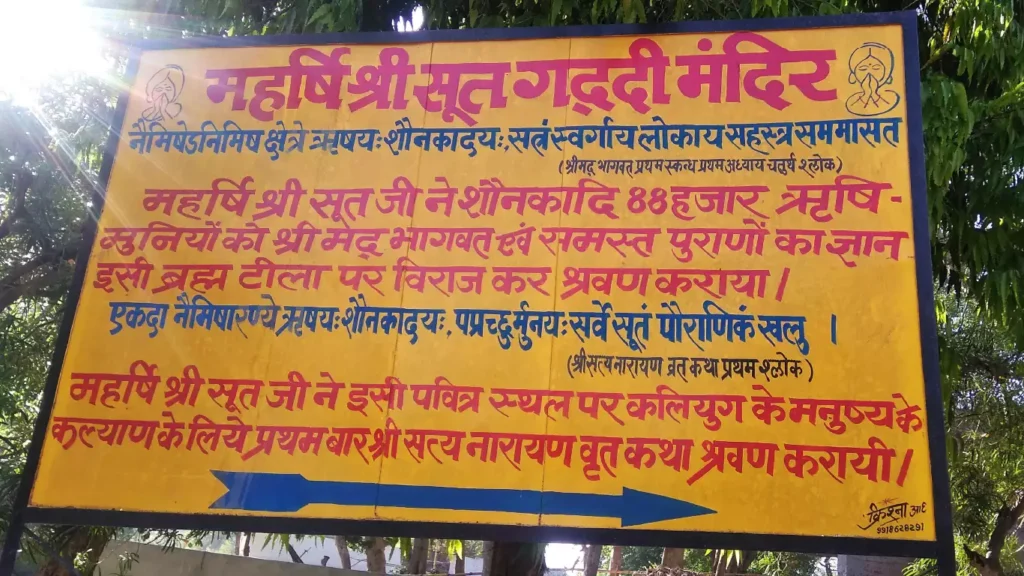
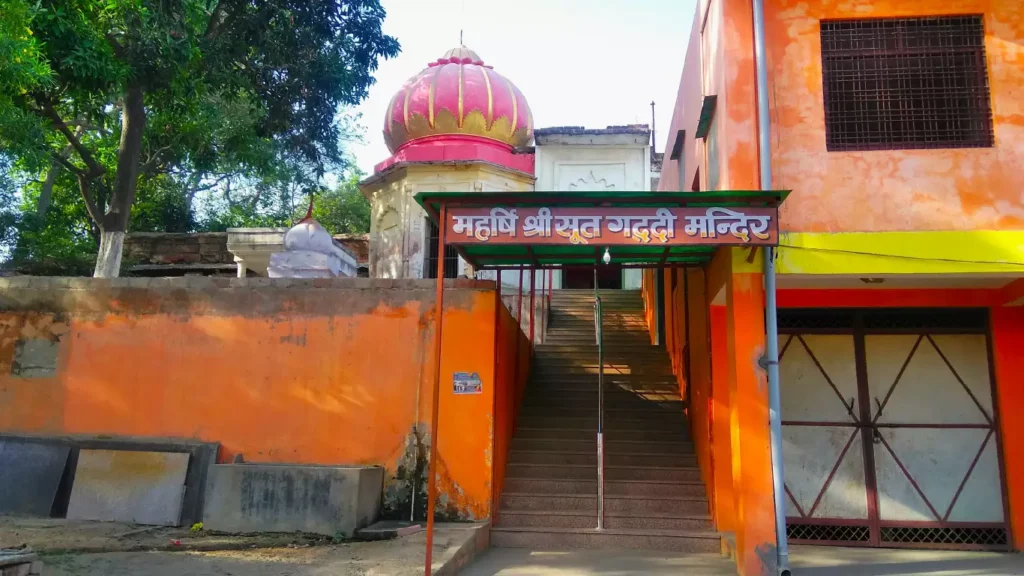
Suta Gaddi in Naimisharanya is the elevated seat — literally a “gaddi” (throne or elevated platform) — from which Suta Goswami recited the Srimad Bhagavata Purana and all 18 Mahapuranas to an assembly of 88,000 rishis led by Shaunaka. This is not a small historical footnote. The Puranas are the living scripture of popular Hinduism — the texts that encode the stories of the gods, the explanations of cosmic cycles, the rituals of everyday devotion, and the philosophy of liberation. When Suta sat here and began to speak, the tradition holds that he was transmitting knowledge that had come down from Brahma through an unbroken chain of divine teachers, and that this transmission happened at this precise spot for a reason: Naimisharanya was, and is, the place on earth where such knowledge could be received most clearly.
Who Was Suta Goswami?
Suta Goswami — also called Sauti, Ugrasravas, or simply Suta — occupies a unique position in Hindu sacred literature. He was a sutaputra, meaning a person born of a mixed Brahmin-Kshatriya lineage, which in the strict caste hierarchy of ancient India placed him in an ambiguous social position. He was not a Brahmin by birth. And yet he became the primary narrator of some of the most sacred texts in the Hindu tradition, including the Bhagavata Purana, the Vishnu Purana, and significant portions of the Mahabharata.
His teacher was Srila Shukadeva Goswami — the son of the sage Vyasa — who had himself received the Bhagavata Purana from his father and had first recited it to King Parikshit during the seven days before Parikshit’s death from the curse of a serpent bite. Suta had been present at that original recitation, listening as Shukadeva narrated to the dying king. He then carried that knowledge to Naimisharanya, where the assembly of rishis under Shaunaka begged him to share what he had heard.
The framing of the Bhagavata Purana — Suta narrating at Naimisharanya what Shukadeva had told to Parikshit — is itself a teaching about the nature of sacred knowledge: it travels through human teachers, each transmission adding something of the transmitter’s own realisation to the words. Suta’s recitation was not a mechanical repetition of Shukadeva’s words; it was a living transmission shaped by his own deep understanding of what he had heard.
The 88,000 Rishis and the First Recitation
The assembly that gathered at Naimisharanya to hear Suta was extraordinary even by the standards of Puranic narrative, where large numbers are commonplace. 88,000 sages — representing the full range of the Vedic learning traditions, different sampradayas (lineages), and regions of ancient India — had gathered in this forest for a prolonged yagna (sacrificial gathering) at the request of Shaunaka, who was recognised as the presiding elder. When Suta arrived, having come from witnessing the recitation to Parikshit, the sages immediately understood that he was carrying something extraordinary. Shaunaka questioned him, and in response Suta gave the first narration of the Bhagavata to a general assembly.
The choice of Naimisharanya for this first public recitation was not accidental. The forest was already understood as the place where Vedic and cosmic knowledge was most safely held and transmitted. The sages who lived here were not casual students — they were among the most advanced practitioners of the age, and their collective spiritual attainment meant that the knowledge Suta was about to share would find receptive ground.
The Satyanarayana Vrata and Other Teachings
One of the most widely practiced rituals in Hindu households today — the Satyanarayana Vrata (also called Satyanarayana Puja) — was narrated by Suta Goswami for the first time at Suta Gaddi. This vrata, dedicated to Lord Vishnu in his form as Satya Narayan (the Lord of Truth), is performed across India and the Hindu diaspora on virtually every auspicious occasion: house warming, weddings, birthdays, business openings, and festival days. The narrative of the Satyanarayana Vrata — the story of how devotees who performed this puja were rewarded with prosperity and protected from misfortune — was first told by Suta to the assembled rishis at Naimisharanya.
Suta also taught at this seat the Ekadashi vratas (the eleven fasting days per month considered sacred to Vishnu), the significance of Ganesha Chaturthi, and numerous other devotional practices that have become part of the standard fabric of Hindu religious life. The influence of what was taught at Suta Gaddi, in other words, extends into the daily religious lives of hundreds of millions of people who have never heard of the place.
The Physical Site and Its Atmosphere
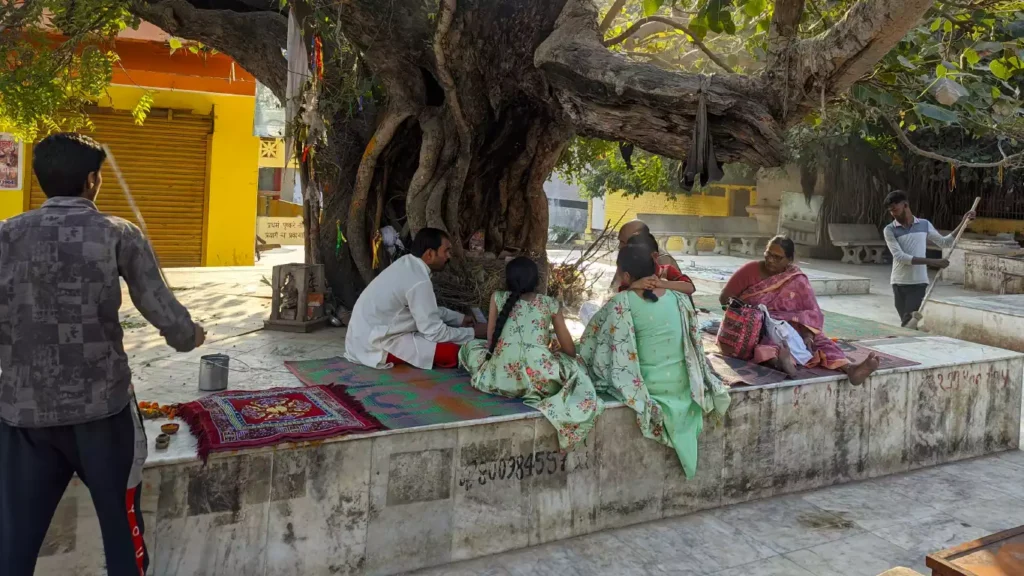
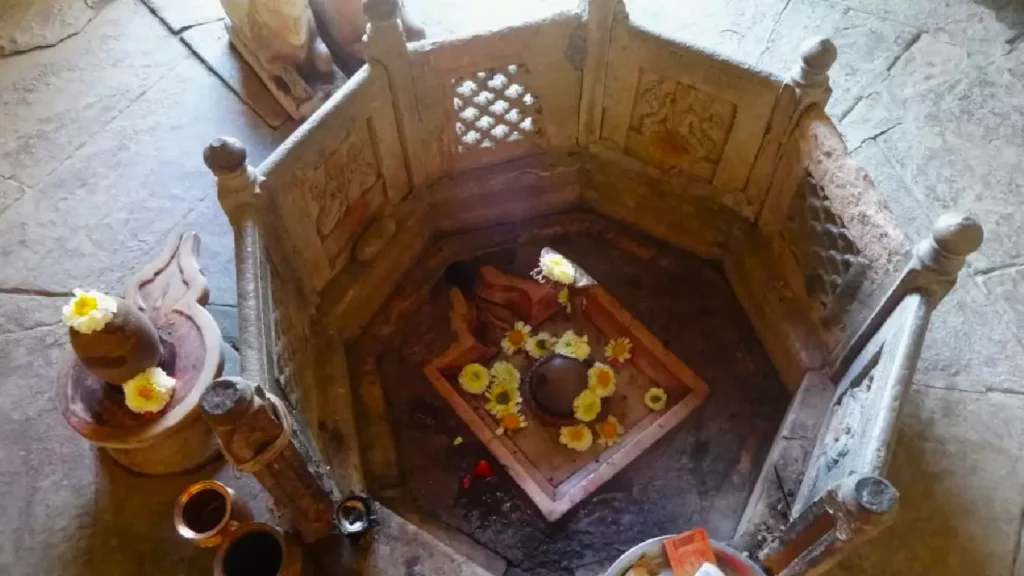
The Suta Gaddi today is a raised platform with a shrine marking the spot where Suta is said to have sat. The platform looks out over the surrounding forest and temple complex of Naimisharanya, giving it a quality of elevated perspective that feels appropriate for a site of knowledge transmission. Pilgrims who visit typically sit on the steps of the gaddi and observe a period of silence or scripture recitation before moving on to the rest of the Naimisharanya circuit.
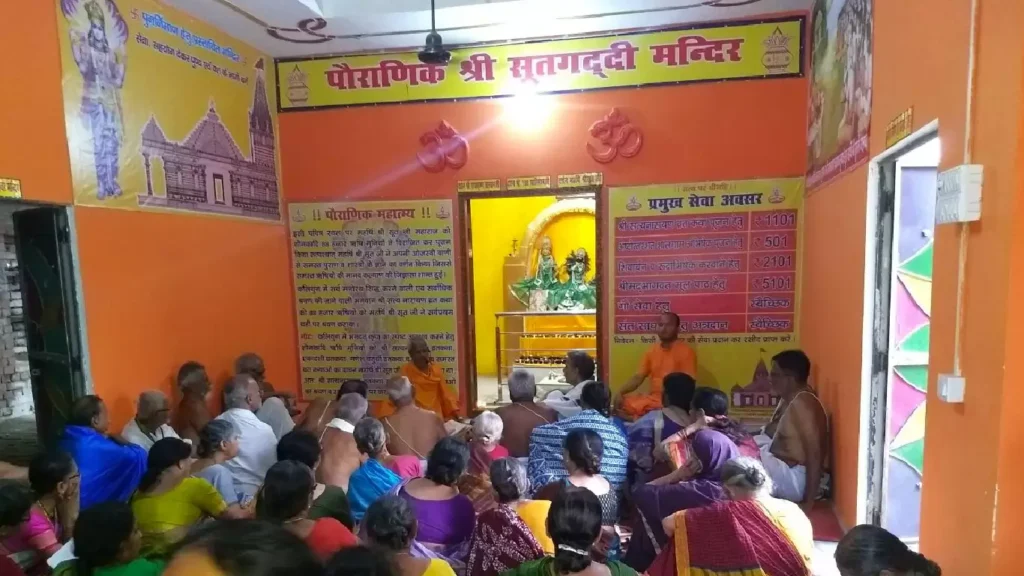
Recitations of the Bhagavata Purana are regularly held at or near Suta Gaddi, continuing the tradition of oral transmission that began here. During major festivals — particularly Kartik Purnima and the Naimisharanya Mela — extended recitations called Bhagavata Saptah (seven-day Bhagavata readings) are organised, with professional scholars narrating the entire text over seven consecutive days in an echo of the original recitation to King Parikshit.
Connection to Vyas Gaddi and the Broader Circuit
Suta Gaddi is most meaningfully visited in conjunction with Vyas Gaddi — the seat of Sage Vyasa, who compiled the Vedas and wrote the Mahabharata and the original Bhagavata Purana, also at Naimisharanya. The two gaddis represent the two ends of a transmission chain: Vyasa composed and compiled; Suta narrated and disseminated. The forest of Naimisharanya was the common ground for both activities. Together, the two sites form the most significant literary-spiritual complex in the entire Hindu pilgrimage tradition.
For a complete guide to the Naimisharanya pilgrimage including Suta Gaddi, Vyas Gaddi, Chakra Teerth, and Dadhichi Kund, see our Naimisharanya travel guide. Our UP Pilgrimage tour package includes Naimisharanya alongside Prayagraj, Ayodhya, and Varanasi in a comprehensive journey through the sacred heartland of North India.