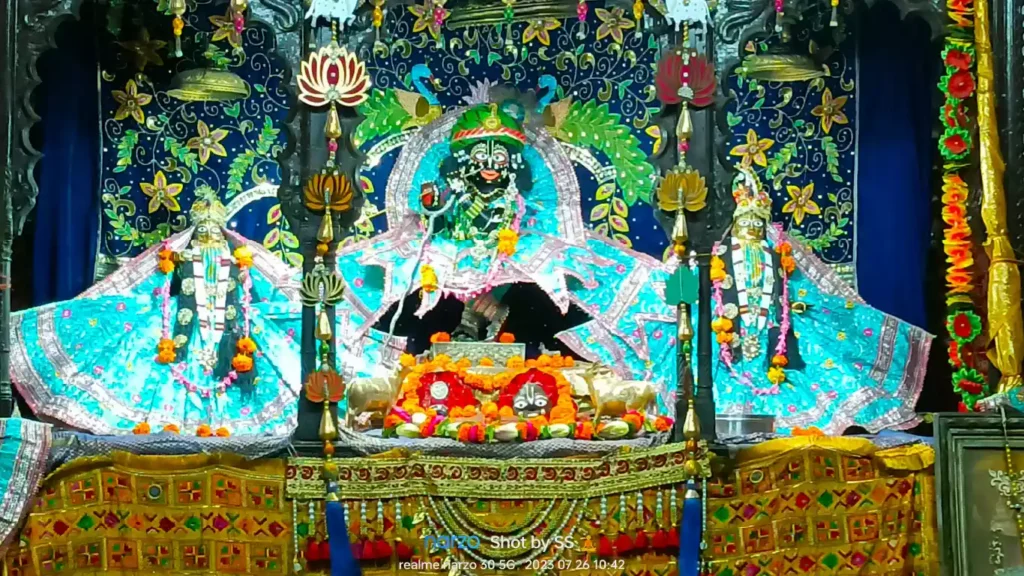
Gopeshwar Mahadev Temple in Vrindavan holds a singular place among the Braj sacred sites — it is one of the very few temples in this overwhelmingly Vaishnava city that is dedicated to Lord Shiva. Located close to Vanshi Vat (the sacred kadamba tree where Krishna is said to have played his flute) and the banks of the Yamuna River, Gopeshwar Mahadev is revered not as a standalone Shaiva site but as an expression of Shiva’s complete devotion to Krishna. The name Gopeshwar means “Lord of the Gopis” — a title Shiva earned through an act of singular surrender that is told across the Braj tradition with great tenderness.
The Story of How Shiva Became a Gopi
The founding legend of this temple is one of the most charming stories in Braj theology. On the night of Sharad Purnima — the full moon night of the autumn season — Lord Krishna performed the Maha Raas Leela on the banks of the Yamuna with Radha Rani and the gopis of Vrindavan. The celestial event was so suffused with divine bliss that Lord Shiva, sitting in meditation on Mount Kailash, felt its vibration and was overcome by a longing to witness it.
He descended to Vrindavan and approached the site of the Raas Leela, but Vrinda Devi (the presiding deity of Vrindavan forest) stopped him at the boundary, explaining that the Raas was exclusively for the gopis and no man could enter. Undeterred, Shiva meditated on Goddess Radha with complete one-pointed devotion. Moved by his surrender, Radha Rani appeared to him and instructed him to bathe in the sacred waters of the Yamuna and emerge in the form of a gopi. Shiva did so, and transformed into a beautiful woman — in this female form, adorned with the ornaments of a Braj gopi, he was permitted entry into the Raas mandal. Krishna, recognising Shiva even in this disguise, received him with great warmth and gave him the name Gopeshwar — the Gopi who is also the Lord.
After the Raas concluded, Shiva resumed his original form and installed a Shivalinga at this spot, vowing to remain in Vrindavan forever as Gopeshwar Mahadev, in perpetual witness of Krishna’s leelas. That Shivalinga, believed to have been established by Vajranabha (Krishna’s great-grandson) during the excavation and restoration of the Braj sacred sites, is the deity worshipped in this temple today.
The Deity and Temple Architecture
The main Gopeshwar Shivalinga is installed in a small sanctum that is notably intimate in scale — the kind of ancient temple where the distance between devotee and deity feels almost non-existent. The lingam is traditionally dressed in the ornaments of a gopi: flower garlands, bangles, and a chunari (veil). This unusual shringar (ornamentation) is a direct reference to the founding legend and is unique to Gopeshwar Mahadev among all Shaiva temples in India. Devotees — whether Shaiva or Vaishnava — come here specifically to witness this image of Shiva in his state of complete devotional surrender to Krishna.
The temple compound includes a small courtyard with a peepal tree that is considered sacred, and a tank fed by the nearby Yamuna. The architecture is modest by the standards of the grand temples of Vrindavan, but this simplicity is part of the temple’s appeal: there is nothing here to distract from the devotional intensity of the place.
Theological Significance in Gaudiya Vaishnavism
Gopeshwar Mahadev occupies a distinctive position in Gaudiya Vaishnava theology. The Goswamis of Vrindavan — the six disciples of Sri Chaitanya Mahaprabhu who established the major sampradayas of Vrindavan in the 16th century — taught that Shiva’s transformation into a gopi represents the highest possible state of devotional surrender: the dissolution of all ego, gender, and identity in the face of divine love. Visiting Gopeshwar Mahadev is therefore considered not a departure from Vaishnava pilgrimage but a deepening of it.
The Gaudiya tradition teaches that Gopeshwar Shiva is the kshetrapala (guardian) of Vrindavan — the divine protector who watches over the sacred city and all who enter it with sincere devotion. It is traditional for pilgrims beginning the Vrindavan parikrama (circumambulation of the city) to first seek the blessings of Gopeshwar Mahadev before proceeding to the Vaishnava temples.
Festivals and Best Time to Visit
The most important festival at Gopeshwar Mahadev is Maha Shivaratri, when the temple stays open through the night and Shiva devotees perform abhisheka (ritual bathing of the lingam) with milk, honey, and sacred water. Sharad Purnima — the anniversary of the Raas Leela night — is the other significant occasion, when the temple is especially crowded with Vaishnava pilgrims re-enacting the night’s story through devotional song and recitation. The Yamuna ghats near the temple are used for ritual bathing on both these occasions.
Getting to Gopeshwar Mahadev Temple
The temple is located in the older part of Vrindavan, near the Yamuna embankment and close to Kesi Ghat. From Vrindavan’s main bazaar (Loi Bazaar area), it is a 10-15 minute walk or a short e-rickshaw ride (₹20-30). The lanes approaching the temple are narrow but passable on foot. The temple opens at sunrise and closes after the evening aarti; timings vary slightly by season. Entry is free.
For a full guide to Vrindavan’s temples, ghats, and sacred sites, visit our Vrindavan teerth-sthal guide. Gopeshwar Mahadev is included on our Mathura-Vrindavan 4N/5D tour package, which covers both the major and lesser-known sites of this sacred region.