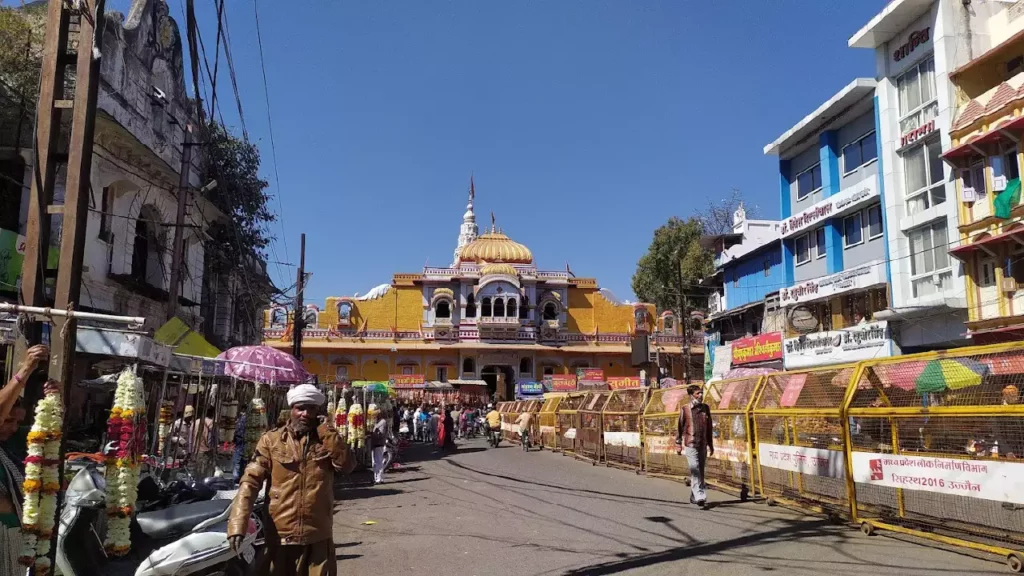
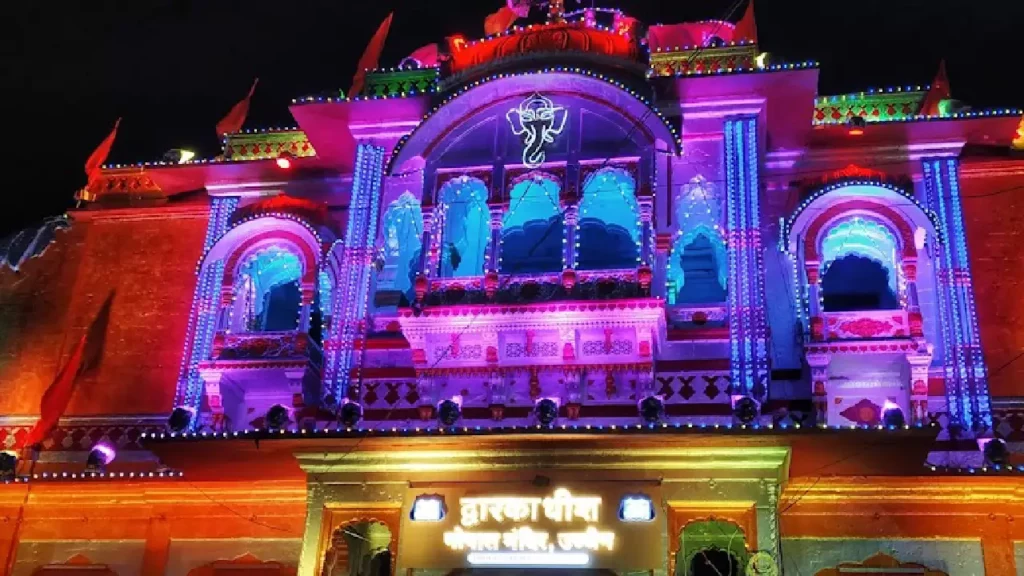
Dwarkadhish Gopal Mandir stands in the heart of Ujjain’s commercial centre, roughly 2 km from Ujjain Junction. Dedicated to Lord Krishna in his form as the Lord of Dwarka, the temple is the second-largest shrine in Ujjain after Mahakaleshwar and draws thousands of devotees every day. Its shining marble tower rising above the busy market lanes of the city is one of the most recognisable sights in all of Avantika.
History and Founding
The temple was built in the 19th century by Bayajibai Shinde, the consort of Maratha king Daulatrao Shinde and one of the most prominent women rulers of the Scindia dynasty. The site was originally a property of the Scindia Estates, and Bayajibai converted it into a grand Vaishnava shrine. The building is now approximately 200 years old, though the site’s sanctity as a place of Krishna worship is considerably older. The Scindia family maintained a close connection with this temple for generations, and the structure reflects the refined tastes and deep devotion of the Maratha court.
The Sacred Idol and the Silver Doors
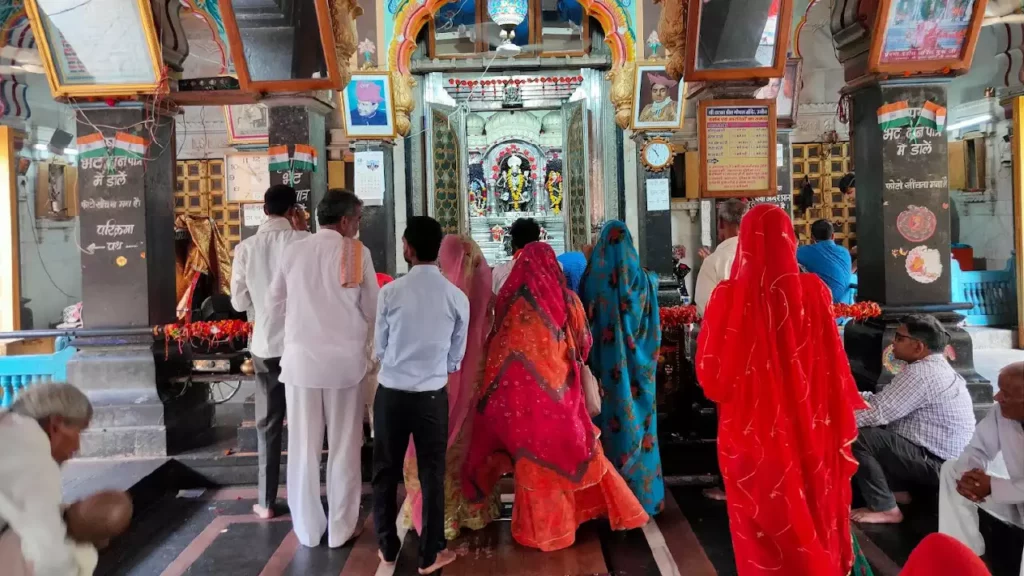
The presiding deity is a two-foot-tall idol of Lord Krishna, crafted and silver-gilded, placed on a marble altar flanked by silver-plated doors. These doors carry their own remarkable story. They were originally part of the Somnath Temple, one of the twelve Jyotirlingas in Gujarat, from where they were taken away by Mahmud of Ghazni during his raids. The doors then passed to Lahore under Mahmud Shah Abdali. After a long diplomatic and cultural effort, they were eventually recovered and installed at Gopal Mandir in Ujjain, giving this temple an almost mythic connection to India’s shared religious history. Inside the sanctum, alongside Lord Krishna, devotees can also take darshan of Lord Shiva, Goddess Parvati, and Garuda.
Architecture: Maratha Craftsmanship in Marble
The temple is a fine example of Maratha architecture, characterised by its white marble shikhara, ornamental carvings, and the use of precious metals in the sanctum interior. The design favours a clean, elevated aesthetic rather than heavily layered ornamentation, reflecting the Scindia court’s synthesis of Rajput, Mughal, and traditional Hindu architectural idioms. The courtyard is spacious, allowing large numbers of pilgrims to gather comfortably, which becomes particularly important during major festivals when the entire square fills with devotees.
Festivals: Harihar Parva and Janmashtami
The two most important celebrations at Gopal Mandir are Janmashtami and the Harihar Parva. Janmashtami, the birth anniversary of Lord Krishna, is observed with midnight abishek, elaborate decorations, and continuous kirtan throughout the night. Tens of thousands of devotees crowd into the temple complex and the surrounding market area for this celebration.
Harihar Parva is a distinctly Ujjain tradition that commemorates the union of Lord Krishna (Hari) and Lord Shiva (Har). On this night, the Mahakal idol from the Mahakaleshwar temple is brought in a ceremonial procession to Gopal Mandir, where Lord Mahakal is said to visit Lord Krishna. The main puja following this union lasts for about two hours through the midnight hours, and the atmosphere — with the sound of conch shells, cymbals, and chanting filling the old city’s lanes — is deeply moving for anyone present.
Connection to Mahakaleshwar and the Ujjain Pilgrimage Circuit
Ujjain is one of the seven Moksha-puri cities of Hindu tradition — the others being Ayodhya, Mathura, Haridwar, Kashi, Kanchipuram, and Dwarka. As the city of Lord Mahakal (a form of Shiva), Ujjain is primarily associated with Shaivism, but Gopal Mandir ensures that Vaishnava tradition is equally celebrated here. A complete Ujjain darshan typically includes Mahakaleshwar, Gopal Mandir, Kaal Bhairav Temple, Harsiddhi Temple, and Ram Ghat, making the city a full Sanatana pilgrimage experience rather than a single-deity visit.
During the Simhastha Kumbh Mela, held every twelve years in Ujjain, the entire city comes alive as millions of pilgrims arrive to bathe in the Kshipra River. Gopal Mandir becomes a focal point for Vaishnava sampradayas during this period, and the market square around it becomes one of the busiest gathering points in the city. The next Simhastha Kumbh in Ujjain will be in 2028.
Visiting Gopal Mandir: Practical Information
The temple is open from early morning until late evening, typically from 5:00 AM to 12:30 PM and again from 4:00 PM to 10:00 PM, with slight variations by season. The aarti timings follow a schedule similar to other Ujjain temples and are announced at the temple. The location in the centre of the market makes it easily accessible on foot from most parts of the old city. Auto-rickshaws and e-rickshaws connect the temple to Ujjain Junction and other major shrines.
Photography is restricted inside the sanctum. Footwear must be removed before entering the temple complex. The market around the temple sells a wide variety of prasad, flowers, and silver items associated with Lord Krishna.
Explore our complete Ujjain travel guide for all the temples, ghats, and pilgrimage routes. Book our Ujjain 4N/5D Mahakal tour package to cover all the major shrines. Also read about the top temples of India for context on India’s most sacred destinations.