The Divine Enchanter of Vrindavan
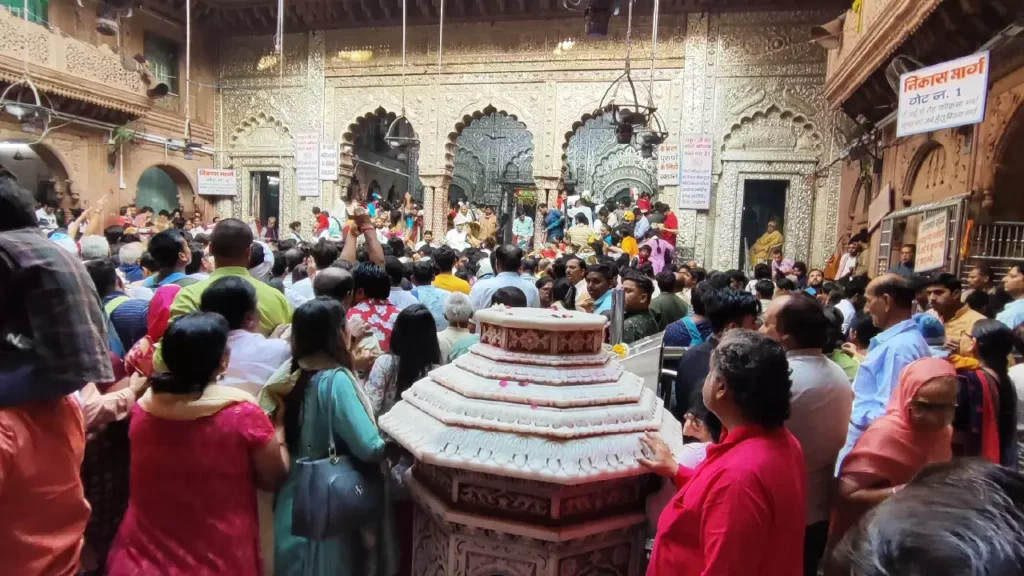
Shri Banke Bihari Mandir is Vrindavan’s most beloved and most ecstatically charged temple. Among the thousands of Krishna temples in the Braj region, Banke Bihari occupies a singular place — not for architectural grandeur but for the sheer intensity of devotion that fills the shrine every single day. Pilgrims who arrive expecting a formal, structured temple experience often find themselves caught off guard by the spontaneous outbursts of ecstatic love, the dense clouds of incense and flower petals, and the curtain system that periodically hides and reveals the deity as if even a prolonged gaze from mere mortals might be too much.
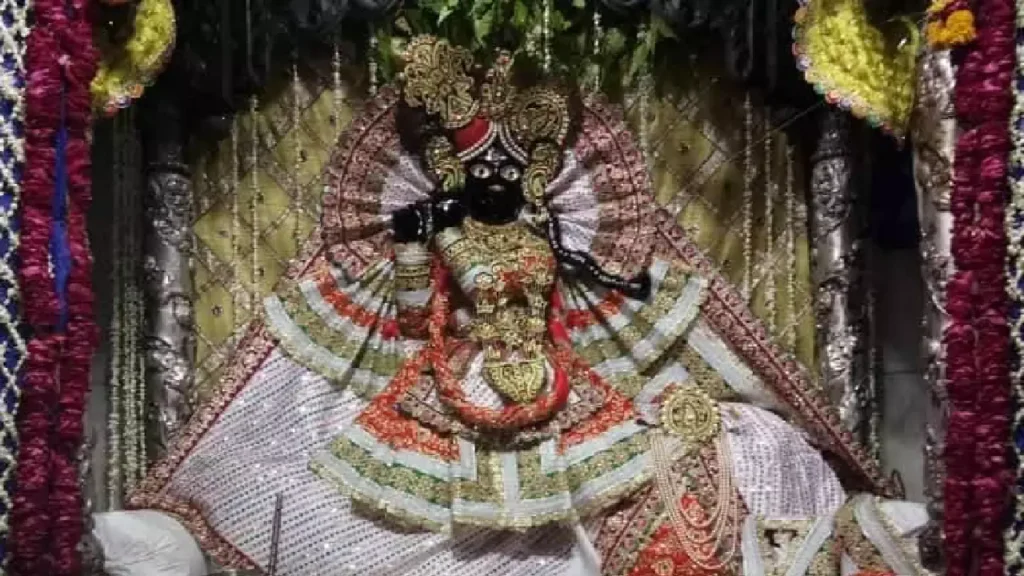
The name “Banke Bihari” encapsulates the deity’s essence: “Banke” means bent in three places — the classic Tribhanga posture in which Krishna stands, weight shifted onto one leg, flute raised, hips curved. “Bihari” means the greatest enjoyer, the one who delights in the pleasures of Vrindavan — the forests, the Yamuna, the rasa-lila dances, the love of the gopis. This idol is Krishna not as a warrior or a teacher but as the eternal lover and playful child of Vrindavan.
The Discovery of the Idol — Swami Haridas and Bihariji
The origin of the Banke Bihari idol is one of Vrindavan’s most treasured devotional stories. In the 16th century, the great saint and musician Swami Haridas — teacher of the court musician Tansen and a devotee of extraordinary intensity — was meditating in the Nidhivan grove of Vrindavan. He is said to have heard a divine voice directing him to dig at a particular spot. He did, and found a beautiful black stone idol of Krishna in the Tribhanga posture, accompanied by the idol of Radha. The idol was originally called Kunj Bihari — the lover of the forest groves — and is said to have emerged in response to Swami Haridas’s devotional singing.
Initially the idol was worshipped in Nidhivan, where Swami Haridas had found it. Later it was moved to the current temple location. The Radha idol was kept separate — at Banke Bihari, Radha is not displayed alongside Krishna as she is at most Vrindavan temples; instead, the two are worshipped together only on Radhashtami, the birthday of Radha.
The Unique Character of Banke Bihari Temple
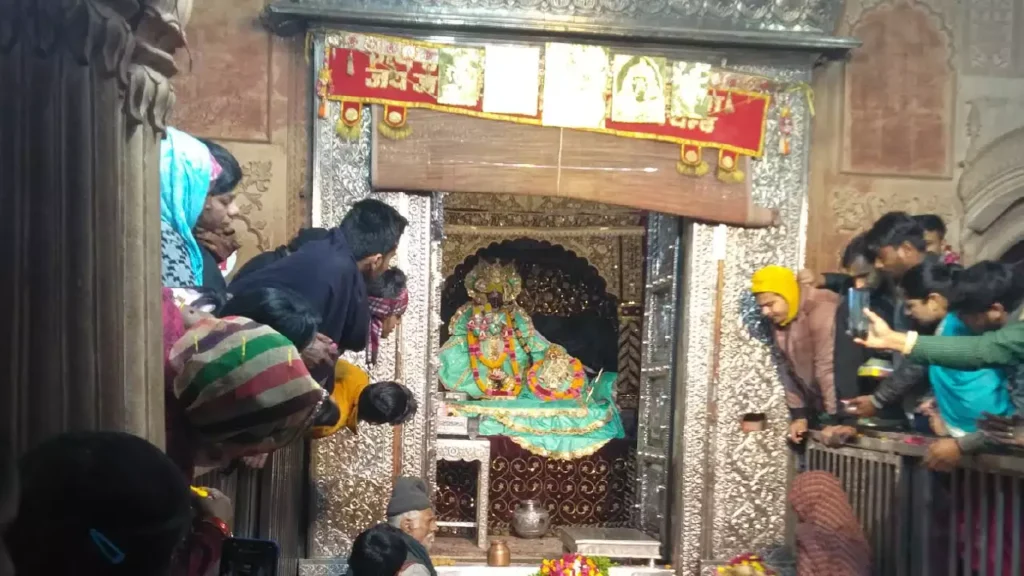
Several customs at Banke Bihari distinguish it from every other Vaishnava temple in India. There are no bells or conch shells used in the rituals — tradition holds that Bihariji finds the sound of bells and conches jarring. Instead, devotees clap their hands and chant “Radha Naam” to invoke the deity. The temple attendants swing the temple doors open and closed rhythmically, offering brief, tantalising glimpses of the idol — the idea is that gazing at Bihariji too long may cause the devotee’s soul to be absorbed into the divine and unable to return.
The spring festival of Holi at Banke Bihari Temple is legendary. Held over 45 days — extending far beyond the standard two-day Holi — it transforms the entire temple into a swirling cloud of flower petals, coloured water, and devotional fervour. Celebrities, saints, and pilgrims from across India make a point of attending at least one day of Banke Bihari’s Holi during the Braj season.
Daily Seva — Shringar, Rajbhog, and Shayan
The temple’s daily worship follows a three-part sewa cycle. Shringar Sewa in the morning involves bathing the idol, dressing it in fresh clothes appropriate to the season, and adorning it with flowers, jewellery, and a crown. The seasonal dress code is taken seriously: light cotton in summer, warm fabrics in winter, and specific colours on specific festival days. The Rajbhog Sewa at midday offers a sumptuous feast of 56 food items (Chappan Bhog) to the deity. Shayan Sewa in the evening settles Bihariji for the night, with music and dimmed lighting creating an atmosphere of gentle rest. Each sewa draws large crowds of devotees who consider witnessing the rituals as valuable as formal puja.
Architecture and the Temple Building
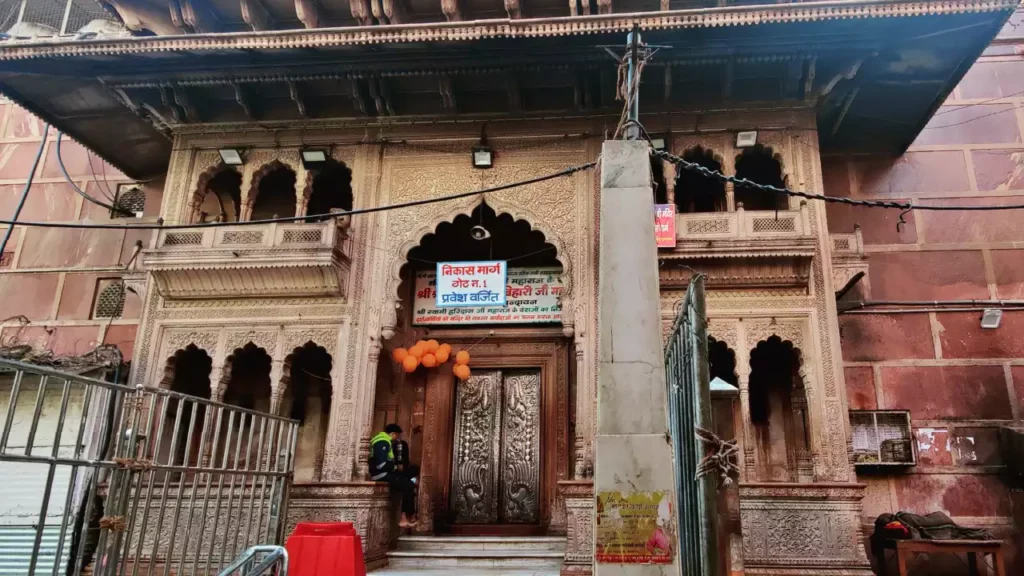
The current temple building was constructed in 1864 CE with funding from the Vrindavan community and wealthy Braj devotees. It is built in Rajasthani haveli style — arched windows, ornate carved facades, and a distinctive silhouette. Unlike the soaring gopuram-topped structures of South Indian temples or the tall shikharas of North Indian Shaiva shrines, the Banke Bihari Mandir is a relatively low, horizontal building whose intimacy matches its devotional character.
The inner sanctum is accessed through a series of interconnecting halls. The idol chamber is not large — the smallness of the space compresses the energy of hundreds of devotees into an almost unbearable intensity during major darshans. The idol itself stands about 2.5 feet tall, in black stone, wearing elaborate seasonal dress and jewellery. Two large fans made of peacock feathers (morpankh pankha) are waved continuously before the idol.
Darshan Timings
- Summer (March–November): 7:45 AM – 12:00 PM and 5:30 PM – 9:30 PM
- Winter (November–March): 8:45 AM – 1:00 PM and 4:30 PM – 8:30 PM
- On Ekadashi, Janmashtami, and other festivals, timings are extended significantly
- Holi (Phoolon ki Holi) starts after Vasant Panchami and runs through to Rangbhari Ekadashi in Chaitra
How to Reach Banke Bihari Temple
- Location: Vrindavan town, 10 km from Mathura city
- By train: Mathura Junction is 12 km away; Mathura Cantt is 11 km; both served by Delhi–Agra mainline trains
- By road: Mathura is 145 km from Delhi on NH44 (Agra–Delhi highway); Vrindavan is 10 km from Mathura
- By air: Agra Airport (55 km) and Delhi’s Indira Gandhi Airport (165 km)
Nearby Temples in Vrindavan and Mathura
Vrindavan is a temple city — every lane contains at least one shrine. The most important temples near Banke Bihari include Prem Mandir (a vast white marble complex built by Jagadguru Kripalu Maharaj, opened 2012), Radha Raman Temple (another 16th-century temple with a self-manifested saligrama-based Krishna idol), Radha Damodar Temple (where the great Vaishnava acharyas Rupa Goswami and Jiva Goswami resided), ISKCON Vrindavan (Sri Sri Krishna Balarama Mandir), and Nidhivan (the sacred grove where Swami Haridas found the idol and where Krishna is said to perform the rasa-lila each night).
In Mathura, the Shri Krishna Janmabhoomi Temple marks the birthplace of Krishna himself, 10 km away. The Dwarkadhish Temple in Mathura city and the Govardhan Hill (sacred Girraj) are within 25 km and are part of the classic Braj Mandal pilgrimage circuit.
See our Vrindavan travel guide for the complete Vrindavan experience. Book our Mathura–Vrindavan 4N/5D tour for a full Braj pilgrimage. Further reading: Spiritual heritage of Mathura–Vrindavan.