Gaya is a city in the Magadh region of Bihar, situated on the banks of the Phalgu River, about 100 km south of Patna. It is surrounded by hills on three sides — Mangla-Gauri, Shringa-Sthana, Rama-Shila, and Brahmayoni — giving the city a distinctly enclosed, sacred geography. Gaya holds a unique position in the subcontinent’s religious map: it is a teertha of immense importance to Hindus for Pind Daan and Shradh rituals for departed ancestors, and it is equally sacred to Buddhists as the site — at nearby Bodh Gaya — where Siddhartha Gautama attained enlightenment under the Bodhi tree.
Pind Daan at Gaya: The Sacred Duty to Ancestors
The defining purpose of a pilgrimage to Gaya, for most Hindu visitors, is the performance of Pind Daan — the ritual offering of rice balls (pindas) to the spirits of deceased ancestors to ensure their liberation from the cycle of rebirth. The Vishnu Purana, the Vayu Purana, and the Agni Purana all specifically identify Gaya as the most efficacious place for these rites. The Ramayana records that Lord Rama himself came to Gaya to perform Pind Daan for his father, King Dashrath.
Pind Daan at Gaya is performed at multiple sites across the city, collectively known as the Gayasiras or the 45 Vedis (ritual platforms). The principal ones are:
Vishnupad Temple is the most sacred of all — rituals here are considered the most effective. The temple enshrines a 40-cm footprint of Lord Vishnu imprinted on basalt stone. The main sanctum is open only to Hindus. The Vishnupad Temple page has full details on darshan timings and rituals. Read our complete guide to Pind Daan at Vishnupad Temple.
Phalgu River (also spelled Falgu) is where Pind Daan is performed directly on the riverbed. The Phalgu is an unusual river — it flows underground for much of its length, and the bed appears dry or barely flowing for most of the year, with water visible only by digging into the sand. The ritual of Pind Daan on the dry sand of the Phalgu is ancient and is specifically mentioned in the Ramayana account of Rama’s visit. Our guide to Pind Daan at the Phalgu River explains the ritual process in detail.
Akshayavat (the indestructible banyan tree), also present at Gaya in addition to the one in Prayagraj, is a site of Pind Daan offerings. Pretashila Hill is one of the most important Pind Daan sites — it is where rites for recently deceased are particularly recommended. The Yama Temple at Pretashila Hill is associated with the god of death and liberation.
For those unable to perform all rituals independently, local Gayawals (hereditary priests who specialise in Gaya rituals) guide families through the process. It typically takes 1–3 days to complete the full circuit of Pind Daan sites. Our arranged services cover the Homa Shradham at Gaya and the Hiranya Shradham and Pinda Pradhanam.
Vishnupad Temple: Architecture and Significance
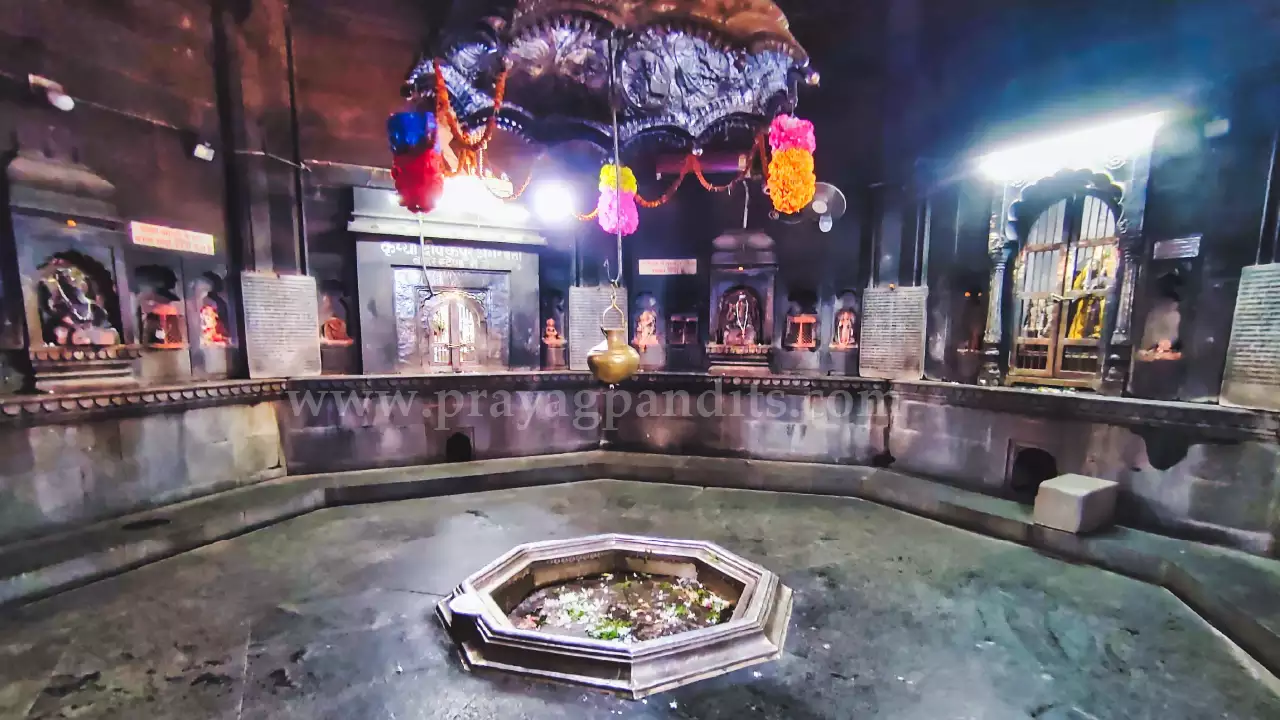
The current Vishnupad Temple was built in 1787 by Maharani Ahilyabai Holkar of Indore — the same queen who rebuilt Kashi Vishwanath at Varanasi and the Mahakaleshwar at Ujjain. The temple rises eight storeys and is capped with a gilded shikhara. It stands on the western bank of the Phalgu and faces east. The inner sanctum houses the Dharmasila — the 40-cm Vishnu footprint in octagonal basalt — surrounded by a silver-plated basin. The footprint was discovered deep in the earth; the current stone is said to have been placed over it by Akbar’s son Salim (later Emperor Jahangir) after a visit.
Mangal Gauri Temple
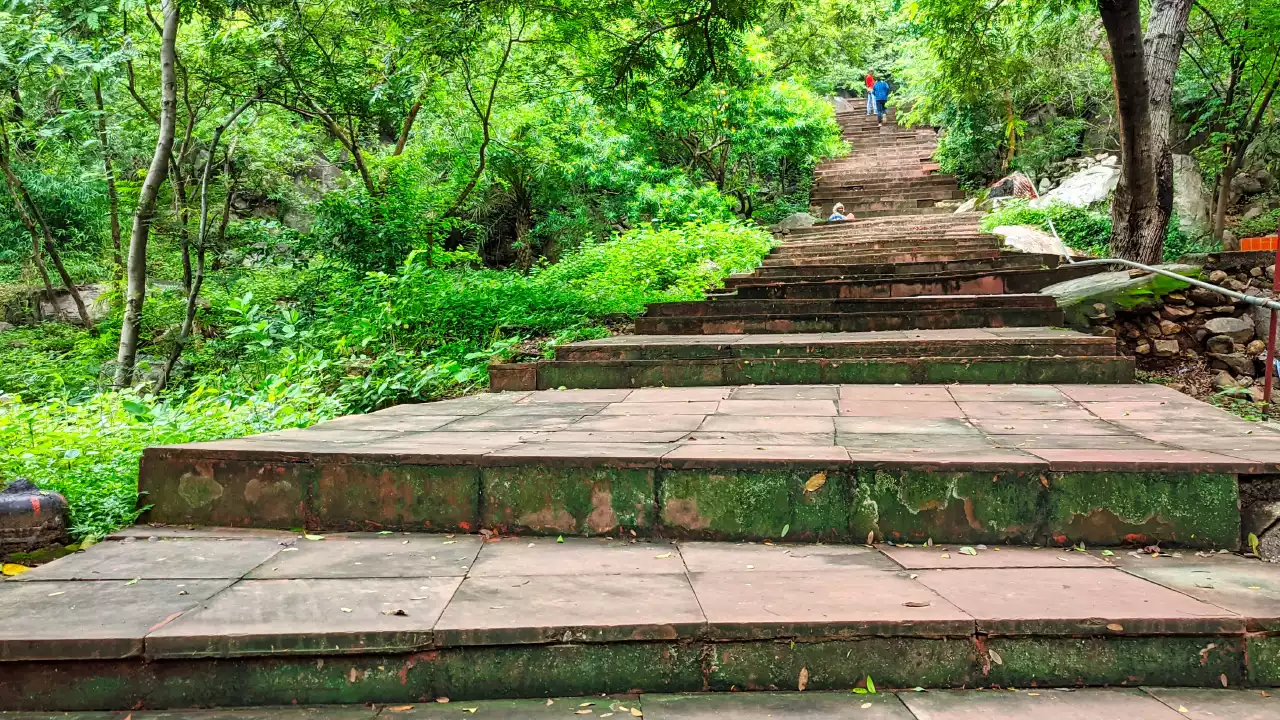
The Mangal Gauri Temple is one of the 51 Shaktipeethas, believed to be where Sati’s breasts (stanau) fell. It stands on Mangala-Gauri hill, one of the four hills surrounding Gaya, and is reached by about 130 steps from the base. The goddess Mangal Gauri is worshipped here as a form of Durga. Navratri is the main festival, drawing thousands of devotees. The view of Gaya city and the Phalgu from the hilltop is panoramic.
Bodh Gaya: The Seat of Enlightenment
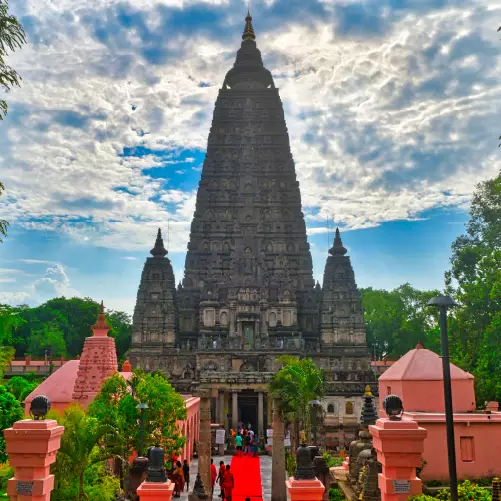
Bodh Gaya is 12 km south of Gaya city and is one of the four holiest sites in Buddhism. Here, around 528 BCE, Siddhartha Gautama sat in meditation under a pipal tree and attained enlightenment, becoming the Buddha. The Mahabodhi Temple, a UNESCO World Heritage Site since 2002, stands at this spot. The Bodhi Tree in the temple complex is a direct descendant of the original tree; a branch was taken to Sri Lanka in the 3rd century BCE by Ashoka’s daughter Sanghamitta, and a sapling was later brought back to replant at Bodh Gaya after the original was damaged.
Bodh Gaya draws Buddhist pilgrims from across Asia — Thailand, Japan, Tibet, Sri Lanka, Myanmar, Korea, and China all have monasteries and temples here. The Thai Monastery, the Great Buddha Statue (80 feet tall), and the Royal Bhutan Monastery are all within a short walk of the Mahabodhi complex. Entry to the Mahabodhi Temple is free; the Archaeological Survey of India charges ₹40 for Indians and ₹600 for foreigners. The site is open from 5:00 AM to 9:00 PM daily.
The Dungeshwari Hill Temples, about 12 km from Bodh Gaya, mark the site where Siddhartha practised severe asceticism before abandoning it for the middle path. The cave-shrines on the hill are among the lesser-visited but most atmospheric spots in the Bodh Gaya region.
Sita Kund Temple
The Sita Kund Temple at Gaya is associated with the Ramayana account of Rama’s pilgrimage — specifically with Sita’s presence during the Pind Daan visit. The kund (tank) is said to be where Sita performed ablutions. It sits within a complex of smaller shrines and is one of the stops on the Gaya pilgrimage circuit.
Pitrupaksha Mela: The Annual Ancestor Fortnight
Pitrupaksha (Shradh Paksha) is a 15-day period in the Hindu lunar calendar (September–October) dedicated to ancestral rites. During Pitrupaksha, Gaya transforms entirely — an estimated 5–7 lakh pilgrims arrive to perform Pind Daan for their ancestors. The riverbanks are lined with families from across India and the diaspora. Hotels book up months in advance. If you plan to visit during Pitrupaksha, make arrangements at least 3–4 months ahead.
Food and Practical Travel
Gaya’s food scene is straightforward — the pilgrimage economy means the city caters heavily to sattvic vegetarian food. Sattu paratha (flatbread stuffed with roasted gram flour, common across Bihar) is the local staple. Litti Chokha (roasted wheat balls with mashed smoky eggplant and potato) is Bihar’s signature dish and is available at dhabas across Gaya. Khaja (a layered, flaky sweet) is the traditional sweet of the region and a good takeaway gift.
Getting there: Gaya Junction is a major railway station with direct trains from Delhi (approximately 12 hours on faster trains), Kolkata (about 7 hours), Patna (2 hours), and Varanasi (3–4 hours). Gaya International Airport (GAY) has connections to Delhi, Kolkata, and international flights to Bangkok, Colombo, and Kuala Lumpur catering to Buddhist pilgrims. By road, Gaya is 100 km from Patna (NH83), about 2 hours by car.
Getting around: Auto-rickshaws are the main mode of transport. Vishnupad Temple, the Phalgu ghats, and the main market are all within a 2 km radius of Gaya Junction. Bodh Gaya is 12 km south; shared autos and buses run regularly. The journey from Gaya to Bodh Gaya takes 20–30 minutes by auto.
Best time to visit: October–March is most comfortable. Pitrupaksha (September–October) is the peak pilgrimage period and requires advance planning. Bodh Gaya is particularly beautiful in the early morning and late afternoon.
Gaya is commonly combined with Varanasi (250 km north-west) and Prayagraj (300 km north-west) in a single pilgrimage journey, since all three cities are central to Pind Daan and ancestral rites.