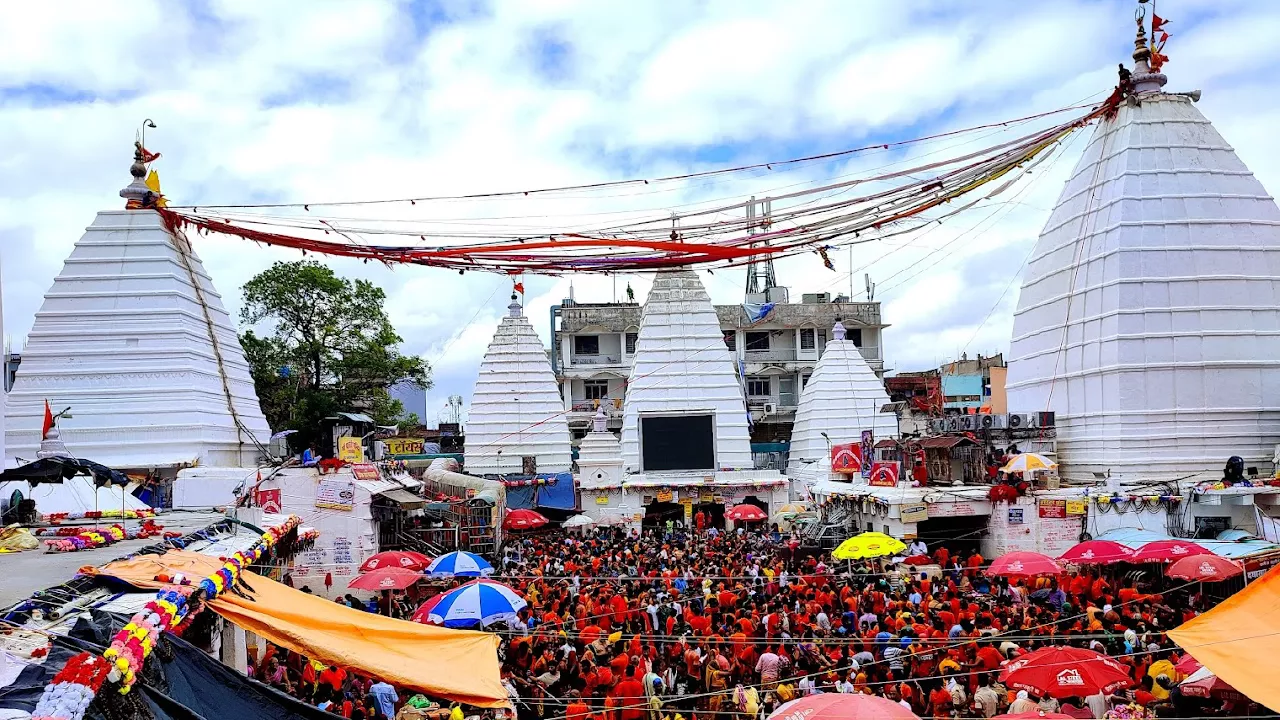
Deogarh — more commonly spelled Deoghar, meaning “abode of the gods” in Sanskrit — is a city in the Santhal Pargana division of Jharkhand, situated approximately 260 km from Patna, 350 km from Kolkata, and 380 km from Ranchi. The city is inseparable from the Baba Baidyanath Dham, one of the twelve Jyotirlingas of Lord Shiva and one of the 51 Shakti Peethas. For this reason alone, Deoghar draws millions of pilgrims every year — but particularly during the Shravan month (July–August), when it becomes one of the largest religious gatherings in the country.
Baba Baidyanath Temple — One of the Twelve Jyotirlingas
The Baidyanath Temple is the spiritual and physical centre of Deoghar. It is dedicated to Lord Shiva in his form as Baidyanath — the Lord of Physicians, the Great Healer. The main linga in the sanctum sanctorum is believed to be a Swayambhu (self-manifested) Jyotirlinga, one of only twelve such lingas in India where Lord Shiva’s divine light is held to be immanent and eternal.
The temple is also significant as one of the 51 Shakti Peethas — the sacred spots where parts of the body of Goddess Sati fell to earth after Lord Vishnu’s Sudarshana Chakra dismembered her corpse to stop the grief-stricken Shiva from wandering the universe with it. At Deoghar, it is believed that Sati’s heart (hridaya) fell, which is why the place carries an especially powerful Shakti energy. The Goddess is worshipped here as Bamlai or Parvati.
The temple complex is compact but intensely active. The main shrine sits within a walled enclosure housing 21 temples in total, including subsidiary temples to Parvati, Ganesha, Lakshmi, and Saraswati. The main Shiva linga is small compared to other Jyotirlingas, which makes it unusual — devotees must crouch slightly to pour Jal (water) over it in the Jalabhishek ritual. This direct, unmediated contact between devotee and deity is one of the features that makes the Baidyanath Temple different from many other major shrines.
Temple timings: 4:00 AM to 3:30 PM and 6:00 PM to 9:00 PM. The Shringar Aarti at dawn and the Sandhya Aarti at dusk are the most atmospheric times to visit. Entry is free for all devotees.
The Sacred Legend — Ravana and the Jyotirlinga
The most widely told origin story of the Baidyanath Jyotirlinga involves the demon king Ravana. According to the Shiva Purana, Ravana was a great devotee of Lord Shiva. To please him and obtain a boon of invincibility, Ravana performed severe penance on the Himalayan peak of Kailash, offering his ten heads one by one into a fire sacrifice. Shiva, moved by his devotion, appeared and cured Ravana’s wounds — thus earning the name Baidyanath, the healing physician.
Ravana then requested that Shiva himself come to Lanka. Shiva agreed, but handed Ravana the Jyotirlinga with the condition that it must not be placed on the ground at any point during the journey, or it would be immovable from that spot forever. During the journey southward, Lord Vishnu tricked Ravana into pausing and handing the linga to a cowherd (or a Brahmin boy, in some versions). The linga was placed on the earth in Deoghar and could not be moved. Ravana, in his anger, pressed the linga down firmly, which is why the linga at Deoghar has a slightly flattened top that is unlike other Jyotirlingas. The marks of Ravana’s fingers are said to be visible on the linga.
Shravan Mela and the Kanwar Yatra
The Shravan Mela at Deoghar is one of the largest religious gatherings in the world. During the Hindu month of Shravan (approximately mid-July to mid-August), millions of devotees known as Kanwariyas undertake a foot pilgrimage carrying Ganga water from Sultanganj — a town on the banks of the Ganges about 109 km away — to pour over the Baidyanath linga at Deoghar. The Kanwariyas walk the entire distance barefoot, carrying decorated bamboo poles (kanwar) from which clay or brass pots of Ganges water hang. Many walk day and night, reaching Deoghar in 3–5 days.
The colours of the Shravan Mela are extraordinary — millions of saffron-clad pilgrims on the roads leading to Deoghar, temporary camps and free langars (community kitchens) stretching for kilometres, bhajan music playing continuously. At its peak in the final weeks of Shravan, the town receives upwards of 500,000 pilgrims a day. The railway authorities run special Shravani Mela trains; additional police, medical teams, and volunteers are deployed. If you are planning to visit during Shravan, expect crowds, reduced accommodation availability, and a genuinely extraordinary atmosphere.
The month of Shravan is considered the holiest period for Shiva worship in the Hindu calendar. In addition to the Kanwar Yatra pilgrims, Shravan Mondays (Shravan Somvar) draw particularly large numbers of local devotees. The belief is that prayers and Jalabhishek offered during Shravan are especially potent and yield divine blessings faster than at other times of the year.
Sultanganj — The Starting Point of the Kanwar Journey
Sultanganj, located on the banks of the Ganges in Bihar’s Bhagalpur district, is where Kanwariyas collect the sacred Ganga water before beginning the 109 km walk to Deoghar. There is a sacred island in the Ganges at Sultanganj called Ajgaivinath, where a Shiva temple stands — devotees offer prayers here before filling their kanwars with river water. The island is accessible by boat from the Sultanganj ghats.
For those who are not able to walk the 109 km route, it is also common to travel by vehicle to Sultanganj, collect Ganga water, and bring it to Deoghar by road for offering. The spiritual intent and the Ganga Jal are considered equally valid regardless of the mode of travel.
Trikuta Hill and Basukinath Temple
Trikuta Hill — about 10 km from Deoghar, this three-peaked hill is associated with the Trikuta Devi and was once home to a dense forest used as a site for meditation. A temple at the summit offers a good view of the surrounding Santhal Pargana landscape. The hill is a short drive or a pleasant walk for those interested in combining the temple visit with some time in nature.
Basukinath Temple — located about 42 km from Deoghar in Dumka district, Basukinath is a significant Shiva temple often visited by pilgrims as the second stop on the Deoghar pilgrimage circuit. The main deity here is Vasuki, the serpent king who is typically depicted coiled around Shiva’s neck. During Shravan, pilgrims who have offered Ganga Jal at Baidyanath often proceed to Basukinath to complete the circuit. The road between the two temples is good and can be covered in about an hour by car.
Nandan Pahar and Satsang Ashram
Nandan Pahar is a small hill on the outskirts of Deoghar that has been developed into a park and leisure zone with children’s rides, a ropeway, and viewpoints. It is a popular stop for families and provides a view of the surrounding town and landscape. Not spiritually significant, but a welcome change of pace after a day of temple visits.
Satsang Ashram is a large spiritual institution founded by Sri Sri Thakur Anukulchandra in the early 20th century. It has a substantial following in West Bengal and Jharkhand and maintains a hospital, schools, and a substantial library on site. The ashram is open to visitors and presents a different, more modern face of devotional life in Deoghar.
The Twelve Jyotirlingas — Context for Visiting Baidyanath
The Jyotirlingas are twelve manifestations of Lord Shiva where his divine light (jyoti) is believed to be present in a self-manifested form rather than being installed by human hands. A complete pilgrimage of all twelve Jyotirlingas — from Somnath in Gujarat to Rameshwaram in Tamil Nadu — is considered one of the most meritorious acts of devotion a Shiva devotee can undertake. Deoghar (Baidyanath) is typically listed as the ninth Jyotirlinga in the canonical sequence, though the exact order varies by tradition. The other Jyotirlingas in eastern and central India that are often combined with a Deoghar visit include Vaijnath (also identified by some traditions with Parli Vaijnath in Maharashtra), Omkareshwar in Madhya Pradesh, and Kashi Vishwanath in Varanasi.
Nearby Destinations and Combination Itineraries
Deoghar works well as part of a broader eastern India pilgrimage circuit. Some natural combinations:
- Deoghar + Sultanganj + Bhagalpur: A 2–3 day circuit covering Baidyanath Jyotirlinga, the Sultanganj Ganga ghats, and Vikramshila Mahavihara ruins near Bhagalpur (a major Buddhist university site).
- Deoghar + Gaya + Bodh Gaya: For pilgrims who want to combine Shiva worship at Baidyanath with ancestral rites at Gaya and a visit to the Buddhist sacred site at Bodh Gaya. Gaya is approximately 230 km from Deoghar by road. See our destination guide for Bodh Gaya for details on the Buddhist pilgrimage sites there.
- Deoghar + Puri: A longer circuit combining the Baidyanath Jyotirlinga in Jharkhand with the Jagannath Temple in Puri, Odisha. Puri is about 500 km southeast of Deoghar.
- Deoghar + Varanasi: Baidyanath and Kashi Vishwanath are two of the most important Shiva temples in India and are geographically accessible in a single trip. Varanasi is approximately 330 km from Deoghar by road. See our destination guide for Varanasi for temple information and travel logistics.
Best Time to Visit Deoghar
Shravan (July–August): If you want to experience the Shravan Mela and the Kanwar Yatra atmosphere, this is the time — but be prepared for very large crowds and plan accommodation well in advance. The emotional and devotional intensity of the Mela is something few religious festivals in India can match.
October to March: The most comfortable weather for tourism and pilgrimage. Cooler temperatures, clear skies, and manageable crowds. Maha Shivratri (February–March) brings a secondary surge of pilgrims and is an excellent time to witness special pujas and night-long festivities at the temple.
Maha Shivratri: The most important night of the Shaiva calendar, Maha Shivratri draws a very large crowd to Deoghar. The temple stays open through the night. Special rudrabhishek rituals and cultural events are held.
Summers (April to June) are hot and humid in Jharkhand, with temperatures reaching 40–42°C. The Shravan month begins in July and temperatures are high with humidity, but the crowds make it an event rather than just a visit.
How to Reach Deoghar
By Air: Deoghar has its own airport (Deoghar Airport) which received its first commercial flights in 2022. SpiceJet currently operates flights connecting Deoghar with Delhi and Kolkata, making it significantly easier to reach than before. Check current schedules as services are being expanded.
By Train: Deoghar Railway Station is on the Jasidih–Dumka branch line. Jasidih Junction (7 km from Deoghar) is the main railhead and is better connected to the national rail network. Several important trains stop at Jasidih, including trains from Kolkata (5–6 hours by Shatabdi or express trains), Patna (4–5 hours), Delhi (14–16 hours), and Varanasi (8–9 hours). Shared autos and taxis connect Jasidih to Deoghar in about 20 minutes. During Shravan, many special Shravani Mela trains are added to accommodate the pilgrim surge.
By Road: Deoghar is connected by NH 114A to Jharkhand and Bihar. Key distances by road: Ranchi 260 km (5–6 hours), Dhanbad 155 km (3 hours), Patna 280 km (5–6 hours), Kolkata 380 km (7–8 hours), Varanasi 330 km (6–7 hours). State and private buses operate on most of these routes. During Shravan, the road between Sultanganj and Deoghar is heavily congested due to the Kanwar Yatra foot traffic — vehicles must use designated lanes and expect delays.
Where to Stay in Deoghar
Accommodation in Deoghar is plentiful and ranges from simple dharamshalas and temple-run guesthouses to decent mid-range hotels. The town is not as developed for tourism as Varanasi or Rishikesh, so expect functional rather than luxurious options outside the top properties:
- Hotel Nilanchal Ashok (JHTTDC) — the government-run Jharkhand Tourism property, clean and reliable, with a restaurant on site. Located close to the temple. Good base for pilgrims.
- Hotel Pawan Palace — a mid-range option near the temple complex with AC rooms and a vegetarian restaurant.
- Hotel Shree Niwas — budget-friendly option near the main market, popular with Indian pilgrim groups.
- Dharamshalas: Several dharamshalas managed by the temple trust and religious organisations offer basic rooms for pilgrims at very low cost. These fill up quickly during Shravan and on Shivratri.
During Shravan Mela, all accommodation in Deoghar is booked weeks in advance. If you are visiting during the peak Mela period, book as early as possible or consider staying in Jasidih (7 km away) or even Dhanbad (155 km) and travelling in daily.
Practical Information for Visitors
- Dress code: Modest dress is expected in and around the temple. Shorts and sleeveless tops are not appropriate. Devotees typically wear white, yellow, or saffron during Shravan.
- Prasad and offerings: The standard offering at Baidyanath is Ganga Jal (Ganges water) poured over the linga as Jalabhishek. Bilva leaves (bel patra), milk, honey, curd, and Panchamrit are also traditional offerings. Shops around the temple sell pre-packed puja samagri (ritual items).
- Queue management: The temple sees very long queues, especially on Mondays and during Shravan. Arrive before 5:00 AM for a shorter wait. VIP darshan passes are available on the temple trust website for those who cannot stand in long queues.
- Language: Hindi is widely spoken. Bengali is also understood, particularly with traders and dharamshalas catering to West Bengal pilgrims.
- Local food: Deoghar has a strong Bengali influence in its food culture. Sattvic vegetarian food — no onion, no garlic — is standard near the temple precincts. Sweets from local mithai shops, particularly peda and khoya-based sweets, are popular as temple prasad and to take home.