Bodh Gaya is a small town in the Gaya district of Bihar, about 17 km south of Gaya Junction. For Buddhists across the world, it is the most sacred place on earth — the exact spot where Siddhartha Gautama sat beneath a pipal tree and attained enlightenment roughly 2,500 years ago. That moment gave birth to one of the world’s great religions, and the town has drawn pilgrims, monks, scholars, and seekers ever since. For Indian pilgrims combining a Buddhist circuit with ancestral rites at Gaya, Bodh Gaya is a natural and deeply meaningful stop on the same journey.
The Mahabodhi Temple — A UNESCO World Heritage Site
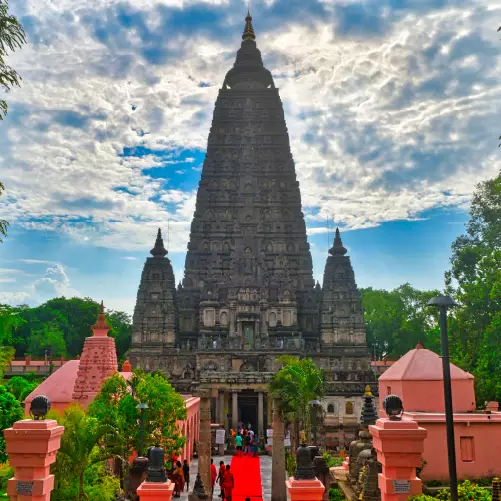
The Mahabodhi Temple Complex is the heart of Bodh Gaya and one of the oldest brick structures in the Indian subcontinent. The main temple rises 55 metres above the ground in a tapering spire of carved stone, unmistakable against the Bihar sky. Construction in its current form dates to the 5th–6th century CE, though the site itself has been venerated since the time of Emperor Ashoka, who visited in the 3rd century BCE and erected a diamond throne (Vajrasana) to mark the spot of the Buddha’s meditation.
UNESCO inscribed the Mahabodhi Temple Complex as a World Heritage Site in 2002, recognising its outstanding universal value as the place most intimately associated with the life of the historical Buddha. The complex includes the main temple, the sacred Bodhi Tree, the Vajrasana, the Animesh Lochana Chaitya, several votive stupas, ornamental railings from the Shunga and Kushan periods, and a large rectangular pool called the Lotus Pond. The entire precinct covers roughly 4.8 acres and is maintained by the Bodh Gaya Temple Management Committee.
Entry to the complex is open from 5:00 AM to 9:00 PM. No photography is permitted inside the main shrine. Shoes must be removed before entering the courtyard. The atmosphere inside — monks chanting, butter lamps flickering, pilgrims circumambulating silently — is unlike anywhere else in India.
The Sacred Bodhi Tree
To the west of the main temple stands a large pipal tree (Ficus religiosa) known as the Bodhi Tree. Tradition holds that it is a direct descendant of the original tree under which the Buddha meditated. Emperor Ashoka’s daughter Sanghamitra is said to have carried a sapling to Sri Lanka in the 3rd century BCE, and a cutting from that Sri Lankan tree was later brought back to Bodh Gaya after the original was destroyed. The current tree was replanted in 1881 by Sir Alexander Cunningham of the Archaeological Survey of India, using a cutting from the Anuradhapura tree in Sri Lanka.
Beneath the tree sits the Vajrasana, or Diamond Throne, a sandstone slab believed to mark the precise seat of the Buddha’s enlightenment. Pilgrims who meditate here often describe a quiet intensity that is difficult to put into words. In the early mornings, the area around the tree fills with monks from Sri Lanka, Thailand, Japan, Tibet, and dozens of other countries, each in their own robes, circumambulating, chanting, or sitting in silence.
International Monasteries and Temples
One of the most striking aspects of Bodh Gaya is the concentration of monasteries built by Buddhist countries from across Asia, each designed in the distinctive architectural style of its home tradition. Walking through Bodh Gaya feels like a quiet world tour through Buddhist culture.
- Thai Monastery (Wat Thai Bodh Gaya) — a gleaming white and gold structure with a classic Thai spired roof, built in 1966. The interiors are lavishly decorated with Thai murals and a large golden Buddha.
- Tibetan Monastery (Karma Temple) — one of the earliest monasteries in Bodh Gaya, managed by the Kagyu lineage. Its large prayer wheels, thangka paintings, and the smell of juniper incense create an immersive Tibetan atmosphere.
- Daijokyo Buddhist Temple (Japanese) — features a serene Japanese garden and a striking five-storey pagoda. Japanese visitors often hold dawn meditation sessions here.
- Chinese Temple — built in 1945, notable for its colourful exterior and a large bronze bell that visitors can ring.
- Indosan Nipponji Japanese Temple — known for its quiet garden and a rare collection of Buddhist manuscripts.
- Bhutanese Monastery — built in classic Bhutanese dzong style with white-washed walls and painted wooden windows.
- Burmese Vihar — one of the oldest international monasteries in Bodh Gaya, predating Indian independence. Its tranquil courtyard is a favourite for quiet reflection.
- Root Institute for Wisdom Culture — run by the FPMT (Foundation for the Preservation of the Mahayana Tradition), it offers meditation retreats and Buddhism courses for international practitioners.
Most of these monasteries welcome visitors during daylight hours. Some offer short-term accommodation for serious meditation practitioners — bookings need to be made months in advance during peak season (November to February).
The Great Buddha Statue (Daijokyo)
About 2 km from the Mahabodhi Temple stands an 80-foot (25-metre) statue of the Buddha, built in 1989 by the Daijokyo Buddhist Organisation of Japan. The statue depicts the Buddha in the Bhumisparsha Mudra — the earth-touching gesture he made at the moment of enlightenment. Inside the statue are smaller Buddha images installed by Buddhist delegations from across Asia. The statue has become a popular landmark and is illuminated beautifully at night.
Other Significant Sites in and Around Bodh Gaya
Dungeshwari Cave Temples (Mahakala Caves) — located 12 km from Bodh Gaya on a rocky hillside, these caves are where Siddhartha practised extreme asceticism before renouncing it in favour of the middle path. A small Hindu shrine dedicated to Mahakala (a form of Shiva) and a Tibetan Buddhist shrine co-exist here, and monks from both traditions maintain a presence at the site. The walk up to the caves on a clear morning is worth the effort.
Sujata Temple and Sujata Stupa — across the Niranjana River, a short drive from the temple complex, stands a brick stupa and shrine marking the spot where the village woman Sujata offered rice pudding (kheer) to the emaciated Siddhartha before his final meditation. This act of simple generosity is honoured in Buddhist tradition as a turning point in the Buddha’s journey. The site is particularly peaceful in the early morning.
Muchalinda Lake — a tank within the Mahabodhi complex, named after the serpent king Muchalinda who is said to have sheltered the meditating Buddha from a storm. A statue of the hooded serpent protecting the Buddha stands at the centre of the lake and is one of the most photographed images in Bodh Gaya.
Archaeological Museum — maintained by the Archaeological Survey of India, the museum houses sculptures, railings, votive stupas, and inscriptions recovered from the Mahabodhi site and the surrounding region. The collection includes some extraordinary Pala period bronzes. Open Tuesday to Sunday, 10:00 AM to 5:00 PM. Entry is free.
Gaya — Ancestral Rites alongside Buddhism — Gaya, 17 km north of Bodh Gaya, is one of the most sacred sites for Hindu ancestral rites. The Vishnupad Temple and the Falgu River at Gaya are where Pind Daan, Tarpan, and Shraddh ceremonies have been performed for thousands of years. Many pilgrims visiting Bodh Gaya also travel to Gaya to fulfil their duties to ancestors. You can read more about Buddhist pilgrimage in India and about Pinda Pradhanam at Vishnupad Temple, Gaya on our site.
Bodh Gaya During Buddha Purnima
Buddha Purnima, the full moon of the Vaisakh month (April–May), is the most significant festival at Bodh Gaya. It marks the birth, enlightenment, and death of the Buddha — all believed to have occurred on the same full moon day. The Mahabodhi Temple is decorated with thousands of lights and flowers. Monks and pilgrims from across the world arrive in large numbers. Candlelit processions, public teachings, and meditation sessions continue through the night. The Bihar government typically organises cultural events and a fair in the town during this period.
The Tibetan New Year (Losar) also brings significant celebrations, particularly at the Tibetan monasteries. If you are planning to visit during either of these festivals, book accommodation at least two to three months in advance.
Best Time to Visit Bodh Gaya
The most comfortable time to visit Bodh Gaya is between October and March. Winters (November to February) are cool and dry — temperatures range from 8°C at night to 22°C in the day — and the international monastic community is most active during this period. The Dalai Lama traditionally visits Bodh Gaya in January each year to give teachings that attract tens of thousands of Tibetan Buddhists and international practitioners.
April and May are hot (up to 45°C) but important pilgrimage months because of Buddha Purnima. June to September brings the monsoon, which makes the landscape green and lush but can disrupt travel. If you are combining Bodh Gaya with Gaya, Rajgir, and Nalanda on a Buddhist circuit, plan for at least 3–4 days in the region.
How to Reach Bodh Gaya
By Air: The nearest airport is Gaya International Airport (GAY), approximately 17 km from Bodh Gaya. Direct flights connect Gaya with Delhi, Kolkata, and Varanasi. During peak pilgrimage season, charter and seasonal flights connect Gaya with Bangkok, Colombo, and other Buddhist-majority countries.
By Train: Gaya Junction is the nearest major railway station, well-connected to Patna (2.5 hours), Varanasi (3.5–4 hours), Kolkata (6–7 hours), and Delhi (12–14 hours via Rajdhani). From Gaya Junction, auto-rickshaws, shared jeeps, and cabs reach Bodh Gaya in about 30–40 minutes. The fare is typically ₹30–50 by shared transport or ₹250–350 by cab.
By Road: Bodh Gaya is connected to Patna (approximately 110 km), Varanasi (approximately 250 km), and Ranchi (approximately 200 km) by road. State and private buses, as well as taxis, operate on all these routes. The road from Gaya to Bodh Gaya passes through the Niranjana River plain and is in good condition.
Where to Stay in Bodh Gaya
Accommodation in Bodh Gaya ranges from budget guesthouses run by monasteries (some offering free or nominally priced rooms for genuine practitioners) to mid-range hotels and one luxury property. The area around the Mahabodhi Temple has the highest concentration of hotels. Key options include:
- Hotel Siddharth Vihar (BSTDC) — government-run, clean, and affordable. Good base for pilgrimage visits.
- Hotel Lotus Nikko — one of the better mid-range options with comfortable rooms and a garden.
- Royal Residency — a reliable mid-range property close to the temple complex.
- Monastery guest houses — Thai, Tibetan, and Burmese monasteries sometimes offer rooms for pilgrims; these must be booked directly with the monastery well in advance.
For a pilgrimage circuit that includes both Bodh Gaya and Gaya, we recommend staying in Bodh Gaya as the base — the accommodation options are better and the town is quieter than Gaya.
Practical Information for Visitors
- Dress code: Modest clothing is expected at the Mahabodhi Temple. Shoulders and knees should be covered. Sarongs are available for hire at the entrance.
- Shoes: Must be removed at the temple entrance. The courtyard can be hot in summer — bring or borrow thick socks.
- Photography: Permitted in the courtyard and around the Bodhi Tree, but NOT inside the main shrine.
- Currency: ATMs are available near the temple complex. Most hotels accept cards, but carry cash for smaller transactions and market purchases.
- Local transport: Auto-rickshaws and e-rickshaws cover most distances within Bodh Gaya. A full-day auto for temple and monastery visits typically costs ₹400–600.
- Temple timings: Mahabodhi Temple Complex — 5:00 AM to 9:00 PM daily. Archaeological Museum — Tuesday to Sunday, 10:00 AM to 5:00 PM.
For those planning a combined Bihar Buddhist circuit — Bodh Gaya, Nalanda, Rajgir, Vaishali, and Kushinagar — or a Gaya pilgrimage combining ancestral rites with a visit to Bodh Gaya, our travel team can help you plan the route, accommodation, and on-ground logistics. You can also explore more about Lumbini, the birthplace of the Buddha, if you are planning a complete Buddhist pilgrimage circuit extending to Nepal.